Goa is abuzz with excitement as vintage bike and car owners, users, collectors and fans are decking […]
Old is Gold
October 4, 2016
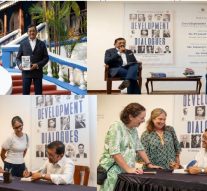
GLIMPSES OF Sunaparanta Goa Centre for the Arts event to celebrate Chairman Dattaraj V Salgaocar’s release of his book, ‘Development Dialogues: Journeys, Ideas and Makers of Modern India’ by Chief Minister of Goa Dr Pramod Sawant. The book is about bringing together 13 distinguished voices from science, diplomacy, business, governance and beyond, it offers compelling insights into India’s evolving journey through conversations with individuals whose ideas, leadership and contributions have helped shape its trajectory.
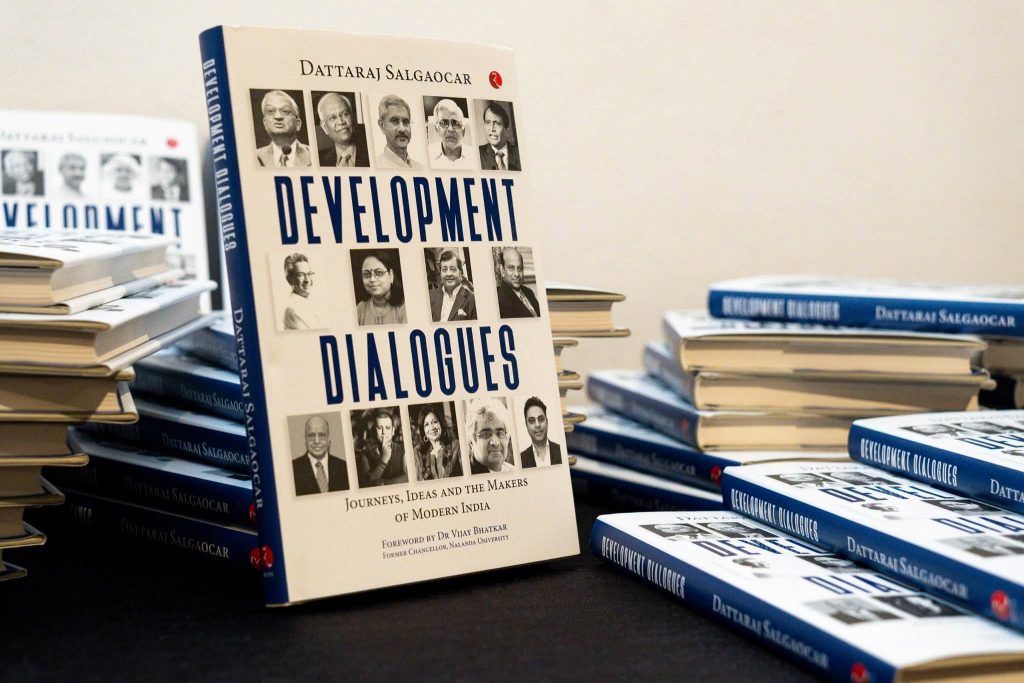
DEVELOPMENT dialogues were an idea definitely mooted by one of Goa’s most intuitive, creative and generous hospitality businessmen, VM Salgaocar. Entrepreneur with a vision, the chairman of VM Salgaocar Corporation, Dattaraj Salgaocar, is a quiet mover and shaker at heart and soul. Perhaps this explains the raison d’etre of his recently released book “Development Dialogues: Journeys, Ideas and the Makers of Modern India” (hardcover, published by Rupa Publications, Rs 595) in July 2026. The book puts together a series of amazingly useful conversations moderated by the author with some of the country’s most engaging personalities — from Dr Anil Kakodkar to Dr Raghunath Anant Mashelkar, Suresh Prabhu, Dr Shekar Mande, Dr S Jaishankar, the late Dr K Kasturirangan, Tenzin Priyadarshi, Rajan Anandan, Dr K Subramanian Dr Vijay Govindrajan, Kiran Mazumdar-Shaw — in a nutshell 13 of the country’s most influential voices. The live conversations took place at the International Center Goa and justly deserve being put together in black and white for anyone to look up as an easily read reference guide – on who are the leaders in their own field, contributing towards nation-building, governance, science, diplomacy and much more. If you’re asking me the book’s an eye-opening read for amongst other things it offers insight into how humble the beginnings are of so many of these famous names of the country and Goa of course. And personally I found the conversations with senior advocate Harish Salve and ISRO senior scientist Ritu Karidhal (of Mars Orbiter Mission or MOM fame) very educative, refreshing — on the subject of power women in the country when they grow up in a supportive system at home. Ritu Karidhal is undoubtedly a role model for any woman aspiring for a career in science, technology, engineering and mathematics (STEM) streams.
“Development Dialogues: Journeys, Ideas and the Makers of Modern India” was released by Chief Minister of Goa Dr Pramod Sawant at the Sunaparanta Goa Centre for the Arts in Panaji in October 15, 2026. Here is an inspirational book courtesy someone who is also a keen wildlife photographer and a lover of the arts. I have always happily welcomed the annual “Spirit of the Wild” desk calendars of Dattaraj Salgaocar! A friend of many in and out of the country he cares about wildlife habitats varnishing from the earth, if humanity continues to live insensitively and insensibly as it continues to do despite the growing problems blowing in the wind. Ironically, oftentimes every new solution is more absurd than the last given how we tend to monetize every solution as yet another business proposal. But that’s my opinion, my dears!
In recent times we have seen how the very word “Sustainable” has become the catchword of our times. Even as plastics continue to degenerate into microplastics multiplying and infiltrating into our very body fabric and everywhere; plus, now we have the specter of monumental technological waste — the dangerous waste of a mod con civilization ever content to seek never ending comfort zones.
ALL this aside if you give a damn at all you cannot do better than get a copy of this book to get back to reading, especially if you consider yourself as part of our business fraternity lobbies and of course, the government of the day. Make time to put this sort of “Bible” — or should I say “Ram katha” – of our times next to your bedside for reading and referencing right away. Then perhaps contribute towards a better, more genuinely sustainable lifestyle not just for the few but the many at the bottom of the pyramid of the good life! Who puts the search for a cosy, fancy lifestyle, over a life worth feeling proud about first?
“Development Dialogues” draws inspiration from Prime Minister Narendra Modi’s vision of Viksit Bharat@2047 and here are some invaluable stories of some inspirational folk, who overcame awesome challenges in their personal and public life – every bit worth knowing about. Dattaraj Salgaocar’s “Development Dialogues” is dedicated to his parents, the late Hirabai and Vasudev M Salgaocar; Foreword is by Dr Vijay Bhatkar, former chancellor of Nalanda University.
The book comes in an unusually interesting format of dialogue presentation which is agreeable, because it comes across as more vivid first person! Although I wish the author’s prompting at intervals was in bolder print for more comfy reading, perhaps this could be done in a subsequent paper book edition. I also like the quick “About the Interviewees” referral at book’s end. Altogether this is a painstakingly put together book. (Catch excerpts from the book elsewhere here in this issue.)
Something about Dattaraj V Salgaocar. Apart from being the owner and chairman of the VM Salgaocar Corporation Group of Companies, he holds an engineering degree from VJTI, Mumbai, and is an MBA from Wharton. He is a founding life trustee and Vice-President of The International Centre Goa, and founded the Sunaparanta – Goa Centre for the Arts in 2009; he heads the VM Salgaocar Law College and established the VM Salgaocar International Hospitality Institute in 2014, also serves on the international councils of the Museum of Modern Art, New York, and Tate, London. Yes, he is an avid wildlife enthusiast and photographer. If anyone has an insider’s view of Indian as well as Goan life and times as they have evolved past, present and will continue to evolve in the near future favorably, I would say it is Dattaraj Salgaocar!
ON that note it’s avjo, selamat datang, poiteverem, au revoir, hasta la vista and vachun yeta here for now. Hope the new year coming up will bring in some real all rounder ache din for the country, including its smallest, most cosmopolitan state, Goa.
Reimagining and Reinventing Post-COVID India
Dr Raghunath Anand Mashelkar, former Director General of the Council of Scientific and Industrial Research (CSIR), and Dr Anil Kakodkar, former Chairman of the Atomic Energy Commission, in dialogue with Dattaraj Salgaocar, Vice President, ICG. This conversation took place on 16 December 2020.
Both of you are products of the Indian education system-municipal schools, no IITs, etc – and have excelled in your respective fields. For there, you went on to chair national committees on higher education. I would like to ask Dr Mashelkar to begin with: What are your views on the future of education in India, from the Right to Education to the New Education Policy (NEP)?
RM: When you ask me about the future of education, I would say education is the future. Therefore, I’m very happy that the government has come out with the NEP. There are several as we speak. You have to see it this way: the right to education, the right education and the right way of education. Right education that imparts values is important. I think this is going to be one of the biggest challenges.
The aspect of right education that someone recently highlighted is that two-thirds of our children in senior schools will end up in jobs that don’t exist today. This raises the question of what kind of education and we should provide for these future jobs. Certain core competencies will remain crucial regardless of the field, such as dealing with complexity, creativity, emotional intelligence, empathy, compassion, cognitive flexibility, and the ability to collaborate with machines like cobots, not just work with robots.
Another significant challenge is the impact of COVID-19, which forced millions of children out of school and into online learning. However, many lacked the necessary digital devices, connectivity, and bands width for effective online education. For online learning you require a digital device like a tablet, smartphone or PC; you require bandwidth, and you require connectivity. One-third of these children don’t have that. Previously, access to education was something different. I got a 60-rupee-per-month scholarship, and that was good enough for me. That is not good enough today. I’m finding that children are committing suicide. This digital deprivation is a pressing issue that needs urgent attention to ensure equal access to education.
Furthermore, the evolution of technologies like big data analytics, the Internet of Things, and artificial intelligence requir4es students to become proficient in these areas. In China, as I understand, they are already training primary school children in AI, coding, etc., highlighting the need for comprehensive preparation for the future job market. Lastly, this learning by rote has to go. It should be by doing, not what the teacher says. You have to create, so learning by creating and co-creating . This is the big shift we have to make in terms of our education so that education determines the kind of future we want for our children.
AK: What we need to do is create an education system in which children are ready to face reality when they enter the job market or workspace. Given the pace at which technology and other requirements are changing, you need to be a lifelong learner. We have to inculcate in children the ability to keep learning and expanding their abilities and skills. While we do that, education must also, in some manner, be situated learning so that you know what the problems are and what the important problems that need to be solved are. If you develop the capability to solve those problems through education, you can contribute at a much higher level. If Everybody can contribute at that higher level, I think the country’s progress will be much faster.
For example, research can be of two kinds: research that can be done with the available educational qualifications, instruments, grants, etc., and research that needs to be done to solve a problem Once you identify an important problem, you must solve it regardless of the resources. Many times the question is asked why no Indian scientist has won a Nobel Prize after C.V. Raman. A lot of things are written on this subject, but the important aspect is passion. Education needs to create that passion to address the real problems of society. When that happens, I think one can say that you have a good-quality education.
The last thing about education is that we have a lot of disparities that create an education divide like the digital divide Dr Mashelkar mentioned. For example, there is a world of difference in the facilities available in cities and those available in villages. When the larger part of our society, population or young people live in villages, you need high-quality education. This is a big challenge. How do we get so many teachers to work in villages and small towns? How do we get the right infrastructure there? Education leads to the creation of technology which creates livelihood and economic progress, but technology can also contribute to the enhancement of education though not necessarily its quality. I you leave it to technology, it may be counterproductive. You need a combination of mentoring by teachers and the multiplier effect of technology. There are many dimensions to good teaching. What I mentioned is only the tip of the iceberg.
 MISSING AUTORIKSHAS AND ‘PANI-PURI’ OF MUMBAI!
 BEFORE IT STRIKES: EARLY ACTION ON DIABETES! By Dr Amit Dias
 A CENTURY IN MEDIA AND STILL BATTING!
 WEEKEND UPDATES
 LETTER TO THE EDITOR FOR ISSUE DATED OCTOBER 31, 2026
 COMMERCE MINISTER PIYUSH GOYAL, CA TO DB BUILDERS, AWARDED CONVENTION DEAL?
 DONA PAULA CONVENTION CENTRE!By Our Special Correspondent
 THE SWAN TELECOM–2G SPECTRUM CASE!By Our Special Correspondent
 ALDEIA DE GOA: THE LAND, PLANNING PERMISSIONS AND THE 2022 HIGH COURT JUDGEMENT!By Our Special Correspondent
 RE-DEVELOPMENT DREAMS OR RE-DEVELOPMENT NIGHTMARES?By Arvind Pinto, Our Legal Consultant
 FROM UNIVERSAL ADULT FRANCHISE TO SIR: HAS INDIA’S VOTER REGISTRATION BECOME A POLITICAL WEAPON?
 FOUND! `MILLET UPMA’ AND `NACHNE IDLI’…
 DEMAND PROOF OR “REFUSE TO SIGN”!WEEKEND UPDATES
 LETTER TO THE EDITOR FOR THE ISSUE DATED OCTOBER 24, 2026
Goa is abuzz with excitement as vintage bike and car owners, users, collectors and fans are decking […]