Goa is abuzz with excitement as vintage bike and car owners, users, collectors and fans are decking […]
Old is Gold
October 4, 2016

ONE of the most noticeable features of urban India is the renewal of its renewal of its urban housing stock. The housing boom of the post war years, witnessed the growth of our cities, while the migration for work resulted in the unplanned growth of slums in the bigger towns. Today, our metropolises are studies in contrast; towering structures surrounded by shanty towns. But with prime land in the cities no longer available, much of our urban housing stock is up for redevelopment.
Yes, redevelopment is being touted as the panacea, for all old buildings and houses. It offers newer homes, better amenities, and for the owners often financial benefits. But often the reality is the opposite: there are delays in project completion, disputes with the promoters, long periods of displacement. In several cases, builders abandon the project and both the displaced tenants and prospective buyers are left in the lurch for several years, their hard earning savings eaten up by unscrupulous promoters who have disappeared! Let’s look at some of the issues that redevelopment raises.
Promise versus Reality
REDEVELOPMENT on paper appears a promise come true. The inhabitants have a modern structure, built according to the latest building techniques, a solid structure that would last another 30 odd years. For the occupants, larger flats, the latest in amenities, while to the individual who buy into these building, costs are the main factor. However thanks to speedy bank facilities, with easy repayment schedules, many are now willing to buy into these projects. Further government initiatives giving builder option regarding slum clearances have encouraged real estate developers to buy into shanty towns to redevelop these patches of urban decay.
DHARAVI, one of Asia’s biggest slums, has been undergoing a process of redevelopment. Today many of India’s corporate institutions are also in the process of real estate development, ensuring a certain reliability for those who visit to buy and apartment. While redevelopment holds out the promise of a new apartment with modern amenities, there is often a long delay in the process as several buyers have found out, especially when projects are delayed or in some instances abandoned.
LEGAL ISSUES
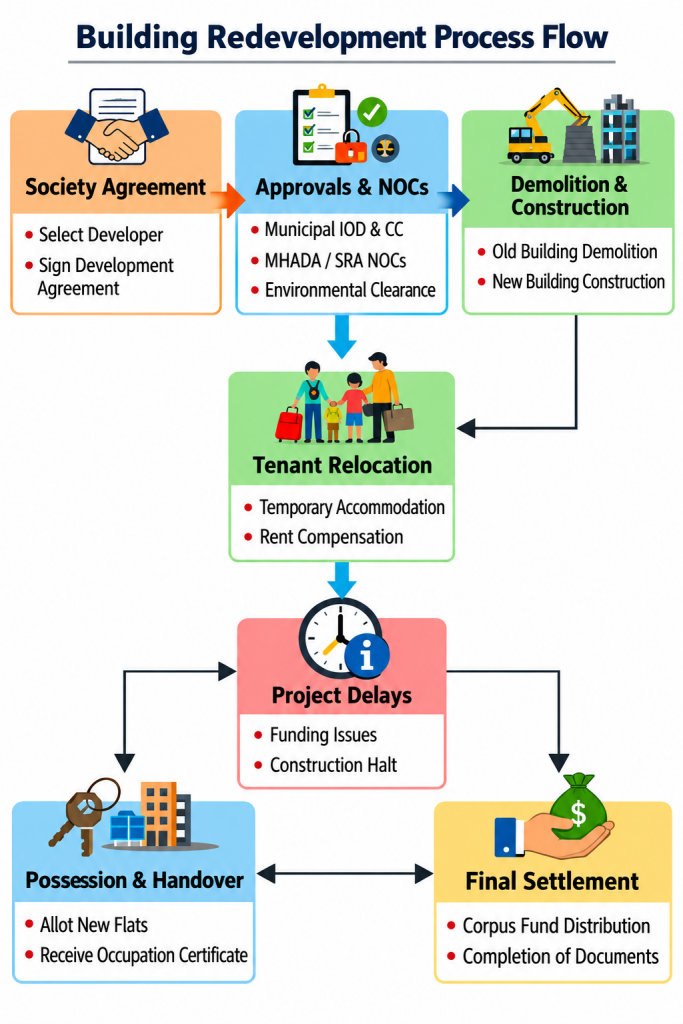
BEFORE the actual process of redevelopment takes off the ground, there is the whole process of legal issues that are required to be sorted out. Often individuals or even tenanted properties are at a disadvantage as compared to the corporate developers. Take the case of a housing cooperative society deciding to redevelop their property. In several states, courts have held that between 51% to 71% of the society members require to agree to a redevelopment proposal, then the project stands approved. In many cases the concerns of the minority owners are not even considered. Then often builders use strong arm tactics like cutting the water or electric connections to expedite the remaining house owners to shift. One of the major documents is the development agreement (DA). This is the document signed between the developer and the owners or flat holders, that is the legal basis of the entire development process. The DA in short hands over the rights of the property to the developer, allowing the latter to seek the necessary licences from the various authorities in relation to the development of the estate. The DA also specifies the entitlements of the recipients in terms of space, areas of apartment, parking, the utilities in the building. Since most of the DA’s are drafted by the developer’s legal team, they are often loaded in favour of the developer. In many cases, the DA agreements find no mention of any penalty clauses for delay, subsequent warranties or time lines for completion.
I HAD occasion to once legally examine a development agreement, on behalf of one of my clients, subsequent to its signing. I found that while most Municipal fees were payable by the builder, the conversion of the land from its lease hold status to freehold was the liability of the owner, which turned us to be a financial sum that was never envisaged be the owners. Today with the Real Estate Regulatory Authority (RERA) requirement of the registration of all property development, new buyers have recourse to an authority in cases of default by builders. But the jurisdiction of this Authority in the case of existing tenants in a tenanted building is a grey area in law. Often those who have sub-leased properties or remain without legal papers struggle to get assistance when projects are stalled.
The Financial Fault Lines
WHEN sold by a developer, the financial calculations look excellent. On handing over your flat or apartment, the builder would promise, shifting charges, together with an appropriate monthly rent until the new building is complete. However, when the project timeline gets extended and the developer runs out of case, this rent comes to a stop, leaving the owners to continue payment rent from their own pockets; often a burden to many middle-class families. Further should a builder go bankrupt, mid-way through a project, the process of bankruptcy at the National Company Law Tribunal (NCLT) often takes months, leaving the original owners stranded without their old homes and the dream of moving into a new construction become a distant mirage! Earlier, several builders would launch projects, collect the initial amounts, which they would invest into newer properties, while leaving the current project at a standstill. RERA has stopped this practice, mandating that developer use funds collected for the project at hand.
The Rigours of Regulations
OVER the decades, the government has attempted to put into place various regulatory frameworks to ensure a modicum of order in the real estate market. On the ground level, there is the requirement of the ownership of land. In several cases, the title of the property remains clouded due to the fact that several generations may have passed on, but the title of the land remains in the ancestor far removed from those alive. Then again, the land in question could be freehold, leasehold, government allotted, with different tenures.
In the case of free hold land, the owner has the absolute right over the land, can sell transfer, gift or mortgage it without restrictions. In the case of leasehold land, the tenure is for a fixed term, often 999 or 99 years. The lease often specifies the payment of a lease rent as also the construction that can be done on the land.
To give an example, there are cooperative societies in Mumbai, where during the colonial era land was given to construct a family-owned cottage. Today, when those families decide to pull down the ancestral cottage and build a multi-storied tower, the district collector levies a certain premium to grant a certificate for a change in the land usage. In certain states conversion of land usage is permitted. Much of the land that is now designated as urban, was once agricultural. In many towns urban dwellers continue to pay non-agricultural cell (NA) to the government. In many cases, over a period of time, the land passes into the hands of different families, who all have rights in the property. Often obtaining consent from the different stakeholders is an issue, when the land is to be sold or transferred to a builder. Thus the title of the land is one of the main issues that often stalls the redevelopment of a property
To enter into the process of redevelopment one of the key factors is to obtain the necessary building sanctions for construction. Where the construction is within urban limits most city corporations or municipalities have building codes, regarding the area to be constructed termed floor space index (FSI) or floor Area Ratio (FAR). The average permissible FSI /FAR is often 1 or 1.5. Thus, on a plot of 1,000 square meters, 500 or 750 square meters is the amount of floor space that can be constructed. The again Municipal building departments have charges for how much can be constructed and what is chargeable. At one stage, in order to encourage residents of high-rise buildings to grow plants in their balconies, the Mumbai municipalities decided to exempt from levy the space used for the flower boxes provided in buildings. Developers promptly added these flower boxes to the apartments. Once the building was completed, most of these residents promptly converted these flower boxes into living spaces. Today this scheme has been scrapped. In the digital age that most government departments function, much of the paper work is now eliminated. All building plans and permissions are uploaded on to a site. Even approvals are given digitally. Besides the basic construction approvals there are further approvals from different authorities, such as the fire department, the tree cutting authority, the sanitation department, in many cases building in the flight path require approval from the Airport Authority of India. Obtaining a Commencement Certificate (CC) requires the fulfilment of around 40 conditions with clearances from around 18 different authorities, where expeditious clearances require a “settlement” even when all documents are in order!
Even when construction actually begins, the woes do not end. During construction neighbours tend to complain about noise and dust, requiring most construction sites to spend on adequate netting, putting up signages on the air and pollutants. Then there are municipal inspectors who make the rounds to inspect the work, requiring the developer to “treat and satisfy” them lest they should stop work. Or again there is the regular Thanedar or Inspector of the precinct who stops by for his regular “chai-pani” or even the local corporator who has to be taken care of; lest he bring up the issue with the local officials. Industry estimates have shown that these payments are around 5 to 15% of the project costs. These transactions are normally termed as “facilitation fees” speed money. In the case of corporate entities, these are paid to “consultants” and termed as “liaising charges,” “service charges,” “donation” or “contribution” and are covered in the overall project.
Once a project is complete, the task of handing over the units to the new owners begin. There are inevitable questions about delayed payments by purchases, the charging of interest, the various family disputes of who is entitled to the flats. Then again there are issues regarding construction and amenities the allocation of garage spaces, the formation of a society and the handing over the building to the new cooperative entity.
Real estate development in India, is indeed a challenging exercise. It requires a through understanding of the various processes involved, human relation skills dealing with several families and their internal issues, getting together land and building with timelines and dealing with various regulatory authorities. Over the decades, many of the smaller builders have gone bankrupt, and now real estate development is big business with several corporate who have the necessary expertise have made the processes reliable for the common man.
(Arvind Pinto is the chairperson of Citizencredit Cooperative Bank Ltd, he also practises at National Company Law Tribunal and is retired chief commissioner.)
 LETTER TO THE EDITOR FOR ISSUE DATED OCTOBER 31, 2026
 COMMERCE MINISTER PIYUSH GOYAL, CA TO DB BUILDERS, AWARDED CONVENTION DEAL?
 DONA PAULA CONVENTION CENTRE!By Our Special Correspondent
 THE SWAN TELECOM–2G SPECTRUM CASE!By Our Special Correspondent
 ALDEIA DE GOA: THE LAND, PLANNING PERMISSIONS AND THE 2022 HIGH COURT JUDGEMENT!By Our Special Correspondent
 FROM UNIVERSAL ADULT FRANCHISE TO SIR: HAS INDIA’S VOTER REGISTRATION BECOME A POLITICAL WEAPON?
 FOUND! `MILLET UPMA’ AND `NACHNE IDLI’…
 DEMAND PROOF OR “REFUSE TO SIGN”!
 WEEKEND UPDATES
 LETTER TO THE EDITOR FOR THE ISSUE DATED OCTOBER 24, 2026
 THERANOS MULTI-BILLION US PATHOLOGY COMPANY EXPOSED!
 INDIA’S PATHOLOGY LABORATORY SCANDAL! By Our Special Correspondent
 MUKESH, ADANI CONTROL MODI?By Our Special Correspondent
 “FRANCE KE SCHOOL THIK KARO”By Paris Correspondent
 INTEGRITY MUST BE CONDiTION FOR POWER!By Ranadhir Mukhopadhyay
Goa is abuzz with excitement as vintage bike and car owners, users, collectors and fans are decking […]