Goa is abuzz with excitement as vintage bike and car owners, users, collectors and fans are decking […]
ALDEIA DE GOA: THE LAND, PLANNING PERMISSIONS AND THE 2022 HIGH COURT JUDGEMENT!By Our Special Correspondent
In the News, Oct 31- Nov 06, 2026 October 30, 2026The most important established fact is that the Bombay High Court at Goa struck down a 2020 permission that would have removed 9,384 square metres of designated open space from the Aldeia de Goa development at Bambolim.
The judgment, delivered on 30 September 2022 in Raman Madhok and Others v. State of Goa and Others, is a significant ruling on the protection of open spaces in private housing developments.
But the case raises a wider investigative question: how did the original land ownership, development permissions and subsequent changes to the layout interact—and who was responsible for approving the attempted conversion?
- What exactly did the High Court invalidate?
The developer, Goan Real Estate and Construction Private Limited (GRECPL), had sought permission to revise the approved layout of Aldeia de Goa.
The sequence documented in the court proceedings was:
• 2004: The approved layout for Phase I identified designated open spaces.
• 2007: The approved layout for Phase II also provided for open spaces.
• 2010: The authorities approved the amalgamation of Phases I and II, retaining the designated open spaces.
• 2020: The developer sought a further revision that would remove 9,384 square metres of open space and make the area available for commercial or residential use.
• 11 December 2020: The Deputy Town Planner granted the contested permission.
• 30 September 2022: The High Court quashed that permission.
The court held that open spaces shown in the approved layout could not simply be reduced or converted to another use under the argument that the development retained more than the minimum required percentage of open space.
The ruling also recognised the rights of plot purchasers who had bought their properties on the basis of the approved plans.
Why this matters: An approved layout is not merely a developer’s internal plan. It can establish legitimate rights and expectations for people who purchase property within the development. - Who owned Aldeia de Goa—and what was the DB Realty connection?
This is the corporate connection that warrants close scrutiny.
The developer was Goan Real Estate and Construction Private Limited (GRECPL). A 2018 credit-rating report by CARE Ratings stated that GRECPL was promoted by the Dynamix Group and described Aldeia de Goa as an integrated township spread over approximately 145 acres. The development included residential plots, villas, apartments, a five-star hotel and proposed commercial facilities.
More significantly, a prospectus filed with the Securities and Exchange Board of India in 2009 identified Aldeia de Goa among the projects developed by the promoter families of Shahid Balwa and Vinod Goenka and their group companies.
These documents establish a historical corporate connection between the project and the business interests associated with Balwa and Goenka.
However, the precise shareholding and beneficial ownership of GRECPL at each relevant date must be established from company filings. A corporate association does not, by itself, establish that any individual committed an offence in connection with the project. - The earlier controversies: land, hill cutting and missing records
The 2022 open-space judgment was not the only controversy surrounding the development.
A 2013 report by Herald documented complaints about alleged land grabbing, tenancy disputes and delays in resolving claims concerning agricultural land at Bambolim. The report referred to survey numbers 11/1, 12/1, 99/1 and 100/1, among others, and to a representation by a person claiming inheritance rights through an agricultural leaseholder. It also reported concerns about missing documents and hill cutting. These were reported allegations and disputes, not proof that the developer unlawfully acquired all the land.
An earlier report from November 2007 described the withdrawal of stop-work orders and a police complaint relating to hill cutting by the developer at survey numbers 95/1 and 96/1. The underlying government orders would need to be examined to establish precisely what was regularised and on what legal basis. These issues should be investigated separately from the 2022 open-space case because they concern different permissions, land parcels and legal questions. - Who authorised the disputed conversion of open space?
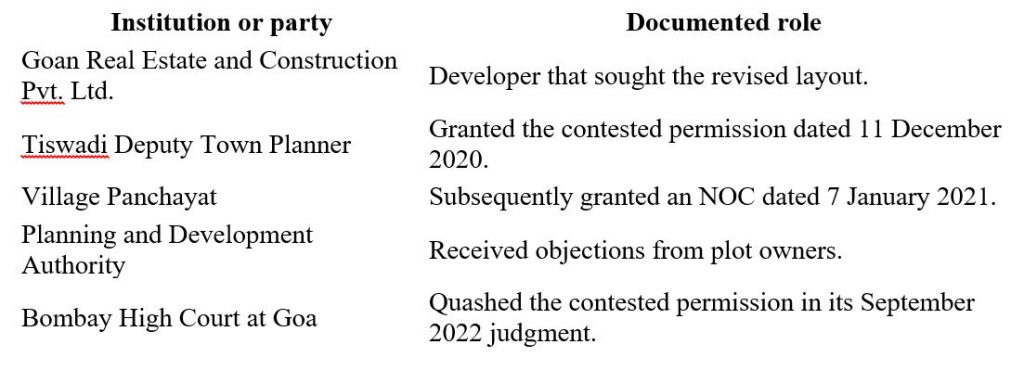
The 2022 case identifies the immediate administrative decision-makers and the permissions challenged.
These details are recorded in the judgment and contemporaneous reporting. The administrative accountability question is straightforward: why was a revision permitting the conversion of previously designated open spaces approved despite objections from plot owners, and what legal scrutiny was applied before the permissions were issued?
The judgment provides a basis for examining the decision. It does not establish that the officials concerned acted corruptly or at the direction of a politician. - The investigative questions that remain unanswered
A comprehensive investigation should now focus on five documentary trails.

A. Original land ownership
• Obtain the title deeds and land-conversion orders for the relevant survey numbers.
• Identify the original owners, tenants and agricultural leaseholders.
• Establish whether tenancy claims were resolved before development permissions were issued.
B. Corporate ownership
• Obtain GRECPL’s historical shareholder registers and annual returns.
• Establish the relationship between GRECPL, the Dynamix Group, DB Realty and the relevant promoter entities at each stage.
• Identify any changes in beneficial ownership.
C. Planning permissions
• Obtain the approved layouts of 2004, 2007 and 2010.
• Compare them with the 2020 revised plan.
• Obtain the complete files supporting the Deputy Town Planner’s permission and the Panchayat’s NOC.
D. Environmental compliance
• Examine the records concerning hill cutting, changes in land use and any environmental permissions.
• Establish which orders were issued, withdrawn or challenged and whether any court subsequently ruled on those matters.
E. Political and administrative accountability
• Identify the officials who processed, recommended and approved each permission.
• Examine the documentary record for any evidence of political intervention, conflicts of interest or preferential treatment.
These questions can be investigated without presuming the answers.
- The bottom line
Three points are established by the available records: - Aldeia de Goa was developed by GRECPL, which CARE Ratings identified as a Dynamix Group-promoted company.
- Historical corporate disclosures linked the project to the promoter families associated with Shahid Balwa and Vinod Goenka.
- In September 2022, the Bombay High Court at Goa invalidated the permission to convert 9,384 square metres of designated open space.
The wider land-acquisition and hill-cutting controversies require examination of their own records.
The next crucial step
The most useful document is the complete 30 September 2022 High Court judgment in Raman Madhok and Others v. State of Goa and Others, Writ Petition No. 25 of 2021.
For the corporate trail, the CARE Ratings report and the SEBI-filed prospectus provide starting points. The next step is to establish the historical shareholding of GRECPL and connect it to the actual land records.
The central investigative question is not simply whether Aldeia de Goa was connected to the Balwa–Goenka business group. It is whether the land acquisition, development permissions and subsequent changes to the approved plans complied with the law—and which individuals and institutions were responsible for each decision.