Goa is abuzz with excitement as vintage bike and car owners, users, collectors and fans are decking […]
Old is Gold
October 4, 2016
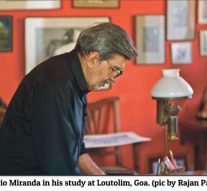
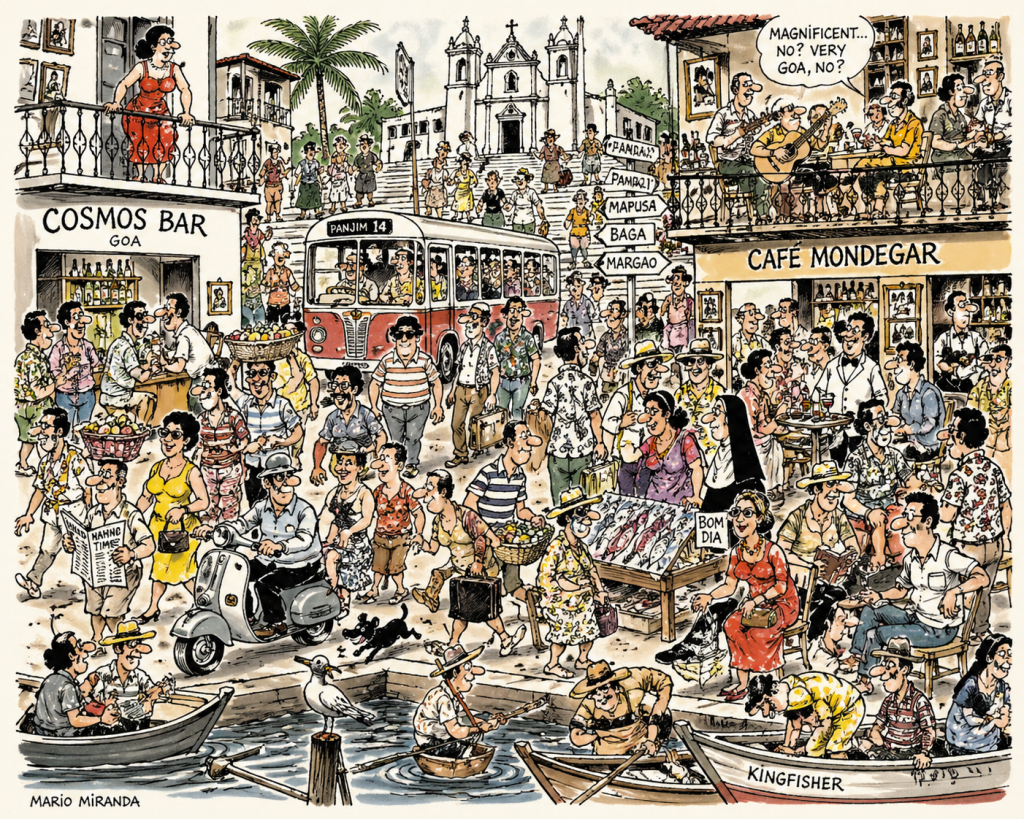
The renowned Goan cartoonist and illustrator Mario Miranda passed away on December 11, 2011 in his village of Loutulim, Goa. Mario-bab was an old world Goan and had in him that inestimable quality of graciousness. He was known best for his brilliant depiction of Goa in his political satire. His canvas was often ‘busy’ but insofar as Goa is concerned, it reflected Mario‘s deep love for his Goan homeland, his insight into its culture, and his attention to detail.
MAY 2, 2026 marks the birth centenary of the legendary Goan cartoonist Mario de Miranda. Mario Miranda was the son of Maria Francisca and Damodar Miranda and was born in the Portuguese colony of Daman. Mario’s father retained the prefix of the pre-conversion suffix of the family Damodar after Dam Bab, considered the presiding deity of Salcette. So much so that Mario was a Catholic bamon by birth although he himself saw himself as a happy agnostic. Never mind that there is a chapel in his ancestral home in Loutalim in south Goa.
Mario’s early childhood was more in Loutalim than in Daman. Damodar Miranda (who was a senior officer in the Portuguese regime) apparently was posted back by the Portuguese administration to Madgaon, within a year of the birth of Mario Miranda. Mario Miranda was sent to Bangalore (now Bengaluru) for his education because in pre-Liberation Goa, facilities for education were very limited.
Indeed, the family is reported to have hired a villa in Bangalore with two caretakers to look after young Mario. As Mario himself has revealed his talent was discovered early in school. Unlike other kids in school Mario spent his time sketching. In a self-portrait there is Mario sketching his beauteous teacher and being caught in the act. As Mario puts it, the discovery of his talent was a painful affair as the teacher gave him five strokes of the cane for his impertinence in sketching her.
Mario went on to Bombay (now Mumbai) after he finished his 10th standard in Bangalore. The intention of the family was that he should be enrolled in the JJ School of Art in recognition of his artistic talent. Mario did not find the atmosphere at the JJ School of Arts very congenial. His formal art education lasted only for one day. Mario was admitted to the St Xavier’s College where he completed a Bachelor’s degree in English Literature.
Even while in college he continued to draw cartoons. His first job was in the “Current Weekly.” Two of the middle level journalists in “The Times of India” had quit to start two tabloids. Dosu Karaka started the “Current” and Rusi Karanjia, another Parsi, started the “Blitz.” They used to wage a furious mock battle against each other as I can testify, as much later I also worked for the “Current Weekly” for a couple of years.
The then editor of “The Illustrated Weekly of India,” Mandy, happened to see Mario Miranda’s cartoons in the “Current Weekly.” Mandy persuaded “The Times of India” management to hire Mario as the cartoonist for the group’s magazines, which included not only “The Illustrated Weekly of India” but “Femina,” “Filmfare” and “The Evening News of India.” Mario was very prolific and he drew cartoons for all the group publications. Excepting for “The Times of India” itself. This was the preserve of RK Laxman which was jealously guarded. Mario himself confided in me that RK Laxman would not brook any competition within the group and forced his departure from “The Times of India.”
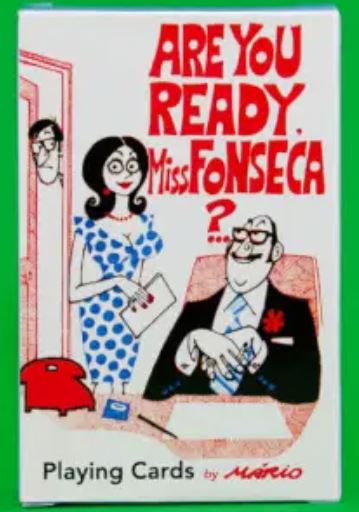
MARIO’S POPULAR CHARACTERS
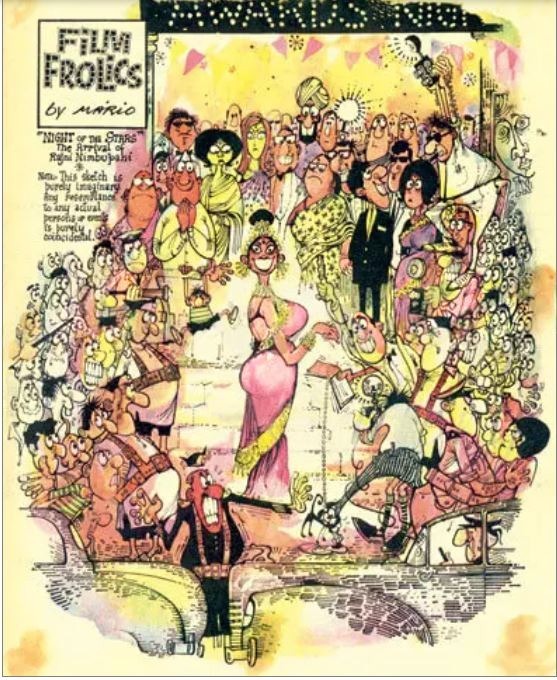
It was while at “The Times of India” that Mario came up with his most popular characters. Like his heroine Miss Nimboopani for “The Economic Times” Mario developed the character of Miss Fonseca, the secretary to the boss. The closest partnership perhaps was between Behram Contractor (Busybee) and Mario Miranda. It is acknowledged that the stray dog logo which accompanied Behram column Aroundabout was created by Mario. I subsequently borrowed the idea of a stray dog for my Stray Thoughts column in the “OHeraldo.”
I first came in contact with Mario after he had quit “The Times of India.” Mario was surviving largely on freelance work. I happened to be the editor of “The Imprint” in 1980. I had converted “The Imprint” from a wholly literary magazine into an in-depth investigative journal while retaining the literary flavor. Amongst the first stories I did for “The Imprint” was titled “Goodbye Bombay, Hello Dubai.” I requested Mario Mirando to do the cover illustration on migrants from India desperately seeking jobs in the Gulf countries. Mario did a brilliant color illustration.
Subsequently, Mario did several illustrations for “The Imprint.” Fortunately, I had a liberal budget and in any case the Imprint owner RV Pandit was a great admirer of Mario. Mario used to stay in Jupiter, a housing colony of senior naval officers in Navy Nagar at the end of Colaba Causeway. It was sea facing 8-storied building. I recall attending at least one major party at his Colaba rented apartment when I first met the then president of the Congress in Goa and future chief minister, Dr Wilfred D’Souza.
It was Mario Miranda who in fact suggested to Raul Fernandes that I was probably the best candidate to convert the Portuguse edition of the “OHeraldo” into a full-fledged English daily in 1983. I travelled to Goa and after successful negotiations with the patrao AC Fernandes I decided to move to Goa. Before going to Goa I dropped in on Mario at his Colaba flat and asked him how I should prepare for Goa. Mario insisted that I stitch a jacket. Mario cautioned me that while it may be okay to attend Catholic weddings in shirt sleeves it would be considered insulting not to wear a dark jacket to Catholic funerals. This is a bit ironical as when Mario died he had apparently expressed a desire much before he died choosing to be cremated rather than buried in the Catholic fashion .
Soon after I moved to Goa Mario also came back to his ancestral house in Loutalim. This was partly because there was no one to look after the beautiful property. There were however other compulsions. The naval officer who had rented the apartment to Mario had retired and wanted his flat back. It was not very easy for dog lovers to find a pet friendly building in Bombay then. Mario returned to his beloved Goa but continued to contribute to all mainstream publications in Bombay.
“The Economic Times” continued to carry a regular cartoon on its front page. During Khuswant Singh’s tenure at “The Illustrated Weekly of India” Mario was always in demand. Mario had a genius for making lifelong friends. His warmth and good nature endeared him to everyone. Mario’s cartoons reflected his own humorous and humane nature. Mario’s cartoons were never hurtful. They may poke fun but it was always gentle.
Amongst his closest friends was the late Vinod Mehta who launched several short-lived publications like “The Sunday Observer,” “The Independent,” “The Pioneer,” before he moved to Delhi to edit the “Outlook.” Vinod Mehta has written a long story about the nature of Mario’s cartoons and his close friendship with the Mirandas. By coincidence, Vinod and Mario had spent a couple of months in Germany. Vinod was writing a book while Mario was had been invited by the German Consulate in Bombay to sketch Berlin.
FROM CARTOONS TO SKETCHING
MARIO moved to far beyond just doing cartoons to doing sketch books on various countries he was invited to visit. Even while he was in the “Current Weekly” he was discovered by the Gulbenkian Foundation and was given a scholarship to spend two years in London doing whatever he pleased. Mario spent his time sketching everything under the sun and the moon in London.
Mario also drew sketches when he pursued his passion for theatre. Some of his London sketches revolve around the musical “Cats” based on TS Elliot’s book on cats. While in London Mario was invited to attend an international cartoonists conference in New Orleans in the USA and there he met all his favorite cartoonists.
While in Bombay the United States Information Services invited him to spend a year in America. Subsequently, the French Consulate invited him to visit Paris. Portugal and Brazil were among the 60 odd countries that Mario visited. These sketching visits resulted in very colorful virtual tourist guides to the countries. Mario was ever watchful. Mario stood back or sat back and watched all the time and made sketches, unlike others who maintained a written diary right from his childhood Mario maintained a diary of sketches.
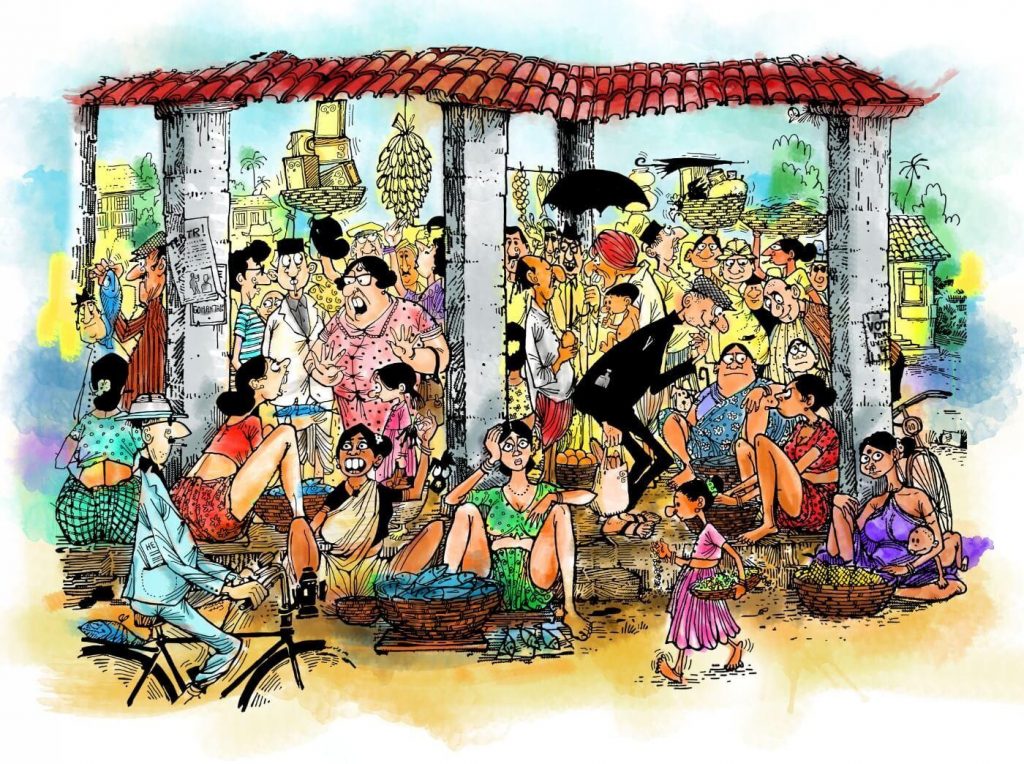
The first conscious attempt to put together the works of Mario was made by INTACH. Lady Hamlyn who headed the Hamlyn Group of Companies which specialized in art material and art books had developed a hobby of restoring old forts worldwide. Lady Hamlyn had set her heart on restoring the Reis Magos Fort in Goa. Unfortunatly, for Mario, who was a close friend of Lady Hamlyn, there was stiff opposition in Goa to handing over the Reis Magos Fort to Lady Hamlyn. As the price for restoration Lady Hamlyn would insist on an apartment within the fort for herself. Subsequently, INTACH stepped in and Dipti Salgaokar took over as the chairperson of the Restoration Committee for the Reis Magos Fort. I distinctly recall the inauguration of the Mario Art Gallery in the restored fort.
Towards the last decade of his life Gerard Da Cunha struck a deal with Habiba, Mario’s wife, to create a trust which would have exclusive rights to all Mario’s works. For the first time all of Mario’s works were catalogued and brought out in a series of books with appropriate text to accompany them. This included Mario’s early days with sketches of the village scenes in Loutalim. Mario poked fun at the pompous priest whom he studied when he was forced to attend mass. The village of Loutalim has its share of cats and dogs which always featured in Mario’s cartoons and drawings.
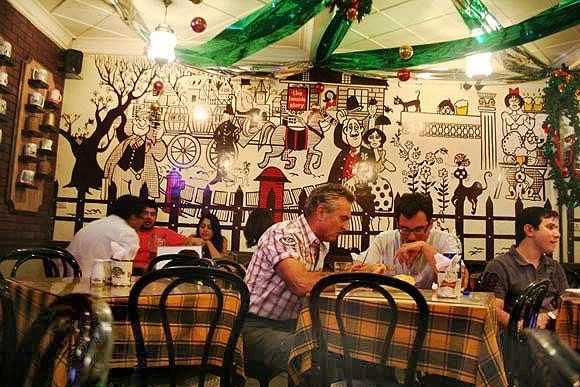
Mario did the interior décor for the Kala Academy indoor auditorium. Mario was also commissioned by Audhut Timblo of Fomento to design the interiors of the Alfama Indo-Portuguese restaurant. It is not widely known that he also designed a mural for a small restaurant in Mala in Panjim. The Mario Miranda Foundation which apparently helped provide a regular income to the family, has a number of souvenirs like coffee mugs to T-shirts and even Portuguese azulo tiles featuring Mario’s sketches. Now there is a permanant Mario Miranda Museum adjacent to the Gerard d’Cunha’s residence in Porvorim.
THE Mario Centenary is being celebrated in a major way across the country. The Cartoonists Association in Bangalore is mounting an exhibition of his works commemorating his birth centenary. Interestingly, the Goa University is holding a seminar and workshop on the political underpinnings of Mario’s cartoons. As far as I know the only political cartooning that Mario did was for a book called “Politics Indian Style” published by Jaico way back in 1977. The book was a joint endeavor by Rajan Narayan and Mario Miranda on the post-Emergency elections.
Mario had no business sense. He was the artist and would never remind publications about overdue payments to him. It was left to wife Habiba to take care of his financial side of life. Habiba kept track of all the work that Mario did. I recall that when Jaico published our book, Habiba made it a point to check with me how much the royalty would be. Mario, of course, was a major source of frustration because he would give away his sketches for free to friends.
Mario left his mark but nobody has been able to inherit his style. It was Mario’s attention to detail that made his work so distinctive. There is a classic ink sketch of a massive elephant done painstakingly by him, the caption depicted a maharaja saying, “Will you please tell the mahout that the elephant is standing on my foot.” No minute detail minute escaped the eye of Mario Joao Carlos do Rosario de Brito Miranda, just Mario Miranda for the rest of us.
 LETTERS TO THE EDITOR FOR ISSUE DATED SEPTEMBER 12, 2026
 GOAN TEACHERS ARE CONTRACT LABOR!
 THE COLOUR IS PRESTIGIOUS! THE PROCESS MUST BE EQUALLY SO!
 DOGS ATTACK GOANS, OWNERS GET ACQUITTED!By Dr Olav Albuquerque & Deborah Cordeiro
 CYBER FRAUD: A THREAT TO FINANCIAL SECURITY & MENTAL WELL-BEING! By Adv Vinayak (Mama) D Porob
 RUPEE IN FREE FALL: WHY THE SLIDE MATTERS MORE THAN THE NUMBER! By Arvind Pinto
 SHRAVAN BYE-BYE, CHOVOTH WELCOME!
 HUSBANDS SHOULD KNOW HOW TO COOK, BE WILLING TO WASH VESSELS!
 HOLD ON TO LIFE: CHANGING THE NARRATIVE ON SUICIDE! By Dr Amit Dias
 WEEKEND UPDATESLETTER TO THE EDITOR FOR THE ISSUE DATED SEPTEMBER 05, 2026
 WHEN A MOUNTAIN BECAME A RIVER!By Ranadhir Mukhopadhyay
 REAL GROUP TURNS 80!
 WHEN ‘I’LL MARRY YOU’ IS A LIE! Why Goa’s courts are failing women…By Dr Olav Albuquerque & Deborah Cordeiro
 WHEN THE LEGAL FRATERNITY TOOK TO THE FIELD IN GOA! By Adv Vinayak (Mama) D Porob
Goa is abuzz with excitement as vintage bike and car owners, users, collectors and fans are decking […]