Goa is abuzz with excitement as vintage bike and car owners, users, collectors and fans are decking […]
Old is Gold
October 4, 2016
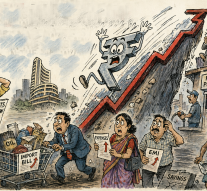
THE Indian rupee’s steady slide past the Rs93–94 per dollar mark in April 2026 has triggered familiar alarm bells. Headlines scream “record lows,” television panels debate blame, and social media reduces a complex macro story to national pride versus panic. Yet, focusing only on the number misses the larger issue. What matters today is why the rupee is falling, how fast it is doing so, and what that means for smaller states like Goa. Finally, on everyone’s mind is the one unspoken fear, would the dollar touch the magic figure of Rs100 by the end of 2026?
More Than a Market Mood Swing
The current depreciation is not a sudden accident. The rupee has been among the weaker Asian currencies since early 2026, losing over 5% in just a few months and close to 10% over FY25–26, its sharpest annual fall in more than a decade. While it is true that most Asian currencies have fallen against the dollar, the rupee has been a mid-to-weak performer. The rupee has fallen more than the Chinese yen or the Thai baht.; less sharply than the Japanese yen and the South Korean won. This has pushed the currency into territory that policymakers especially the RBI requires to take a close look at.
Forces acting against the Rupee
First, the dollar has strengthened globally. The rise in high US interest rates makes dollar assets more attractive. This results in an outflow of capital from emerging markets such as Indian, back to the US market. In periods of geopolitical stress, capital does not negotiate — it runs. Emerging market currencies like the rupee are usually the first casualties. This is one of the reasons for the fall in our stock markets, as capital is being pulled back to the US. For in times of geo-political instability, investors prefer the comfort of their own markets.
Second, oil. The West Asia conflict has pushed Brent crude beyond $100 a barrel at points in March and April. India imports nearly 85–90% of its crude oil. Every rise in oil prices raises India’s import bill, widens the current account deficit, and increases dollar demand —directly weakening the rupee. The majority of the oil market is dollar denominated. With the increasing price of crude, there is need of additional dollars increasing its value vis-à-vis the rupee. Thus, with rise with a $10 rise in prices, India’s annual import bill increases by $12-13 billion; which impacts the current account deficit and put pressure on the rupee.
Third, foreign portfolio outflows. In 2026 alone, equity outflows have crossed the Rs1 lakh crore mark, creating sustained dollar demand as investors exit rupee assets. This is not a vote against India’s growth story so much as a reflection of global risk-off behaviour. While Indian investors and corporates have stepped in to cushion the fall of the market, the exit of foreign portfolios have weakened the market.
RBI: Managing the fall, not defending a fortress
The Reserve Bank of India has intervened heavily in both spot and forward markets, drawing on its large foreign exchange reserves — still above $700 billion — to smooth volatility. But the RBI has been clear: it is not defending a specific level, only preventing disorderly moves.
This distinction matters. A slow, predictable depreciation can be absorbed. A sharp, fast slide can spill into inflation expectations, bond markets, and business confidence. The danger is not that the rupee is at Rs94 — but that it reached there too quickly.
Why Goa feels the currency pain (and gain) more sharply
For Goa, the rupee’s weakness is not an abstract macro chart — it shows up in daily life.
On the positive side, tourism gets a boost. A weaker rupee makes Goa cheaper for foreign tourists, improving hotel occupancy, restaurant footfalls, and allied services. Remittances from Goans working abroad also translate into higher rupee incomes, giving households more spending power. Unfortunately, the foreign tourist market is slowly abating. In March 2026, foreign tourist arrivals were only 31,082 as compared to 56,644 in March 2025. This is apparent – from the number of foreign tourists on the beaches at Colva, Calangute or Baga. Thus the much-needed foreign exchange is not forthcoming. Further with the uncertainty in the Gulf, the remittances of Goans have also dropped. Earlier Goans working in the Gulf traditionally remitted Rs1,200 to Rs1,500 crore annually to Goa. This has now declined to around 20% in 2026 due to the West Asia conflict. Thus, the decline in the number of foreign tourists and the declining remittances from Goans abroad has reduced the inflow of foreign exchange although the value of the dollar has increased.
But there is an equal and opposite effect. Fuel costs rise, pushing up transport, electricity, and food prices. Imported goods — from electronics to construction inputs — become more expensive. Families sending children abroad for education or businesses dependent on imported raw materials feel an immediate squeeze.
Export-oriented sectors such as pharmaceuticals, seafood, and iron ore may gain competitiveness, but currency volatility complicates pricing contracts and hedging. For a small state economy like Goa’s, dependence on tourism and imports makes exchange rate swings especially consequential.
The bigger signal the rupee is sending
The rupee’s fall has also produced statistical side effects. India slipped from fourth to sixth place in global GDP rankings — not because growth collapsed, but because GDP measured in dollars shrank as the rupee weakened. Rankings aside, the message is clear: currency weakness amplifies vulnerabilities, even when domestic growth remains healthy.
The Economic Survey 2025–26 acknowledged this tension, noting that despite strong fundamentals, persistent trade deficits and reliance on volatile capital flows leave the rupee exposed to external shocks.
Stability needs structure, not slogans
It is tempting for governments to treat the rupee as a symbol to be defended. But central banks cannot rewrite fundamentals. Long-term currency stability depends on reducing energy dependence, narrowing trade deficits, boosting exports, and attracting durable foreign investment, not merely hot money.
For Goa in particular, policy must focus on diversifying tourism, strengthening export value chains, and lowering logistics and energy costs. A weak rupee can be a temporary advantage — but relying on currency weakness as a growth strategy is a risky bargain.
The rupee’s slide is not a verdict on India’s potential. It is a reminder that in an uncertain world, resilience — not denial — is the real measure of economic strength. In managing the currency market, the RBI has the unenviable role of ensuring the stability of the rupee. While the RBI does not aim to fix the rupee at a particular level, it would like to manage volatility, and prevent panic in the market and to ensure that there is no violent economic disruption. Its intervention in the forex market is to ensue that there is sufficient liquidity for economic transactions. With a forex reserve of $ 700 billion, the country has an adequate reserve to meet its creditors, but the rise of the rupee vis-à-vis the dollar, hurts our national pride, making our hope of being a high income developed economy by 2047 a distant dream!
 LETTERS TO THE EDITOR FOR ISSUE DATED SEPTEMBER 12, 2026
 GOAN TEACHERS ARE CONTRACT LABOR!
 THE COLOUR IS PRESTIGIOUS! THE PROCESS MUST BE EQUALLY SO!
 DOGS ATTACK GOANS, OWNERS GET ACQUITTED!By Dr Olav Albuquerque & Deborah Cordeiro
 CYBER FRAUD: A THREAT TO FINANCIAL SECURITY & MENTAL WELL-BEING! By Adv Vinayak (Mama) D Porob
 RUPEE IN FREE FALL: WHY THE SLIDE MATTERS MORE THAN THE NUMBER! By Arvind Pinto
 SHRAVAN BYE-BYE, CHOVOTH WELCOME!
 HUSBANDS SHOULD KNOW HOW TO COOK, BE WILLING TO WASH VESSELS!
 HOLD ON TO LIFE: CHANGING THE NARRATIVE ON SUICIDE! By Dr Amit Dias
 WEEKEND UPDATESLETTER TO THE EDITOR FOR THE ISSUE DATED SEPTEMBER 05, 2026
 WHEN A MOUNTAIN BECAME A RIVER!By Ranadhir Mukhopadhyay
 REAL GROUP TURNS 80!
 WHEN ‘I’LL MARRY YOU’ IS A LIE! Why Goa’s courts are failing women…By Dr Olav Albuquerque & Deborah Cordeiro
 WHEN THE LEGAL FRATERNITY TOOK TO THE FIELD IN GOA! By Adv Vinayak (Mama) D Porob
Goa is abuzz with excitement as vintage bike and car owners, users, collectors and fans are decking […]