Goa is abuzz with excitement as vintage bike and car owners, users, collectors and fans are decking […]
Old is Gold
October 4, 2016
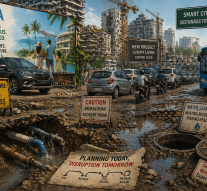
As incomes rise and cities expand the everyday reality of broken roads, failing utilities, and reactive planning reveals a deeper crisis beneath the surface….
ON a hot summer’s day, the traffic on DB Marg in Panaji does not flow, it negotiates. Vehicles inch forward in a tense choreography, swerving to avoid manhole covers jutting out from the centre of the road, braking suddenly to dodge waterlogged patches, and squeezing past each other on streets never designed for their size. What should be a simple commute becomes an exercise in constant vigilance. In that moment, the chaos is not just about traffic, it is about planning, or the lack of it. And this experience is witnessed in other key cities and towns of Goa, at the cost of people’s well-being.
THE ILLUSION OF DEVELOPMENT
ACROSS Goa, there is a visible rise in prosperity. Households own more vehicles, digital connectivity has surged, and lifestyles have evolved. Yet, the physical backbone of this growth has remained largely unchanged. Roads, drainage systems, sewage lines, and utility networks continue to operate at capacities designed for a different time. The result is a striking contradiction: socio-economic development without corresponding infrastructural transformation. Cities expand, but the systems that sustain them lag behind. What emerges is not seamless growth, but a growing strain on outdated foundations.
INVISIBLE SYSTEMS, VISIBLE CRISES
NOWHERE is this gap more evident than in water and sewage infrastructure. Ageing pipelines, leakages, and poor maintenance are technical shortcomings, but also public health risks. The recent diarrhoea outbreak in Dabolim underscores how fragile these systems are. When sewage and water lines intersect without adequate safeguards, the consequences are immediate and severe. Similarly, the cycle of road repairs reflects a deeper planning failure. Even as Panaji’s roads are patched and resurfaced, they are slated to be dug up again for gas pipeline installations. This repetitive disruption is not merely inconvenient. It signals a lack of coordination between departments. Development, in such cases, becomes an endless loop rather than a forward progression.
DESIGN FLAWS AND DAILY DANGERS
BEYOND large-scale issues, it is the smaller design failures that shape everyday risk. Manhole covers and sewer grates placed in the middle of roads force drivers into unpredictable manoeuvres. In congested traffic, these slight deviations can, and do, lead to accidents. At the same time, vehicles have grown larger, but road widths have not. The mismatch is evident in daily congestion, near-misses, and the constant friction of shared space.
The absence of consistent traffic management only compounds the problem, leaving roads to regulate themselves in already strained conditions. And yet, step into a private space such as a private doctor’s office, a hotel, café, or mall, and the contrast is stark. Interiors are polished, utilities are seamless, and maintenance is meticulous. Disappointingly, the approach roads and neighbourhoods surrounding such spaces are more often than not broken, poorly lit, or waterlogged. This juxtaposition between private efficiency and public neglect is one of the most telling features of Goa’s urbanism.
PLANNING THE EVERYDAY CITY
GOA does not lack urban planning expertise; it lacks its application where it matters most. While grand projects and flagship developments receive attention, the everyday city remains overlooked. Lanes, junctions, and neighbourhoods are rarely the focus of sustained planning efforts even where these are the places that life actually unfolds.
Ironically, these spaces present some of the most complex and creative challenges for urban planners. Integrating utilities without repeated excavation, redesigning congested streets without disruption, and ensuring safety within existing constraints require innovation and long-term thinking. Yet, these problems remain under-addressed.
What Goa appears to be missing is what urban theorists have often described as a form of “sewer socialism” or “sidewalk socialism”, an approach to governance that prioritizes the mundane but essential foundations of public life. It is not an ideological slogan, but a practical ethic: that the legitimacy of development lies in functioning drains, reliable water systems, well-designed roads, and safe pedestrian spaces. These are the quiet infrastructures that rarely make headlines but determine the quality of everyday life.
When governments overlook these in favour of visible, large-scale projects, they risk creating cities that appear modern on the surface but remain fragile underneath. In this sense, the true test of Goa’s development is not its rising incomes or expanding skylines, but whether its most basic systems work reliably, equitably, and without disruption.
Global examples offer a different approach. Singapore plans infrastructure with future demand in mind, integrating utilities through underground corridors to avoid repeated disruption. Tokyo demonstrates precision in even the smallest details—where manhole covers are not only safely integrated but are also artistically designed, reflecting local culture and turning infrastructure into public art. Seoul shows how continuous investment and smart systems can ease congestion and improve urban mobility. These cities treat infrastructure as a living system; one that evolves alongside economic growth. That is the shift we must make.
FROM CHAOS TO CONSEQUENCE
THE chaos on Panjim’s roads is not an isolated inconvenience; it is a symptom of a larger structural issue. As Goa continues to grow, with an ever-increasing floating population, the challenge is not merely to build more, but to build better, and to plan not just for expansion, but for experience. Because development, ultimately, is measured not in skylines or statistics, but in the ease and safety with which people navigate their everyday lives.
Paradoxically, Goa is home to several illustrious architects, urban planners, and sustainability consultants who are celebrated for their work on ambitious, large-scale projects. Yet, their expertise remains largely absent from addressing the everyday infrastructural challenges that citizens routinely face, and is seldom meaningfully leveraged by the State to improve lived urban experiences. .

 LETTER TO THE EDITOR FOR ISSUE DATED SEPTEMBER 19, 2026
 ELEVATED HIGHWAY TO HELL!
 MEDICAL DEVICES LOOT!By GS Mudur
 HOSTILE ACT BY PAKISTAN: `PNS HUNAIN’ TRIED TO DISRUPT OUR NAVAL SURVEILLANCE! By Dr Olav Albuquerque & Deborah Albuquerque
 BLACK MONEY IN POLITIAL PARTIES: ADR’s Alarming Revelations By Arvind Pinto
 `KHANDVI MILLE-FEUILLE’ AT BRICS ALL VEG BUFFET!
 SATYA NIKETAN TRAGEDY: HOW GLOBAL STUDENT HOUSING MODELS COULD HELP INDIA FIX A BROKEN SYSTEM!By Sneha Swaminathan
 GANESH PANDALS HIJACKED BY ADANI, AMBANI
 WHY DOES A DEMENTIA DIAGNOSIS MATTER? By Dr Amit Dias
 WEEKEND UPDATES
 LETTERS TO THE EDITOR FOR ISSUE DATED SEPTEMBER 12, 2026
 GOAN TEACHERS ARE CONTRACT LABOR!
 THE COLOUR IS PRESTIGIOUS! THE PROCESS MUST BE EQUALLY SO!
 DOGS ATTACK GOANS, OWNERS GET ACQUITTED!By Dr Olav Albuquerque & Deborah Cordeiro
 CYBER FRAUD: A THREAT TO FINANCIAL SECURITY & MENTAL WELL-BEING! By Adv Vinayak (Mama) D Porob
Goa is abuzz with excitement as vintage bike and car owners, users, collectors and fans are decking […]