Goa is abuzz with excitement as vintage bike and car owners, users, collectors and fans are decking […]
Old is Gold
October 4, 2016
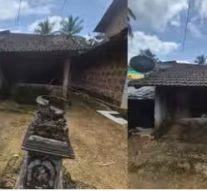
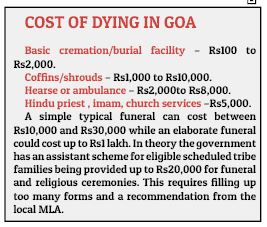
It is not suprising that senior citizen in Pernem from a very poor family could not be cremated because his sisters living on Dayanand Social Security Scheme (DSSS) could not afford the fire wood. The cost of dying could range from Rs 10,000 to a lakh. The NOC from the Panchayats or Municipality may cost only Rs100. The family however has to pay for transport, the materials for cremation, the coffin and the kafan and ofcourse the charges of the bhatji and the parish priest. Moreover even in death we are divided as there are seperate funeral sites divided religionwise. There is not a single secular electric crematorium in Goa.
EVEN death has a price and politics begins at the gate to the last journey. Goa likes to advertise itself as India’s richest little state. A place of high incomes, luxury villas, casinos and 5-star tourism. But there is another Goa. A Goa where a poor family may be able to keep a sick relative alive only with great difficulty, but even after death may discover that the final journey is a fearful torture.
The body of Ashok Vishnu Palyakar in the northern most taluka of Pernem remained overnight at the Municipal cremation ground recently, because his family could not afford the firewood required for cremation. His sisters were reportedly dependent on a Rs2,000 government dole.
Death itself maybe cheap. Nothing around it is cheap. On paper, government charges are absurdly low or very affordable. The Goa government charges only Rs100 for cremation and Rs200 for burial in last resting places owned by the Municipalities and the Panchayats. But this is only the fee for the No Objection Certificate for cremating or burying a body. All other expenses have to be borne by the family. This includes the ambulance or hearse used for the transportation of the body to the burial or cremation grounds.
For Christian burials the coffin is mandatory while for Hindu cremations firewood is needed. It is shocking but true that abandoned tyres are used at cremation ghats because they are cheap and burn very quickly, reportedly. Besides the firewood you have to pay the priest, pastor or maulana. Then there are the flowers and the religious material and funeral arrangements. Life goes on for the living and surviving relatives have to get a death certificate to be able to claim any legacy of the dearly departed.
In Goa this becomes very important because of the Uniform Civil Code. The Code mandates that all daughters and sons and nephews and nieces and brothers and sisters have equal share in the ancestral property. The obituary advertisements published in Goan newspapers are an invitation to all the relatives to stake their claim. I have personally been witness to the number of documents needed to claim the dues. A close friend had fixed deposits in nationalized banks and cooperative banks. He had LIC policies and his Provident Fund. His semi-illiterate wife could not do the paperwork. Multiple forms had to be filled to ensure that his modest savings of Rs25 lakh could be inherited by his wife and family.
In the case of niz Goenkar bhatkar families the process may involves lengthy litigation as heirs can dispute not only their share but the value of each asset. Death could become a nightmare for the living who are the surviving heirs.
RIGHTS OF BURIAL
GOA also has experienced disputes over the right to the last resting place. Catholic burial grounds are under the jurisdiction of the local parish priest. As in life Catholics are divided even in death. Protestants and sects like the Believers and Jehova’s Witnesses do not have access to the burial grounds controlled by the Diocesan parish priests. The only burial ground which is open to all sects in Goa as far as we know is the revived old British cemetery in Dona Paula. Hindus and Muslims may not be buried there in the burial grounds reserved for Catholics.
Conversely, for a Catholic to be cremated in a Municipality run crematorium in Panjim or Madgao they have to get special permission. It may be recalled that the late artist cartoonist Mario de Miranda had expressed a wish to be cremated rather than buried. There is a reluctance to provide land for the burial of the increasing number of Muslim migrants in Goa. Ironically, the objection comes from the Christian community. The Muslims in Panjim and Tiswadi are still waiting for additional land to expand their burial grounds.
It is not only the builders from outside who are coveting scarce precious very high cost land in Goa. Even crematoriums, cemeteries and kabrastans require land. Goa can find land for hotels, villas, commercial complexes and infrastructure projects like the Peace University and the new Indian Institute of Technology, but nobody is willing to provide land for final resting places for the people.

DEATH HAS BECOME POLITICAL
THIS is where death becomes politics. A living person can travel but a dead person cannot. The family must find a place where the law, municipality, religion and local community will all permit the final rites of cremation or burial. A 2015 investigation in a Goan local daily reported that several crore have been spent by civic bodies on maintaining crematoriums, cemeteries and kabarastans. These are not however accessible to low caste and tribal people. The tribals like Gaudi and Kunbi people prefer to prefer to bury their dead rather than cremate them. There are many villages with only a crematorium but no kabaristan.
In 2025 land was allotted for crematoriums at Morjim and Mandrem following years of complaints about the absence of adequate facilities for the dead. Indeed, the residents of Morjim marched to the chief minister’s residence with a women’s body after a dispute over a cremation site. There’re of course no issues for cremation of VVIPs. It may be recalled that the first chief minister of Goa, Dayanand Bandodkar, set a precedent with his family cremating his body at Miramar beach in Panjim with a public memorial.
The BJP insisted on equal treatment for the late chief ministerof Goa, Manohar Parrikar. In July 2026 when former minister and Taleigao MLA Jennifer Monserrate died there was a grand funeral attended by Chief Minister Pramod Sawant and other political leaders. A guard of honor and a gun salute was provided by the police department. The chief minister even issued an official order mandating that when a freedom fighter dies a deputy collector should attend the last rites. For the politically important the State comes to the funeral. For the desperately poor the family may struggle to bring the funeral to the state. There is no free death in Goa.
NO ELECTRIC CREMATORIUM
SHOCKINGLY, the richest state of Goa and international tourist destination, does not have a neutral electric crematorium. The city of Mumbai has at least two large electric crematoriums, one at Chandanwadi in south Mumbai and another at Worli. At the electric crematorium it does not matter if you are a Hindu, Catholic, Muslim or Parsi or atheist. Unlike crematoriums abroad Indian crematoriums have places for performing the religious rites of various communities. When the late Ratan Tata died Parsi religious rights were performed at the Worli Crematorium.
 LETTER TO THE EDITOR FOR ISSUE DATED SEPTEMBER 26, 2026
 IF YOU CLAIM THE CREDIT, TAKE THE RESPONSIBILITY!By Joquim Goes
 8 EMAILS IN 7 DAYS, BUT VALID GOA VOTERS STILL LEFT OUT: EC’S FLAWED SYSTEM!By Ritika Chopra
 MAKE IN INDIA: UNITED PAYMENTS INTERFACE India’s digital local leap to global benchmark…By Arvind Pinto
 BRING BACK THE FLATBREADS OF INDIA!
 EARLIER YOU KNOW, THE MORE YOU CAN DO Dementia diagnosis matters… By Dr Vailanki Nazira Raposo
 YOUNG LOVE IS A CRIME IN BIHAR!
 THE BOAT BECKONS, THE UNICORN WATCHES! By Prema Viswanathan
 WEEKEND UPDATES
 LETTER TO THE EDITOR FOR ISSUE DATED SEPTEMBER 19, 2026
 ELEVATED HIGHWAY TO HELL!
 MEDICAL DEVICES LOOT!By GS Mudur
 HOSTILE ACT BY PAKISTAN: `PNS HUNAIN’ TRIED TO DISRUPT OUR NAVAL SURVEILLANCE! By Dr Olav Albuquerque & Deborah Albuquerque
 BLACK MONEY IN POLITIAL PARTIES: ADR’s Alarming Revelations By Arvind Pinto
 `KHANDVI MILLE-FEUILLE’ AT BRICS ALL VEG BUFFET!
Goa is abuzz with excitement as vintage bike and car owners, users, collectors and fans are decking […]