Goa is abuzz with excitement as vintage bike and car owners, users, collectors and fans are decking […]
Old is Gold
October 4, 2016
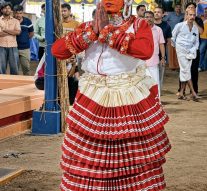
Inner Strength: Vikas Panikkar as Raktha Chamundi. Photo by Prema Viswanathan
At Shree Vadakke Kavu, a sacred grove in Pattuvam, northern Keralam, Theyyam—a hereditary ritual in which performers are worshipped as deities—endures through families who inherit its obligations. Over three days, I followed the men who become goddesses.
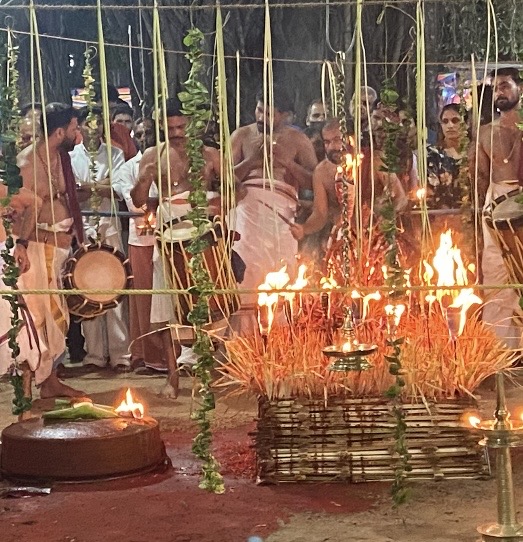
NIGHT falls slowly over Pattuvam. The paddy fields darken first, then the coconut groves, then the slow bend of the Kuppam river, until all that remains is the sacred grove of Shree Vadakke Kavu, its coal fires and brass lamps glowing at the heart of the darkness.
The sound of the chenda, the ritual drums, unfurl with a deep, measured beat, like a pulse throbbing in the earth. One rhythm dovetails into another, the insistent, overlapping beats drawing the gathering crowd into an almost hypnotic spell. Then the cheenikkuzhal, a traditional double-reed wind instrument, rises above the pounding percussion, its thin, keening notes piercing the night. As a deity prepares to enter, the chendas surge into a crescendo, their mounting rhythms filling the grove with an almost palpable expectancy.
OUT of the darkness Raktha Chamundi — raktha means “blood” in Malayalam — bursts into view, her painted face fierce and incandescent. The drums reach a thunderous peak. Vikas Panikkar has crossed the threshold. For those gathered here, the goddess has arrived.
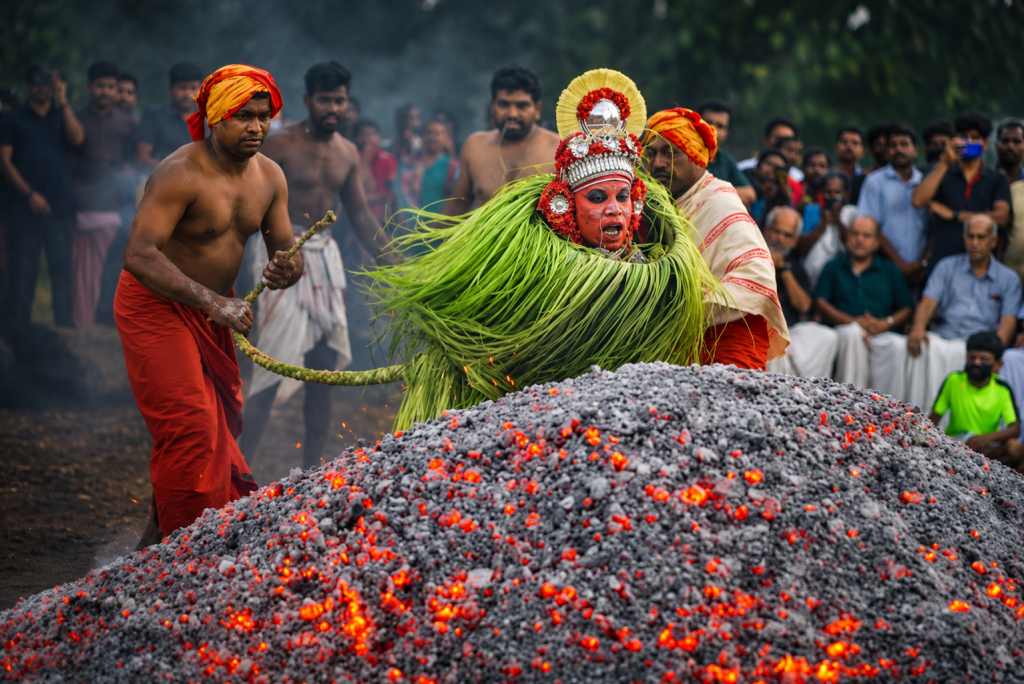
Later, the rhythms gather force once more as Thee Chamundi — the word “thee” denoting “fire”— plunges into the bed of embers. Sparks fly; smoke rolls across the grove; the chendas hammer on, rising to another crescendo. The crowd surges forward, then recoils as the figure of Sajil — who, like Vikas, is still in his 30s — rises from the fire.
It is almost too vivid to take in. Yet the flames, colour and sound are only what the eye and ear first catch. Beneath the spectacle lie inherited obligations, bodily discipline and a faith that can make a man’s emergence feel like the arrival of a deity.
I am here as a guest of K, whose family has cared for the grove for generations. Over three days, I move between the performance and the quieter world around it: preparations, family stories and conversations with those who fulfil the ritual’s obligations. Snehalatha, a member of the tharavad — the ancestral household — is part of this world in which paying obeisance to the goddess is not confined to the hours of performance. Two voices stay with me: Vikas, who embodies Raktha Chamundi and works as an electrician by day, and Perumalayan Shaji, hereditary performer who becomes Panchuruli Amma.
I ALSO speak to Sajil, who transforms into Thee Chamundi. He tells me that whatever the goddess speaks through him during the ritual is forgotten when he returns to his ordinary self — including the answers the deity gives, immediately afterwards, to devotees seeking help with their day-to-day dilemmas.
A goddess finds a home
THE goddess’s arrival is told in multiple ways. A 1961 Census of India account by TV Achuthan Nair, the grand uncle of the tharavad’s current incumbents, recounts how Ponnarathachan, a warrior-chief of Kolathunad in the north Malabar region, travelled to Tulunadu – a Tulu speaking region covering parts of coastal Karnataka and Keralam — to train in the art of fencing. An ardent devotee of Bhagavathy, he wished to consecrate her as the presiding deity of his fencing school. On his way back to his native village, he spent a night at the residence of the prominent Thazhathu Veedu family. The following morning, his umbrella and walking stick could not be lifted from the ground. Astrologers interpreted this as the goddess’s wish to be consecrated at that very spot, and the family built a temple there.
The performers’ thottam, or ritual song, endows the story with a more epic journey: the goddess travels from Dharmasthala, crosses the river at Pattuvam and defeats Gandharva Mayamalaramban before finding a home.
Here in Pattuvam, she is Panchuruli Amma, worshipped in a gentle, sattvic form alongside Kuluul Bhagavathi and Madiyan Kshetrapalan. At Kurankunnu, in Cherukunnu, she is remembered in her fierce, raudra form. Local accounts connect her with Varahi and Panchami; her name also encapsulates the boar spirit revered in Tulunadu’s Bhuta Kola. These are resonances across a shared cultural landscape.
The moment the human becomes divine
FOR Vikas, transformation begins long before he steps into the grove. “The mental preparation begins from the moment we receive the adayalam,” he says, referring to the sign or initiation that marks the ritual obligation. As the face is painted, the performer chants moola mantras. “We focus entirely on the deity we have attained.” The colors grow more intricate, but the inward work is just as important.
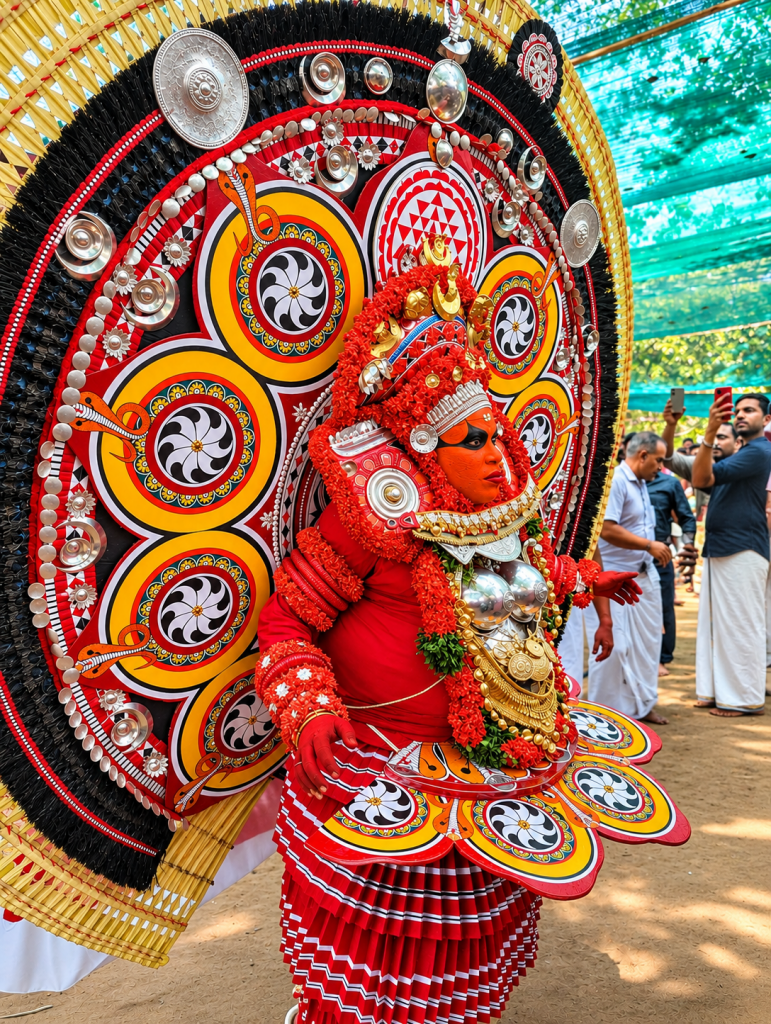
The threshold is crossed at the aniyaraal, the ritual crowning, says Vikas. “It is the primary moment where we transition from the level of a human to the divine,” he says. When he emerges as the deity, even his father and elders touch his feet for blessings. “In those moments, I am not viewed as an individual; they are seeking the blessings of the deity I embody.”
Vikas watched his father and grandfather perform from the age of three or four. “The understanding of how to perform is developed by seeing, hearing, and experiencing it,” he says. By day he works as an electrician; during Theyyam season he takes leave to fulfil obligations inherited through his family. The two lives coexist. Working elsewhere, he insists, does not diminish his commitment to the ritual.
Vikas warns that Theyyam cannot be hurried to suit an audience. He has seen how photographers can obstruct performers or enter the aniyara, the private dressing space, without permission. Thottam songs can be taught to those who wish to learn, he says, but sacred mantras and certain practices remain within the lineage. Wider attention may bring recognition, but access is not entitlement.
Shaji’s account brings the cost of transformation into the body. When he began performing as Panchuruli Amma at 19, he says, people doubted he could complete the ritual. Ten or 12 pieces of starched cloth are wound around his body. Twenty-one gurus fasten the headgear and further attachments hold it in place. “It’s a situation where the blood circulation doesn’t happen clearly,” he says. “If the headgear isn’t tied tightly enough, it will slip.”
To explain the pressure, Shaji offers a simple comparison: “Just try tying a small thread around a finger for two or three minutes; you can feel the pressure.” Now imagine that constriction around the waist and legs while standing for hours. Flowers alone weigh three to four kilograms; feathers, the painted board and silver ornaments add to the burden.
How does he endure it? “It is not a strength we create ourselves. We pray to the universal power of the Mother, and she guides us,” he says. Shaji’s faith is not an explanation added after the ordeal. It is how he marshals the strength to bear it.
A life beyond the ritual
SHAJI, now 45-years-old, used to work as a mason but had to give up the trade because of back issues. The demands and physical toll of his inherited role have shaped his choices, but he cannot be reduced to hardship or treated simply as a vessel for the goddess. He speaks of the Mother with conviction, and of the relationships that sustain the tradition.
Shaji recalls how K helped him sustain his home and conduct his sister’s wedding. He speaks of that help with gratitude, understanding what he received through the Mother’s grace. Gratitude is not servility; material inequality does not tell us everything about how people experience a bond. Around the grove there are hierarchies, but also affection, obligation, memory and mutual recognition.
K describes the bond with startling bluntness. In everyday life, he says, the relationship can resemble “master and slave.” But when the performer becomes the deity, the roles reverse: “The master becomes the reluctant slave.” He calls the performer an actor and Theyyam “the dance of a God”; other family members speak more directly of the goddess’s presence. Snehalatha receives the deity’s sharp words as a mother’s admonition. Faith and scepticism share the same space.
The ritual may temporarily overturn ordinary social relations: people bow to performers from communities historically pushed to the margins. But this reversal does not, by itself, abolish caste hierarchy or economic disadvantage once the chendas stop. For a few charged hours, the performer is viewed as divine; afterwards, he returns to a world where work and social standing still matter.
Will the grove endure?
THE future of the grove is uncertain. Some younger family members remain committed but live far away; others dismiss the old practices as superstition. Arjun Ravindran, who works in technology in the United Kingdom, has recorded the ancestral story, carrying it into another generation and another country. One of his phrases stays with me: “a rain of blessings.”
K believes the grove will endure as long as “faith, hope, love” survive. I think of Thee Chamundi rising through smoke and sparks; of Vikas describing the crowning as the passage from human to divine; of Sajil, who will not remember what the goddess said through him; of Shaji’s body bound beneath the ornaments, and his insistence that the strength to endure comes from the Mother. Theyyam lives in the flash of fire and color, but also in the work before and after — in inherited knowledge, complicated relationships and the people who keep faith with the grove.
I depart through the dark fields with Arjun’s phrase resonating in my mind. “A rain of blessings.”
 THE DIGITAL DIVIDE – BRIDGING THE GAP!By Arvind Pinto
 GOA AND MACAU: SHARED HERITAGE, DIFFERENT DESTINIES! By Dr RG Wiseman Pinto
 MUMBAI IS MORE HEALTH CONSCIOUS THAN GOA!
 MAMA MIA ‘UN-COLPO DI FULMINE’… A BOLT OF LIGHTNING!
 The Invisible Pandemic WHEN MEDICINES STOP WORKING Fight Anti-Microbial Resistance! By Dr Amit Dias
 WEEKEND UPDATES
 LETTER TO THE EDITOR FOR ISSUE DATED NOVEMBER 07, 2026
 WHO’S DREAMING OF A BLUE WAVE IN GOA?What will it take? Asks PhD researcher and architect… Tahir F de Noronha
 FREEDOM OF SPEECH AND EXPRESSION! By Cleofato Almeida Coutinho
 STIFFLING OF DISSENT
 AI HITS IT JOBS VERY HARD!
 THE TATA TUSSLE: BOARDROOM BATTLES! By Arvind Pinto
 MISSING AUTORIKSHAS AND ‘PANI-PURI’ OF MUMBAI!
 DIALOGUES AT THE ICG…
 BEFORE IT STRIKES: EARLY ACTION ON DIABETES! By Dr Amit Dias
Goa is abuzz with excitement as vintage bike and car owners, users, collectors and fans are decking […]