Goa is abuzz with excitement as vintage bike and car owners, users, collectors and fans are decking […]
Old is Gold
October 4, 2016
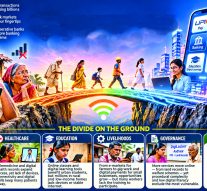
THE promise of India’s digital revolution is dazzling — UPI transactions crossing billions, stock markets accessible at the tap of a smart phone, and cooperative banks migrating to core banking systems. Yet beneath this sheen lies a stubborn divide: between those who can harness digital tools and those left behind. Let’s look at some of the sectors and the people who have to face this chasm.
Banks – Your account
IN the days gone by – the opening of a bank account was a wonderful experience. One went over to the bank of one’s choice, one was were given a form to fill, with name and address. Then you were given a paying slip and you pulled out a Rs100 note, walked up to deposit it at the teller and lo! The account was opened. You got a pass book, a cheque book and you were in the business of operating your own account.
Today in the digital age, this is not possible. To open an account, one has to possess an Aadhar card indicating your name and address. Having an address in Bihar and trying to open an account in Goa – the bank will not open an account in your name. A bank in Goa would require a local address proof, like an electricity bill, rental agreement that for the labour or gig workers is hard to come by. Without a local address, the bank risks non-compliance as per RBI regulatory norms. Today the RBI is taking KYC norms as serious non-compliance and imposing fines on non- compliant banks. Therefore, to open an account in Goa, you will need to change your address to Goa. But what if you do not have a permanent place in Goa or require to hang on to the address in Bihar, since you have an account there where you would like to send the income you earn in Goa to your village in Bihar. Then again banks regularly ask their customers to update the Know Your Customer (KYC) details. This requires in many cases visiting the bank, filling forms, submitting your Aadhar and PAN card, a set of photographs and a signature verification. Further, as a measure of anti-money laundering watch, banks look with suspicion on any large deposits of cash. In India, banks must report cash deposits of Rs10 lakh or more in savings accounts during a financial year, and Rs50 lakh or more in current accounts. Any single deposit of Rs50,000 or above requires PAN disclosure, and receiving Rs2 lakh or more in cash in one transaction is outright prohibited under Section 269ST of the Income Tax act 1961.
ACCORDING to Section 269ST of the Income Tax Act no person shall receive Rs2,00,000 or more in cash: from a single person in one day, or in respect of a single transaction, or in respect of transactions relating to one event or occasion from a person. This rule applies to individuals, businesses, trusts, and institutions alike. The penalty for its breach, is that the recipient must pay a penalty equal to the amount received in cash (i.e., 100% of the sum). Despite the harsh penalty, most on money transactions take place in cash, going by the record of seizures by either the income tax or enforcement directorate.
DESPITE India’s digital surge, cash still accounts for about half of all financial transactions in 2026, especially in rural and semi-urban areas, even though UPI and card payments now dominate retail transactions. Why cash persists in India, despite the harsh penal clauses in our law? In rural India, cash is king. For in our villages, with limited smart phone penetration, patchy internet, and low digital literacy, cash reigns as the only means of transaction. Then again our cultural preference is for cash. On many occasions customers make a constant request to banks for new notes. Most rural and semi rural folk still trust hard currency for daily trade, weddings, and informal lending. Many rural cooperative banks and small traders often lack robust digital systems, reinforcing the need for dependence on cash.
According to a 2024 report from India Business corruption survey, despite our anti-corruption laws, 83 percent of bribes are paid in cash, while around 17% are paid by ways of gifts, foreign travels, favors through agents. Cash in India is still king, despite the government’s push towards a digital denomination.
India’s digital push has reshaped nearly every aspect of daily life—from how people earn, shop, and learn, to how they access healthcare, banking, and government services. While urban areas have embraced digital tools rapidly, rural communities are catching up, though gaps remain. Lets look at some of these sectors.
Digital Commerce and Payments
IN daily life, and commerce, digital payments (UPI, mobile wallets) have become mainstream, reducing reliance on cash in cities. Should you have forgotten your wallet while out on the road, or a shop, you have only to pull out your phone and pay for the item you have purchased. Your phone contains your bank account. Buying and selling stocks and shares that once required telephoning your broker is not passe. Stock can be bought or sold via mobile apps. In fact, most people trade the stock market from the privacy of their mobile phones.
In today’s digital age, the market has come to your house. Sit in the privacy of your phone and you can buy almost anything online — be it groceries, household furnishing, your clothes. You wish to eat or drink — open app Zomato or other food apps and you can have varieties of dishes to choose from . In today’s virtual work, education is not only in a physical school or college. Teaching comes to your home, where teachers over a video call can teach students any subject one wishes to learn. Even in healthcare, telemedicine and online consultations ensure that patients get home care, rather than visiting a doctor or a hospital. Paying bills that once required standing in long queues at a government office now can be done online.
The growing divide
THIS digital push is however a paradox. While the digital age has empowered the youth and the tech savvy, these processes are a nightmare to the uninitiated, the elderly or those in rural outposts. Many elderly citizens are often cheated when they share their passwords or PIN codes to a trusted household help to withdraw money from the bank. Or again many of our senior citizens have been fleeced by scamsters who talk them into sharing their bank details posing as police or law enforcing agencies. For several of the elderly, who have to use many of these digital platforms, the time they take to search or enter their passwords or PIN, the app shuts down. While these time limits are security features built into the app, the time span is not variable – since it has been designed for speed and quick entering of either the PIN or password. Further most of these apps or sites are for the able-bodied. There are no braille scripts for the blind or those who cannot type. Further most apps presume a smart phone and an internet connection; which may not be available with everyone or all at places in the country.
As the decade progresses, the digital push will encompass most sectors of the economy and much of our daily lives. While digital India is a promise for those who are educated and able, it is still a hurdle for those who do not have these digital skills. As India continues to grow in its digital transformation, our policy makers and technical gurus, require to provide for those who do not have such skills. For digital India will create another strata in our country, between those who are skilled to work in the digital milieu and those who are unable to use this digital technology in their everyday working. This is where our social policies and technical governance need to ensure that digital technology is user friendly and accessible to everyone!
(Arvind Pinto is the chairperson of Citizencredit Cooperative Bank Ltd, he also practises at National Company Law Tribunal and is retired chief commissioner.)
 THE 10-HEADED RAVANA: WHEN DEMOCRACY LOSES ITS MANY VOICES
 NARKASUR CELEBRATES BAHUJAN SAMAJ CREATIVITY!By Kaustubh Naik
 GOA AND MACAU: SHARED HERITAGE, DIFFERENT DESTINIES! By Dr RG Wiseman Pinto
 MUMBAI IS MORE HEALTH CONSCIOUS THAN GOA!
 MORTAL BY DAY, GODDESS BY NIGHT!By Prema Viswanathan
 MAMA MIA ‘UN-COLPO DI FULMINE’… A BOLT OF LIGHTNING!
 The Invisible Pandemic WHEN MEDICINES STOP WORKING Fight Anti-Microbial Resistance! By Dr Amit Dias
 WEEKEND UPDATES
 LETTER TO THE EDITOR FOR ISSUE DATED NOVEMBER 07, 2026
 WHO’S DREAMING OF A BLUE WAVE IN GOA?What will it take? Asks PhD researcher and architect… Tahir F de Noronha
 FREEDOM OF SPEECH AND EXPRESSION! By Cleofato Almeida Coutinho
 STIFFLING OF DISSENT
 AI HITS IT JOBS VERY HARD!
 THE TATA TUSSLE: BOARDROOM BATTLES! By Arvind Pinto
 MISSING AUTORIKSHAS AND ‘PANI-PURI’ OF MUMBAI!
Goa is abuzz with excitement as vintage bike and car owners, users, collectors and fans are decking […]