How the metaphor of Ravana’s 10 heads illuminates the dangers of personality cults, suppression of dissent and the concentration of political authority in contemporary democracies.
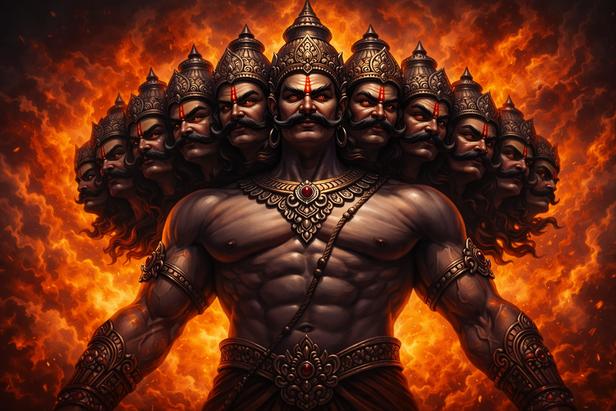
There is perhaps no more politically revealing metaphor in the Ravanayana than Ravana’s ten heads. Conventionally, the ten heads are interpreted as symbols of his extraordinary knowledge, intellectual accomplishments and mastery of different disciplines. In the new cinematic interpretation, however, they acquire an additional psychological dimension. They represent competing voices within Ravana himself: ambition, anger, pride, scholarship, revenge, desire and the capacity for restraint. This offers an intriguing metaphor for modern democracy. A healthy democracy is itself a ten-headed organism. It survives because it accommodates different opinions, conflicting interests, competing political ideologies and independent centres of authority. Its strength comes not from unanimity but from the ability to reconcile disagreement. Parliament, opposition parties, independent courts, the media, civil society, universities, constitutional authorities and ordinary citizens constitute the multiple voices of a democratic society. They are not inconveniences to be tolerated by the government. They are essential to its survival. The tragedy of Ravana is that although he possesses multiple voices, he eventually allows his own ego to overwhelm them. His ten heads do not produce ten independent judgements. They ultimately become extensions of one man’s will. That is precisely the danger confronting contemporary democracies: the gradual transformation of a system of collective decision-making into a system of individual command.
The ten heads as the ten institutions of democracy
Imagine Ravana’s ten heads as ten independent institutions of a modern democratic republic. Each head represents a different source of political wisdom and accountability.
Parliament — the voice of elected representatives.
Opposition — the voice of political alternatives.
Judiciary — the voice of constitutional restraint.
Media — the voice of scrutiny and investigation.
Civil society — the voice of public protest.
Universities — the voice of intellectual independence.
Bureaucracy — the voice of institutional continuity.
Election authorities — the voice of electoral integrity.
Federal governments — the voice of regional autonomy.
Citizens — the ultimate voice of democratic sovereignty.
A functioning democracy requires these heads to operate independently. They must be capable of disagreeing with the executive, questioning its decisions and, when necessary, preventing it from exceeding its constitutional authority. But what happens when all ten heads begin looking in the same direction? What happens when Parliament becomes an instrument for endorsing executive decisions, the media becomes increasingly deferential, constitutional authorities are perceived as partisan and dissenting citizens are treated as enemies of the government? The ten-headed democratic organism begins to resemble a single-headed political establishment. This is the essential difference between a democracy that celebrates power and one that celebrates constitutional righteousness.
India: When the ruling party begins to overshadow the democratic institutions India provides one of the most important contemporary illustrations of this tension. The Constitution of India envisages a system in which the executive is accountable to Parliament, the judiciary safeguards constitutional rights, the Election Commission supervises elections and the media scrutinises those exercising power. But the growing personalisation of political communication around Narendra Modi raises questions about the relationship between the leader, the ruling party and these independent institutions. The issue is not whether Modi enjoys popular support. He unquestionably commands a substantial electoral constituency. Nor is it whether a democratically elected government has the right to implement its programme. The issue is whether electoral popularity can become a substitute for institutional accountability. Consider three developments. First, the changing relationship between Parliament and the executive. The opposition’s role is not merely to oppose legislation. It is to scrutinise the government, demand explanations and expose administrative failures. When parliamentary debate becomes secondary to the executive’s legislative agenda, one of democracy’s important heads is weakened. Second, questions surrounding the independence of constitutional authorities. The appointment process for Election Commissioners was changed through legislation in 2023, giving the government a greater role in the selection process. The opposition has questioned whether this sufficiently protects the institution’s independence. The controversy surrounding the Special Intensive Revision of electoral rolls in 2025 and 2026 has further intensified questions about the Election Commission’s neutrality. The government and the Commission have defended the exercise, while opposition parties have raised concerns about voter exclusion and transparency. Third, the pressures confronting independent journalism. The Reuters Institute’s 2025 Digital News Report identifies concentrated media ownership, economic pressures and legal harassment as important challenges facing independent journalism in India. It also records the blocking of the Tamil news outlet Vikatan Plus following publication of a cartoon critical of the Prime Minister and his government. These developments should be examined individually, rather than treated as proof that all democratic institutions have ceased functioning. India continues to have competitive elections, opposition governments in states and vigorous independent media. Indeed, the 2024 general election demonstrated that voters can significantly alter the political balance. The BJP lost its parliamentary majority and had to depend on coalition partners to form the government. That is an important reminder that the democratic heads have not disappeared. But the Ravana metaphor asks a more fundamental question: how much independence can each head retain when the political establishment increasingly revolves around one commanding personality?
America: The paradox of a democracy built on checks and balances The United States offers another revealing example. The American Constitution was deliberately designed to prevent the concentration of political authority. The President cannot simply become Parliament. Congress cannot replace the courts. The Supreme Court can examine the constitutionality of executive action. State governments retain their own constitutional powers. The Founding Fathers understood that even an elected leader could become excessively powerful. Yet Donald Trump’s second presidency has produced an intense debate about the limits of executive authority. A Carnegie Endowment study published in August 2025 examined the similarities between the American experience and democratic backsliding in countries including Hungary, India, Poland and Türkiye. It identified the centralisation of power and weakening of institutional checks as recurring features of democratic erosion. The conflict with the Associated Press is particularly illustrative. After the news organisation declined to adopt the administration’s preferred terminology for the Gulf of Mexico, it was excluded from some White House events. The courts ordered the restoration of access, but the administration subsequently changed the arrangements for newswire participation in the White House press pool. This was not simply a disagreement over geographical terminology. It raised a question about whether the executive could determine which journalists were entitled to access based on their editorial positions. reutersinstitute.politics.ox.ac.uk There is an even more significant development. A Reuters investigation published in August 2026 found that federal judges had ruled against the Trump administration in 75 of 93 cases involving First Amendment challenges during his second term. The cases concerned universities, journalists, protesters, unions and other organisations. These judicial decisions demonstrate two things simultaneously: the administration’s actions have faced substantial constitutional challenges, but the American judiciary continues to provide an independent avenue of resistance. Reuters This is where the ten-headed metaphor becomes especially interesting. Trump may seek to concentrate authority in the presidency, but the American constitutional system still contains independent heads capable of challenging the executive. The critical question is whether these heads will retain the strength and independence to do so.
The global warning: Democracy can be weakened without abolishing elections The most disturbing aspect of contemporary democratic erosion is that it does not necessarily involve military coups or the formal abolition of elections. It can happen gradually, through the accumulation of executive powers.
A government is elected democratically. It subsequently changes institutional procedures, weakens oversight, pressures independent organisations and makes dissent increasingly costly. Elections continue. Parliament continues to meet. Courts continue to function. But the quality of democratic accountability deteriorates. This is sometimes described as executive aggrandisement. The V-Dem Institute’s Democracy Report 2026 offers a particularly sobering assessment. Its analysis of 2025 finds that autocracies outnumber democracies, with 44 countries undergoing autocratisation. It identifies freedom of expression as the most severely affected democratic dimension and highlights the concentration of presidential power in the United States as an important example of democratic backsliding. The metaphor of Ravana’s heads captures this process remarkably well. Democracy does not necessarily die when the ten heads are physically destroyed. It can die when they are gradually deprived of their ability to speak independently.
The suppression of dissent: When disagreement becomes disloyalty Perhaps the most dangerous development in a personality-centred political system is the gradual redefinition of dissent. In a healthy democracy, a journalist questioning the Prime Minister is performing a public service. An opposition leader challenging a government policy is exercising a constitutional responsibility. A student protesting against an injustice is exercising a democratic right. But in an increasingly polarised political environment, these activities can be portrayed as attacks on the nation itself. Three distinctions become blurred: • Criticism of the government becomes criticism of the country. • Opposition to a political leader becomes opposition to national interests. • Demands for accountability become allegations of political conspiracy. This is particularly dangerous because it creates a climate of self-censorship. Journalists begin avoiding uncomfortable questions. Universities become cautious about controversial research. Civil society organisations worry about administrative action. Citizens hesitate before expressing unpopular opinions. Human Rights Watch’s World Report 2026 documents concerns about the treatment of journalists, activists, students and government critics in India during 2025. It also records restrictions on peaceful expression and the use of criminal laws against critics. Human Rights Watch The important point is that dissent is not necessarily correct merely because it opposes the government. But it must be permitted to exist. A democracy that allows only agreeable opinions is not a democracy celebrating intellectual freedom. It is a political establishment celebrating its own reflection.
The missing tenth head: The citizen There is one important addition to the Ravana metaphor. The tenth head should represent neither a politician nor an institution. It should represent the citizen. Ultimately, all democratic authority originates with the people. Parliament, governments, courts and constitutional institutions derive their legitimacy from a constitutional order established in the people’s name. Yet personality cults can gradually reverse this relationship. Instead of the leader being accountable to citizens, citizens are expected to demonstrate loyalty to the leader. Instead of political parties representing voters, voters are encouraged to identify themselves with political personalities. Instead of the government being judged by its performance, the leader’s image becomes the principal measure of political success. This is the transition from representative democracy to leader-centred politics. It is also the point at which the Ravana metaphor becomes particularly relevant to the Modi-Trump phenomenon. Both leaders have developed exceptionally strong personal political brands. Their supporters frequently identify their national political aspirations with the fortunes of the individual leader. But this should not be confused with an assertion that their governments are identical or that their political systems have become autocracies. The useful comparison concerns the risks of personalisation: the extent to which a leader’s political authority becomes difficult to distinguish from the authority of the institutions he heads. The citizen must retain the right to say no. That is the ultimate democratic head that no ruler should be allowed to silence.
The counterargument: Is a strong leader necessarily a despotic leader? A balanced editorial must address an important objection. Democracies need decisive leadership. Governments cannot function through endless discussion and disagreement. A Prime Minister must make decisions on national security, economic policy, foreign relations and emergencies. A President must sometimes act quickly. Nor does a large electoral mandate automatically indicate authoritarianism. Modi’s electoral victories and Trump’s return to the White House are legitimate expressions of voter choice. Their supporters are entitled to admire their leadership and endorse their programmes. The distinction is between strong leadership and unchecked leadership. A strong leader can withstand criticism. An insecure leader seeks to eliminate the critic. That is perhaps the most useful political distinction that emerges from the Ravanayana.
The final paradox: Ravana’s greatest enemy was not Rama but himself The ultimate tragedy of Ravana is that he possesses almost everything traditionally associated with greatness. He is learned, courageous, ambitious, resourceful and powerful. He has risen from disadvantage to become the ruler of a prosperous kingdom. Yet his accomplishments cannot protect him from his own weaknesses. His ten heads, which could have represented ten different sources of wisdom, eventually become instruments of a single overwhelming ego. He is unable to accept that there may be limits to his authority. He cannot tolerate humiliation. He cannot subordinate personal desire to moral responsibility. He cannot recognise that his power does not confer ownership over other human beings. Rama’s contrasting strength lies in his acceptance of duty and restraint, although the wider Ramayana also presents difficult moral questions about his treatment of Sita and the demands of kingship. This qualification is important. Righteousness should not become another unquestionable political slogan. It must itself remain open to moral examination. That is why the Ravanayana metaphor is so relevant to modern political culture. It warns against confusing the spectacle of power with the substance of leadership. A ruler may command millions of followers, dominate Parliament, control the political narrative and enjoy extraordinary electoral popularity. But none of these accomplishments automatically makes him righteous. The real measure of leadership is whether power is exercised with restraint, whether dissent is protected and whether the rights of citizens survive even when they challenge the government. The editorial conclusion: A democracy must retain all its heads The ten-headed Ravana provides an extraordinary metaphor for the contemporary democratic predicament. The problem is not that one head becomes more powerful than the others. The problem is when the other heads lose their independence. A democracy needs strong leaders, but it also needs strong institutions capable of disagreeing with them. It needs governments that can govern, opposition parties that can challenge, courts that can restrain, journalists who can investigate and citizens who can protest without fear. The lesson for India, the United States and other democracies is therefore not that every powerful leader is another Ravana. It is that every powerful leader must be judged by the same democratic standards. The real danger begins when a country starts believing that the leader is greater than the institution, that loyalty is more important than truth and that national interest is whatever the leader says it is. Ravana’s ten heads ultimately failed because their extraordinary intellectual and political potential could not overcome the tyranny of his own ego.
Modern democracies must not repeat that mistake.
A democracy does not become great because it has a ten-headed leader. It becomes great because it allows ten different voices to speak, disagree and hold the leader accountable.
That, perhaps, is the most important political message of the Ravanayana.
Editorial note for publication in Goan Observer: The ten institutions listed here are an extended political interpretation of the Ravana metaphor, not a claim that the film explicitly assigns each head to a particular democratic institution. Similarly, the Modi-Trump comparison is about the dangers of personalised political authority, not an equation of their records or constitutional systems.
The article would be particularly effective if accompanied by a satirical illustration of Ravana’s ten heads representing Parliament, judiciary, media, opposition, universities, election authorities, civil society, bureaucracy, federalism and citizens — with the central head representing the supreme leader attempting to silence the other nine.
 LETTER TO THE EDITOR FOR THE ISSUE DATED NOVEMBER 14, 2026
 `RAMAYANA’ TURNS `RAVAYANA’?
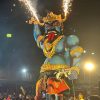 NARKASUR CELEBRATES BAHUJAN SAMAJ CREATIVITY!By Kaustubh Naik
 THE DIGITAL DIVIDE – BRIDGING THE GAP!By Arvind Pinto
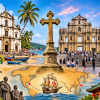 GOA AND MACAU: SHARED HERITAGE, DIFFERENT DESTINIES! By Dr RG Wiseman Pinto
 MUMBAI IS MORE HEALTH CONSCIOUS THAN GOA!
 MORTAL BY DAY, GODDESS BY NIGHT!By Prema Viswanathan
 MAMA MIA ‘UN-COLPO DI FULMINE’… A BOLT OF LIGHTNING!
 The Invisible Pandemic WHEN MEDICINES STOP WORKING Fight Anti-Microbial Resistance! By Dr Amit Dias
 WEEKEND UPDATES
 WHO’S DREAMING OF A BLUE WAVE IN GOA?What will it take? Asks PhD researcher and architect… Tahir F de Noronha
 FREEDOM OF SPEECH AND EXPRESSION! By Cleofato Almeida Coutinho
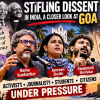 STIFFLING OF DISSENT
 AI HITS IT JOBS VERY HARD!