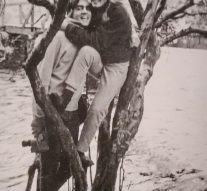
Photo taken by a friend of Sonia and Rajiv Gandhi embracing perched on a tree!
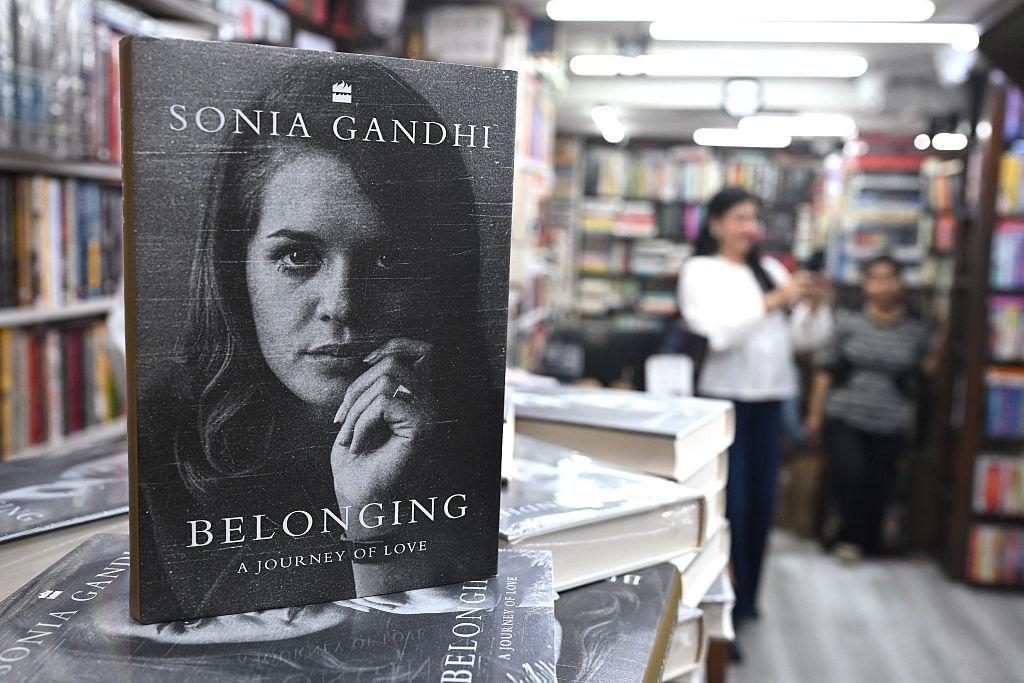
Sonia Gandhi’s memoir “Belonging— A Journey of Love” recasts Jayaprakash Narayan as an RSS instrument, portrays Maneka Gandhi as a family conspirator and presents Indira Gandhi’s political paranoia through the prism of assassination fears…
The central question is whether Belonging: A Journey of Love is simply Sonia Gandhi’s personal recollection of the Nehru-Gandhi family, or whether it also attempts to establish a retrospective political narrative in which the Congress family’s opponents are discredited, its internal challengers are demonised and the decisions of Indira and Rajiv Gandhi are explained sympathetically. There is a distinction between writing a memoir and writing history. A memoir is entitled to subjectivity. An author can describe how she felt, what she believed and how she interpreted events as a young member of a powerful political family. But when a memoir makes claims about the origins of a national movement, the political loyalties of a national leader, the motivations of a political rival or an alleged assassination conspiracy, it enters the territory of historical evidence. That is where Sonia Gandhi’s account deserves closer examination. Three episodes are particularly revealing:
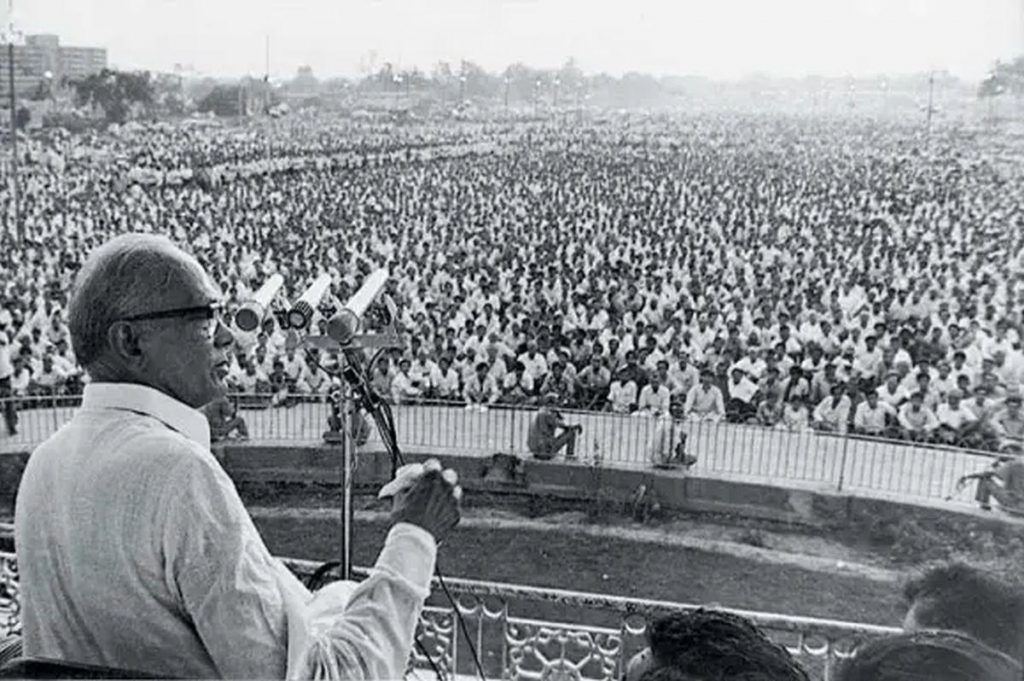
Jayaprakash Narayan: From the architect of Total Revolution to an alleged RSS creation The most consequential political interpretation in Sonia Gandhi’s account concerns Jayaprakash Narayan. JP was not an ordinary opposition politician. He was one of the most important figures in India’s freedom struggle and post-Independence socialist politics. He had a political pedigree that predated the emergence of the RSS as a significant national political force. His political journey is important because it contradicts any simplistic suggestion that he was manufactured by the RSS. JP’s credentials before the RSS entered the picture Born in 1902, JP became a prominent socialist during the freedom movement. He was a founding figure of the Congress Socialist Party in 1934 and participated in the Quit India movement of 1942. He was imprisoned by the British, escaped from captivity and became one of the most celebrated underground resistance leaders of the freedom struggle. After Independence, he continued to be an influential socialist intellectual and political activist. He declined ministerial office and eventually withdrew from conventional party politics to concentrate on Sarvodaya, social reform and Gandhian constructive work. A scholarly study by Rakesh Ankit in Studies in Indian Politics describes JP as a leading Congress socialist, an admirer of Jawaharlal Nehru and a prominent political figure long before the Bihar movement. This is the first important historical distinction. The RSS did not create JP. It entered a political movement that JP had initiated and was leading. The difference is fundamental. What actually happened in Bihar in 1974? The Bihar movement did not begin as an RSS operation. It emerged from student protests against corruption, inflation, unemployment, misgovernance and deteriorating educational conditions. Students approached JP, who had largely withdrawn from active electoral politics. He agreed to lead their agitation. On June 5, 1974, at Gandhi Maidan in Patna, he gave the movement its defining slogan: Sampoorna Kranti, or Total Revolution. His programme was not simply the replacement of Indira Gandhi’s government. He wanted a transformation of political institutions, public morality, administration and society. The movement subsequently attracted socialists, Gandhians, student organisations, trade unionists and political parties opposed to Congress rule. The Jana Sangh and RSS also became involved. That involvement is documented. It should not be denied or minimised. The ABVP, the RSS-affiliated student organisation, had an important organisational presence in the student movement. RSS volunteers provided cadres, mobilisation networks and organisational capacity. Research by Christophe Jaffrelot and Pratinav Anil, published in their work on the Emergency, demonstrates how the association with JP helped the RSS acquire wider political legitimacy. But this leads to a different historical conclusion from the one implied by the description of JP as an RSS creation. Who used whom? There are two competing interpretations. • The Congress interpretation: The RSS exploited JP’s moral authority and used the popular movement to gain respectability and political influence. • The JP interpretation: A national movement against corruption and authoritarianism needed the participation of every democratic organisation willing to join it, irrespective of ideological differences. JP believed that engagement with the RSS might moderate it and bring it into a wider democratic and non-communal political framework. Whether this was politically naïve is a legitimate question. It is not evidence that he was an RSS puppet. Indeed, an important historical study of the period records that JP’s association with the RSS gave the organisation political legitimacy, while the RSS provided organisational strength to the movement. There was mutual political advantage. The RSS gained access to a much wider national audience through JP’s standing. JP gained an organised network of volunteers. This was a political alliance of convenience, not proof of ideological subordination. The historical irony The RSS and Jana Sangh were among the organisations banned during the Emergency. Their activists were imprisoned alongside socialists, Gandhians and other opposition leaders. The Janata experiment of 1977 brought these different political streams together. JP was its moral and political inspiration. It is therefore misleading to rewrite the entire movement as an RSS project. Equally, it would be misleading to pretend that the RSS was merely an insignificant passenger. A serious historical assessment must acknowledge both. The more important question for Sonia Gandhi is why the memoir gives such prominence to the RSS connection while the independent political history of JP is much larger than that association. JP’s movement had its own causes: inflation, corruption, unemployment, public anger, the crisis of Congress legitimacy and, ultimately, the Emergency itself. These causes cannot be explained away by attributing the movement to the RSS. Was JP an opponent of secularism? This is another question requiring nuance. JP was a Gandhian socialist with a long association with secular and democratic politics. His willingness to cooperate with Hindu nationalist organisations generated genuine criticism, including from people within his own political tradition. But political cooperation is not the same as ideological conversion. The strongest criticism of JP is that his accommodation with the RSS helped legitimise an organisation whose ideological objectives were not necessarily compatible with his inclusive vision. That is a serious historical criticism. It is very different from suggesting that he was an RSS creation.
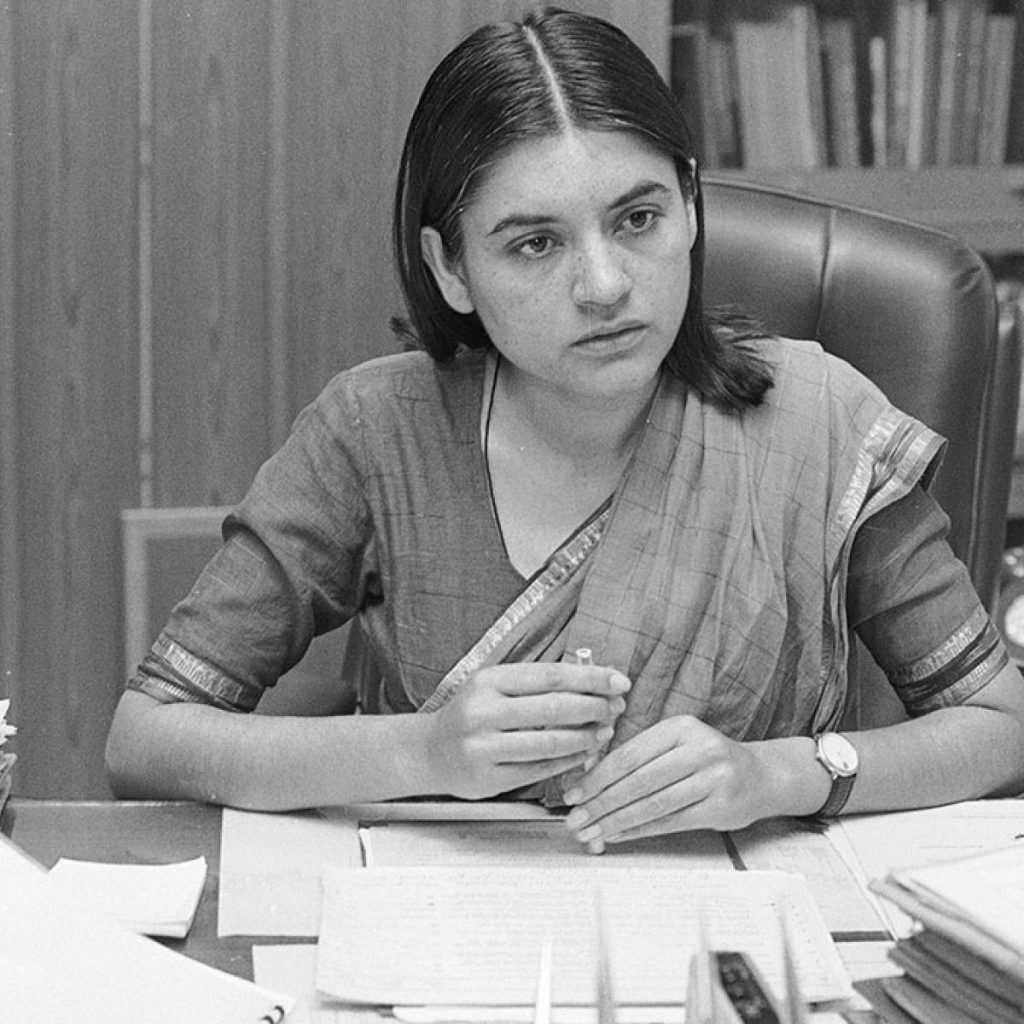
Maneka Gandhi, widow of Sanjay Gandhi and daughter-in-law of Indira Gandhi
Maneka Gandhi: Was a widowed daughter-in-law being politically eliminated? The Maneka episode is more personal, but its political implications are equally important. Sonia Gandhi’s account presents a family conflict in which Maneka’s ambitions, her association with people connected to the RSS and her conduct towards Indira Gandhi combine to explain her eventual departure from the Prime Minister’s residence. The account is particularly revealing because it is written from the perspective of a person who subsequently became the central figure in the Congress establishment. To understand the episode, one must go back to June 1980. The death of Sanjay Gandhi changed the succession equation Sanjay Gandhi died in an aircraft crash on June 23, 1980. He had become the most powerful political figure around Indira Gandhi during the Emergency. Although he held no constitutional office equivalent to that of Prime Minister, his influence over the Congress organisation, Youth Congress and administration was considerable. His political ambitions were well known. His widow, Maneka, was just 23 and had a young son, Varun. She was not simply a grieving daughter-in-law. She was also the widow of a politician who had developed his own political following. There was an obvious political question: what would happen to Sanjay’s supporters? Rajiv Gandhi, who had initially avoided politics and worked as a commercial pilot, began entering public life after his brother’s death. He contested the Amethi parliamentary by-election in 1981. That development changed the political balance within the family. Maneka’s political ambitions and Rajiv’s growing political prominence were increasingly difficult to reconcile. The Vasundhara Raje birthday party Sonia’s memoir makes much of Maneka’s decision to celebrate the first birthday of her son, Varun, at the residence of Vasundhara Raje. Raje belonged to the Scindia royal family and was associated with the Hindu nationalist political establishment. Sonia interprets this as a deliberate political affront to Indira Gandhi. She also connects the incident with the eventual sale of Maneka’s magazine, Surya, to people associated with the RSS. The implication is that Maneka was moving into a political camp opposed to her mother-in-law. The Print account of the memoir reproduces this interpretation and describes Sonia’s allegation that Maneka’s political sights lay elsewhere. But there are questions the memoir does not settle. Was the birthday party really a political declaration of allegiance? Was Maneka attempting to establish an independent political identity? Was she simply cultivating friends and political contacts who were willing to support her? A birthday celebration is not, by itself, evidence of a conspiracy. And a magazine’s sale to people with RSS affiliations does not establish that its former owner had become an ideological subordinate of the organisation. These are matters requiring corroboration. The real confrontation: March 1982 The departure of Maneka from the Prime Minister’s residence was not merely a private family disagreement. It was a public political event. Contemporary reports indicate that Indira Gandhi was angry about Maneka’s political activities, particularly her participation in a convention associated with Sanjay Gandhi’s supporters. The confrontation culminated in Maneka leaving the residence in March 1982. A contemporary UPI report dated March 30, 1982, records Maneka’s own account that she had been expelled because of her political activities. It also reports Indira’s objection to the convention as being against her and the Congress establishment. A contemporary New Yorker account in May 1983 described the wider political conflict, including Maneka’s attempts to mobilise Sanjay’s supporters and the difficulty she faced in establishing an independent political base. The Indian Express retrospective also records Maneka’s account that she had been given little time to leave and had a sick young child. These reports establish that the expulsion was closely connected with political rivalry. They do not establish every allegation made by either side. The question Sonia’s account does not adequately address Why was Maneka’s independent political ambition treated as a threat? There were two possible heirs to Sanjay’s political constituency: • His widow, who was closely associated with his political legacy. • His elder brother, Rajiv, who was being drawn into the Congress establishment. The political establishment ultimately rallied around Rajiv. Maneka was outside the succession arrangement. Her subsequent political trajectory confirms that she did not simply disappear from public life. She contested the 1984 general election against Rajiv Gandhi in Amethi, later joined the Janata Dal and eventually entered the BJP. She became an important political figure in her own right. It is therefore reasonable to ask whether Sonia’s recollection gives sufficient weight to the political dimensions of Maneka’s exclusion. Maneka’s political ambitions are presented as evidence of disloyalty, while Rajiv’s entry into politics is presented as a natural response to family tragedy and national responsibility. That asymmetry deserves scrutiny. It does not prove that Sonia deliberately engineered the expulsion. In fact, Sonia’s account says that she and Rajiv were not present during the confrontation itself. But the consequences were clear: Maneka was outside the family establishment, while Rajiv’s political career was moving forward.
Was Maneka really a vicious, conniving woman?
There is an important distinction between Maneka being politically ambitious and being personally malicious.
Sonia’s account repeatedly interprets Maneka’s conduct through the vocabulary of provocation, manipulation and disloyalty.
But the political circumstances were more complicated.
Maneka had married into one of India’s most powerful political families. Her husband was dead. His political constituency remained. Her mother-in-law was Prime Minister. Her brother-in-law was entering politics.
She was in a particularly vulnerable position, despite her proximity to power.
There is another consideration.
Indira Gandhi was not an ordinary mother-in-law. She was a political leader accustomed to exercising enormous authority over her household, party and government.
The family home was also the Prime Minister’s official residence. Private disagreements could easily become political confrontations.
Maneka’s subsequent political choices suggest that she wanted an independent career rather than simply remaining dependent on the Gandhi household.
One can criticise her political alliances, her rhetoric or her ambitions. But it is not historically responsible to convert these into proof of a malicious personality.
The Rajiv-Sonia-Maneka triangle
The most interesting question is the contrast between the treatment of the two daughters-in-law.
Sonia’s memoir presents Indira as a loving mother-in-law whose relationship with her was built on affection and mutual understanding.
Maneka is presented as someone who challenged Indira’s authority and attempted to exploit the memory of Sanjay.
It is entirely possible that the two women had very different relationships with Indira.
But there was also a major political difference.
Sonia was married to the son whom Indira eventually chose to enter politics. Maneka was married to the son who had been her political heir before his death.
This is the uncomfortable political context.
The family conflict cannot be understood simply as a clash between a virtuous daughter-in-law and a scheming one.
It was also a conflict over the ownership of Sanjay Gandhi’s political inheritance.
The subsequent denial of access to Varun was another dimension of the dispute. Sonia recalls the family’s legal efforts to secure visiting rights and the difficulties surrounding access to the child.
This was a deeply personal conflict, but it also involved the exercise of power within an exceptionally influential political family.
An important distinction
It would be equally unfair to assume that Rajiv and Sonia deliberately planned Maneka’s expulsion.
There is no evidence establishing such a conspiracy.
But a historian should ask whether Sonia’s account is sufficiently detached from the interests of the family whose political fortunes she later came to represent.
That is the appropriate test of the memoir.
Indira Gandhi’s fear of assassination: The Mujibur Rahman connection This is perhaps the most disturbing portion of the narrative because it takes us into the psychology of a Prime Minister who had concentrated extraordinary political authority in her hands. Sonia recalls the effect of the assassination of Bangladesh’s founding leader, Sheikh Mujibur Rahman, on Indira Gandhi. On August 15, 1975, Mujibur Rahman and most of his family were murdered in a military coup at his residence in Dhaka. The victims included his wife and three sons. His ten-year-old son Sheikh Russel was among those killed. The date was particularly shocking: India’s Independence Day. Mujib’s assassination was an extraordinary political crime. It was also a reminder that even powerful national leaders and their families could be vulnerable to sudden violence. Sonia’s memoir says that Indira Gandhi could not overlook the possibility of a similar fate for herself and her family. Was Indira’s fear understandable? Yes. Indira Gandhi had experienced political violence and had many powerful opponents. Her government had also intervened decisively in the affairs of Bangladesh during the 1971 liberation struggle. The assassination of Mujibur Rahman would naturally have been alarming to her. But there is a crucial distinction between a legitimate security concern and a political obsession with assassination plots. The former is an understandable response to a dangerous world. The latter can become an instrument through which ordinary political opposition is interpreted as a threat to national security. The question is whether Indira’s fear contributed to the increasingly authoritarian character of her government. The chronology matters The Emergency was proclaimed on June 25, 1975. Mujibur Rahman was assassinated on August 15, 1975. Therefore, the Bangladesh assassination cannot have been the original reason for imposing the Emergency. It happened nearly seven weeks afterwards. This is a critical historical distinction. The Emergency had already been imposed following the Allahabad High Court judgment against Indira Gandhi’s election, escalating opposition protests and the political crisis surrounding her government’s legitimacy. Sonia’s recollection may help explain Indira’s subsequent fears, but it cannot be used retrospectively to explain the original decision to impose the Emergency. The memoir must be read with this chronology firmly in mind.
The CIA assassination conspiracy: Evidence or political paranoia? Sonia’s account also recalls Indira Gandhi’s suspicion that powerful foreign interests might be involved in plans to assassinate her. The comparison with Mujibur Rahman’s assassination gives this fear a dramatic historical setting. There is, however, a difference between documenting Indira’s fear and establishing that the alleged conspiracy existed. These are two separate propositions. Was Indira Gandhi frightened of being assassinated? Sonia’s personal recollection is evidence of that fear. Was there an established CIA plan to assassinate Indira Gandhi and her family? That requires documentary evidence. I have not found credible, independently corroborated evidence establishing such a CIA assassination operation. The CIA’s own declassified historical records are relevant here, but they must be read carefully. One CIA document dealing with the Soviet propaganda campaign following Indira Gandhi’s assassination in 1984 describes how Radio Moscow accused the United States of involvement in the killing. It records the Soviet effort to connect the CIA with several assassinations of foreign leaders. This document is evidence of Cold War propaganda and mutual suspicion. It is not evidence of an actual CIA plot against Indira Gandhi. The Bangladesh comparison The assassination of Mujibur Rahman had international implications. Bangladesh was strategically important to India, and the change of regime in Dhaka affected the regional balance of power. The circumstances of the coup, the involvement of military officers and the international response deserve independent investigation. But one must not automatically move from the proposition that the CIA had interests in Bangladesh to the proposition that it planned to assassinate Indira Gandhi. The latter is a much stronger allegation. It requires evidence such as: • Declassified operational communications. • Identifiable intelligence personnel and intermediaries. • Financial or logistical records. • Independent testimony. • Corroboration from multiple documentary sources. Without these, the allegation remains unproven. Indira’s political insecurity There is a more significant political issue. Indira Gandhi’s government was facing an unprecedented domestic challenge. JP was mobilising opposition parties. Students were protesting. Trade unions were agitating. The railway strike of 1974 had demonstrated the capacity of organised labour to disrupt the country. The Congress establishment was under pressure. The Prime Minister was also facing a serious constitutional challenge following the Allahabad High Court judgment. It is important to ask whether Indira increasingly interpreted these political challenges through a security lens. Sonia’s account of assassination fears offers an intimate glimpse into the anxieties of the household. But it does not answer the larger question: how much did these fears influence the Prime Minister’s political decisions?
George Fernandes: From alleged conspirator to Defence Minister One of the more striking aspects of the Emergency narrative is Sonia’s recollection that Indira Gandhi suspected George Fernandes of being involved in a conspiracy to assassinate her. Fernandes was a trade union leader and a formidable opponent of Indira Gandhi. He had led the historic 1974 railway strike. During the Emergency, he went underground and became associated with the Baroda Dynamite Case. The authorities accused Fernandes and others of plotting to use explosives to destroy government installations and challenge the Emergency. He was arrested in 1976. The case became one of the most prominent examples of the government’s attempt to portray organised opposition as a threat to the state. There is an important distinction here. The Baroda Dynamite Case concerned an alleged conspiracy to sabotage government installations. It should not automatically be equated with a plot to assassinate Indira Gandhi. Sonia’s recollection of Indira’s suspicions needs to be distinguished from the actual charges and evidence in the case. Fernandes subsequently became Defence Minister in the Vajpayee government. That later development is politically significant. A man who had been regarded by Indira Gandhi’s government as a dangerous conspirator became a senior constitutional functionary in a democratically elected government. This does not establish that every allegation against him was false. It demonstrates how radically the political interpretation of opposition can change.
The Emergency: What Sonia’s memoir explains and what it leaves unexplained The Emergency remains the defining test of Indira Gandhi’s political legacy. On June 25, 1975, the President proclaimed the Emergency under Article 352. Civil liberties were severely curtailed. Opposition leaders were imprisoned. Press censorship was imposed. Political activity was restricted. The government justified its actions by invoking internal disorder and threats to national stability. The Shah Commission subsequently examined the abuses associated with the Emergency. Sonia’s account acknowledges the excesses but also provides explanations rooted in the anxieties of the Gandhi household. The concerns about Mujibur Rahman’s assassination, alleged threats from political opponents and the influence of Sanjay Gandhi become part of this narrative. But the central constitutional issue cannot be displaced by family recollections. Indira Gandhi was not merely a frightened individual protecting her family. She was the Prime Minister of a constitutional democracy. She had access to the machinery of government, intelligence services, the police and the armed forces. Her responsibility was to protect democratic institutions, even when confronted with formidable political opposition. The inconvenient question of Sanjay Gandhi Sonia’s memoir also attributes considerable responsibility for Emergency excesses to Sanjay Gandhi. His influence over the government and his Five-Point Programme, including coercive sterilisation drives and demolitions, are important parts of the historical record. This is another area where the family narrative deserves scrutiny. Sanjay was not Prime Minister. Yet he exercised considerable political influence. How was this possible? What was the role of the Prime Minister’s Office, the Congress organisation, the police and senior bureaucrats? How did an unelected political figure acquire such authority? These are questions that cannot be answered merely by attributing the excesses to Sanjay’s personality. The Emergency was a failure of institutions, not just a family tragedy.
Jayaprakash Narayan addressing a gathering.
8 . The ultimate question: Is Sonia Gandhi protecting a family legacy or interpreting India’s political history? There are two possible ways of reading Belonging. The first is as an intensely personal memoir by a woman who entered an extraordinary political family and subsequently suffered two devastating assassinations. The second is as a political narrative that seeks to defend the Nehru-Gandhi family’s historical position at a time when its legacy is increasingly contested. Both interpretations can be true. Sonia Gandhi is entitled to defend Indira Gandhi’s memory. She is entitled to describe her fears and her understanding of family disputes. But she cannot expect readers to accept her interpretation of JP, Maneka or the Emergency without examining independent evidence. The JP episode is especially revealing. The RSS unquestionably benefited from its association with JP. It gained political respectability and organisational opportunities. But JP’s movement had independent origins and a much broader social constituency. To describe him as an RSS creation would be historically untenable. The Maneka episode is similarly complicated. Her political ambitions were real. Her association with political opponents of Indira was also real. But that does not make her a villain. The succession struggle following Sanjay’s death is indispensable to understanding why the family relationship collapsed. And the assassination narrative requires the greatest caution. Indira’s fear following Mujibur Rahman’s murder was understandable. But an actual CIA plot to assassinate her and her family has not been established by the evidence presently available. Nor can fears about assassination retrospectively justify the imposition of the Emergency.
Conclusion: A memoir is not a substitute for history Sonia Gandhi’s Belonging is an important political document because it offers a window into the private world of one of India’s most powerful political dynasties. Its value should not be dismissed simply because its author belongs to the Congress establishment. But neither should its claims be accepted simply because they come from someone who witnessed events from inside the family. There is a danger in allowing the personal narrative of a political dynasty to become the accepted history of the country. Jayaprakash Narayan was not created by the RSS. He was a freedom fighter, socialist and Gandhian whose decision to work with the RSS remains a legitimate subject of historical criticism. Maneka Gandhi was not simply a grasping daughter-in-law. She was a young widow with political ambitions, caught in a succession struggle after the death of Sanjay Gandhi. Her expulsion was a political event as much as a family dispute. Indira Gandhi’s fear of assassination following Mujibur Rahman’s murder may have been genuine. But genuine fear does not establish the existence of a CIA assassination plot, nor does it excuse the destruction of democratic freedoms. The distinction between explaining a political leader’s behaviour and justifying it is fundamental. The greatest danger in political memoirs is not necessarily the deliberate invention of facts. It is the selective arrangement of facts to create a particular moral impression. In this case, the impression is that Indira and Rajiv Gandhi were victims of hostile forces, that their opponents were either manipulated by the RSS or driven by personal ambition, and that the family was repeatedly forced to defend itself. That is one perspective. It is not the whole history of India. The Emergency, JP’s movement, the Sanjay-Maneka-Rajiv succession conflict and Indira Gandhi’s political insecurities deserve to be examined as independent historical events, not merely as episodes in the emotional history of the Nehru-Gandhi family. The final verdict must come from documents, contemporary reporting, independent scholarship and testimony from all sides.

 LETTER TO THE EDITOR FOR ISSUE DATED NOVEMBER 28, 2026
 THE BEAUTY TRAP: MERCURY IN FAIRNESS CREAMS! By Our Special Correspondent
 57th IFFI 2026: IT’S BEEN A YEAR OF RECOGNITION FOR GOAN CINEMA! By Our Special Correspondent
 IFFI 2026 EATING OUT QUITE GRACIOUS!
 HUMILIATING PUNISHMENT IN SCHOOLS!
 WATER QUALITY: UNDERSTANDING DRINKING WATER CHEMISTRY! By Dr Amit Dias
 CONCRETE OVER CANOPY: Goa’s New FAR Rules Risk Regularising Yesterday’s Overreach! By Dr Olav Albuquerque & Deborah Cordeiro
 THE CONTRADICTIONS OF INDIAN CRONY CAPITALISM! By Arvind Pinto
 WEEKEND UPDATES
 LETTER TO THE EDITOR FOR THE ISSUE DATED NOVEMBER 21, 2026
 MY TRYST WITH CINEMA
 ‘AN OCCURRENCE AT OWL CREEK BRIDGE’ MOST OUTSTANDING SUSPENSE FILM
 THE GOAN WEALTH DIVIDE! By Our Special Correspondent
 THE GREAT GOAN PARADOX: CHANGES THAT WE DO NOT NOTICE! By Arvind Pinto
 BALAN NAMBIAR: RITUAL, NATURE & THE ALCHEMY OF FORM! By Prema Viswanathan