Goa is abuzz with excitement as vintage bike and car owners, users, collectors and fans are decking […]
Old is Gold
October 4, 2016

AS Goa commences its tourist season, policy planners, Goan tour operators as also the local businesses, are asking this common question: Goa receives huge visitor numbers, yet many local businesses complain that their incomes are incomes are falling. There could be many reasons for this. With the rise of all-inclusive resorts, patrons are ferried to and from airport to hotel to airport and the visitors barely move out of their hotels on independent sorties, except for site seeing.
With the growth of the online platforms, revenue that was received by hotels is first paid outside and only the amount contracted comes to the concerned resort in Goa. At times Goan hotels lose on such contracts. Over time, most of the hotel chains and big business in Goa, have links outside Goa. Tourists book hotel rooms or transport before they arrive in Goa. A part of this revenue does not reach Goa, since it is appropriated by commission and other discounts into the hands of those who bring tourists to Goa. During the hippie era of the ‘70s, local markets prospered, since these flower people, with little means bought from the traditional markets – the Friday Maupsa market, the fish market in Panjim or the Margoa market. Today’s tourists have neither time nor inclination for traditional markets, since most of their purchases are either online or the Kashmiri or non-Goan shops that line the way to the beach. Sadly Goan small gig businesses, like taxis, shacks and small hotels suffer from lack of custom, the traditional village economies are slowly dying since these wares do not interest the tourists of today. Tourism that is the mainstay of the Goan economy, no longer caters to the sustenance of the Goans.
Is Goa becoming too expensive for Goans and its budget tourists?
THIS is one question that many returnees ask when they come back to their native land. One of the common questions asked in the market is that the price of fish has gone so high that many cannot afford buying it any more. For the common answer is that the fish is picked up by the hotels and restaurants to feed their clients. The locals get to buy only what is left. Like fish, so it is with the prices at restaurants, or even the elite beach shacks, vegetables in the markets or shopping around Panjim, Margao and Vasco. Why are goods more expensive in Goa, that in places like Mumbai or Bangalore? The reasons are many – Goa is a tourist destination. Most goods come from out of the state. Most shopper are tourists who are willing to pay prices higher than the locals. Now over the decades, property prices have risen. Land prices in villages have also risen with outsiders willing to pay prices that the local cannot afford. This has given rise to the derogative term “bailo munis” for those coming to Goa from other states and who are willing to pay a higher price for both land and property in the Panjim, Margoa or Ponda. Today Goans are beginning to believe that they have become outsiders in their own land! Sad but true especially in terms of buying power! Before the ’60s with limited entrance into the state, Goa with its limited population was Goan. With the integration to the Indian state, Goa drew migrants from different parts of the country. Many old timers believe that their land has been bought by the Delhiwallah. Travel to beach fronts like Calangute or Baga and one will wonder whether this is Goa or some place in Delhi? The reach of the outsider has come to even the remote villages of Goa. Much of the labour is either from Andhra or Karnataka. The casinos at Panjim are operated by young employees from the North-east states, while the big business is operated by companies from Mumbai or Delhi.
Goan Villages
GOA it was said, lived in its villages. When Goans speak among themselves, the first question asked is, Which village are you from? The answer told you everything – in the bigger villages the name of the “vaddo” told you about the person, the lineage, the caste and the family. On returning to Goa, one went to one’s ancestral village, since it was there that family and kinsfolk lived. The eyes and ears of the village, knew everything – whose child has returned, what is happening in the houses in the village.
To give one illustration – on returning to my village and going to the market to buy fish – one of the elderly bai there talked to me and asked me “What do I have in my market bag?” Without much ado, she looked at the fish I bought. This familiarity is common in a village, where everyone knows everyone.
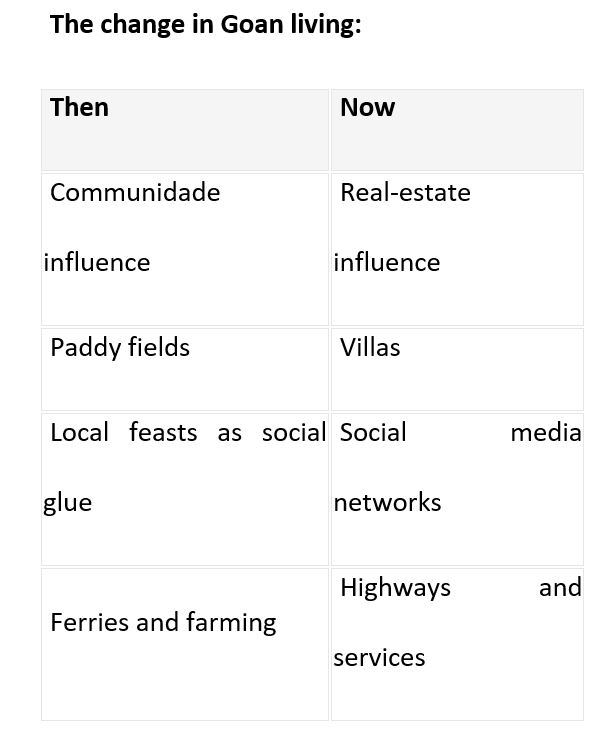
Sadly, today Goan villages are dying as our people move into flats and apartments in the urban towns turning rapidly into vertical cities of sorts, and the villages of Goa are slowly in a state of decay. Many call this development, but the Goan village life with its artisanal handicrafts, its local produce is slowly fading into history!
The coming water crisis nobody is talking about!
SEVERAL decades ago water in Goa was abundant. Being on the rainwater side of the Western Ghats, it is blessed with swift flowing rivers like the Mandovi, the Zuari and their various tributaries. Goa was blessed with water. In our villages, each family had their traditional well attached to the kitchen of their homes, together with a community well, that was often the place to meet and greet. Today the village wells are slowly drying up the vanishing of ground water.
Developing cities requires additional water but urban planners don’t think about this vital subject. Many of the come lately or newer complexes have to hire water tankers to give the new flats or apartments drinking water at the very least. Goan agriculture is slowly dying since our Khazan lands that were protected by a system of “bunds” and “manos” (sluice gates) to regulate the supply of water is in disrepair and local village authorities do not have either the initiative or the funds to maintain this infrastructure.
Goa is slowly becoming an example of “Water, water, water everywhere, but not a drop to drink.” Goan planners seriously need to look at the looming drought partially brought about by climate change, to ensure that water is adequately available to the growing population that has made Goa their home!
The New Gold Rush – Land
GOA was once known for its mining – coal was its gold that was extracted and exported, that brought wealth to the top Goan mining magnates, a limited prosperity to the workers, sufficient revenue to fill the coffers of the government. Today mining is all but dead. The recent lifting of the embargo on mining now realises that there is little demand for exports and with strict ecological laws in place, mining is no longer as remunerative as earlier. Today the gold is in land. Our cities have been expanding into the surrounding villages as the demand for real estate blooms. In many of our villages especially on the coastal belt, apartment towers look to the sky where once were palatial villas. Goa has is becoming an urban sprawl with governments opening what was agricultural lands into residential and commercial complexes. With Goa becoming an ideal investment plan for those who have spare money, real estate companies attempt to grab more land to put up buildings and complexes. Today property in Goa is the new gold for India’s noveau riche!
Come Goa winter months at year’s end the state becomes a festival and festive state for tourism. Although diminishing by the day, foreign tourists still come to Goa, during this season. Its scenic beaches, relatively cheap lodging and rich vibrant culture still attract tourists to come to relax here – away from the cold of their own counties. Goa has indeed over the decades changed. Would it still continue to draw tourists? Or would the increasing costs, the changing culture and the commercialization of this state make tourists search for a new destination to travel to!
(Arvind Pinto is the chairperson of Citizencredit Cooperative Bank Ltd, he also practises at National Company Law Tribunal and is retired chief commissioner.)
 BALAN NAMBIAR: RITUAL, NATURE & THE ALCHEMY OF FORM! By Prema Viswanathan
 You GUT to GET This Right for Your BRAIN Health! By Dr Amit Dias
 ARE CHILDREN IS UNSAFE IN SCHOOLS?
 GOA’S ONE DAY WINTER SESSION… Sparks debate over executive power and legislative scrutiny!By Dr Olav & Deborah Albuquerque
 WEEKEND UPDATES
 LETTER TO THE EDITOR FOR THE ISSUE DATED NOVEMBER 14, 2026
 `RAMAYANA’ TURNS `RAVAYANA’?
 THE 10-HEADED RAVANA: WHEN DEMOCRACY LOSES ITS MANY VOICES
 NARKASUR CELEBRATES BAHUJAN SAMAJ CREATIVITY!By Kaustubh Naik
 THE DIGITAL DIVIDE – BRIDGING THE GAP!By Arvind Pinto
 GOA AND MACAU: SHARED HERITAGE, DIFFERENT DESTINIES! By Dr RG Wiseman Pinto
 MUMBAI IS MORE HEALTH CONSCIOUS THAN GOA!
 MORTAL BY DAY, GODDESS BY NIGHT!By Prema Viswanathan
 MAMA MIA ‘UN-COLPO DI FULMINE’… A BOLT OF LIGHTNING!
 The Invisible Pandemic WHEN MEDICINES STOP WORKING Fight Anti-Microbial Resistance! By Dr Amit Dias
Goa is abuzz with excitement as vintage bike and car owners, users, collectors and fans are decking […]