Goa is abuzz with excitement as vintage bike and car owners, users, collectors and fans are decking […]
Old is Gold
October 4, 2016
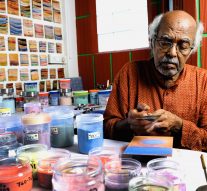
Balan Nambiar at work in his enamel studio. Photo by Namas Bhojani
SOMEWHERE behind the gleaming steel forms Balan Nambiar has created, a chenda is still beating in the dark. It is the drum heard in Kannapuram, in Kannur district of northern Keralam, where he was born on November 12, 1937. In the courtyard of his family home, a man painted in vermilion and crowned in palm and fire became a god.
Nambiar has since worked across several disciplines: painting, sculpture, enamelling, photography and scholarship. His massive sculptures occupy institutional and public spaces in India and abroad; his smaller enamel works find their way into the homes of individual and institutional collectors. He has written a book, published 23 research papers and built an extensive photographic record of ritual arts and cultural traditions of India’s west coast. Yet the story of his art begins in a landscape where nature and ritual were inseparable.
He grew up in a matrilineal farming household, amidst the abundance of the northern Keralam countryside. The family had its own shrine, and Theyyam arrived there each year in the last week of December. A performer, painted and costumed, became the deity, dancing through the night to the chenda, speaking in the god’s voice and blessing the waiting village.
WHAT stayed with the young Nambiar was the wholeness of the event. The performer was a choreographer, embodying the skills of a painter, costume-maker, singer, drummer and medium. Art was not divided into separate disciplines but gathered into a single, living presence. That sense of an art in which image, material, movement and belief converged would remain with him, even as his own practice moved into very different territory.
An Independent Course
NAMBIAR’S route to art was not direct. After training as a drawing teacher and teaching for a year, he moved to Madras in 1959 and took a draughtsman’s job with the Southern Railway, drawing signal equipment by day and painting in his spare hours. His encounter with KCS Paniker, then principal of the Government College of Arts & Crafts, proved decisive. Acknowledging his debt to Paniker, Nambiar entered the college in 1967, initially to study painting, before discovering sculpture through clay and becoming mesmerised by the possibilities of bronze casting and fabrication. A five-month internship in the metallurgy department of IIT Madras gave him experience in these fields.
At a time when many Indian artists looked West for inspiration, Paniker drew upon regional and local traditions, incorporating ancient scripts, mathematical signs, astrological symbols and calligraphy into his distinctive metaphysical style. His unique modern idiom created an artistic climate in which Nambiar could develop his own practice, even as he eventually chose an independent path.
The years in Madras coincided with the emergence of the Madras Movement and Cholamandal Artists’ Village. Nambiar designed the layout of the land for Cholamandal in 1965, but chose not to become part of the collective.
Scholar & Photographer
NAMBIAR’S engagement with ritual traditions developed over decades of looking, listening, photographing and writing. Theyyam was a central preoccupation, but his interests extended well beyond it: to Bhuta Kola in coastal Karnataka, Kathakali, Koodiyattam and other ritual arts and cultural practices. He documented not only the finished spectacle but also the knowledge, objects, gestures and people that sustain these traditions. Some 1,600 of his photographs have been acquired by the Indira Gandhi National Centre for the Arts, forming a significant visual record of practices often transmitted orally and through performance.
His writing has been equally pathbreaking. He undertook an early comparative study of Theyyam and Bhuta Kola; his essay “Gods and Ghosts” appeared in Marg in 1982. Through his writings, essays and lectures, Nambiar has pursued the documentation and interpretation of ritual and traditional arts.
Nature, Mathematics & Metal
WHEN I meet Nambiar, he draws my attention to the extraordinary mathematical precision embedded in the structures of nature. The spiralling geometry of a shell, the intricate architecture of a bird’s nest, the proportions that recur in organic forms — he sees in them not merely patterns to be admired, but evidence of an underlying order.
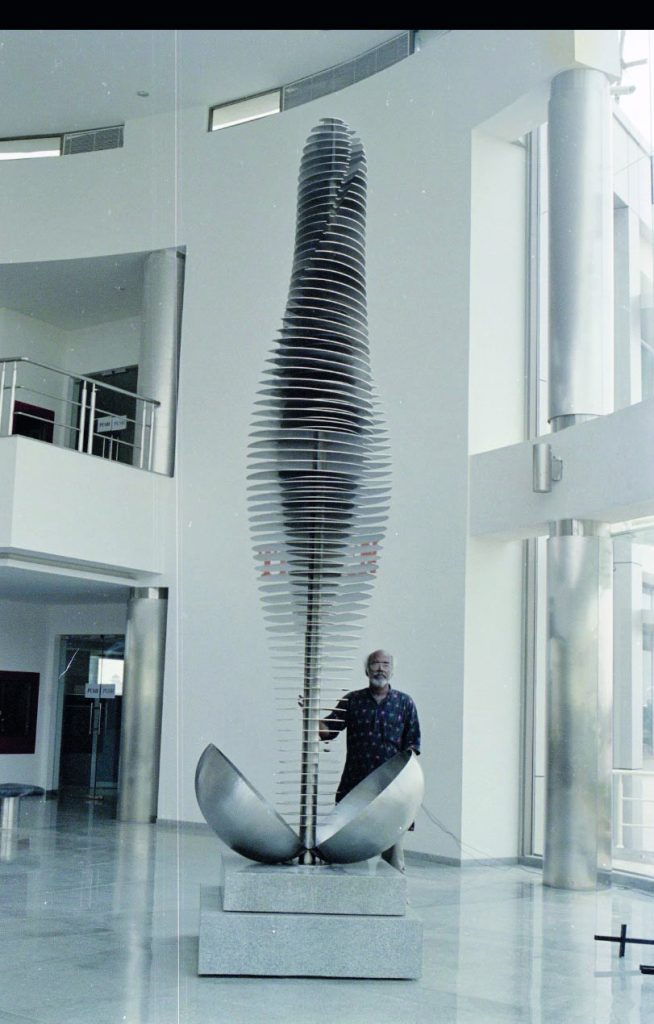
The Tree sculptures and The Nest, both made in stainless steel, draw on the natural world; the latter takes its inspiration from the weaver bird’s nest. Close observation becomes an exercise in abstraction, proportion and engineering. Here, the alchemy of form lies in the meeting of an artist’s eye with the precision of science.
Other sculptures begin with objects and signs encountered in ritual. The Kalasa-thara altars of Theyyam, with their ordered grids of wicks, find an echo in stainless-steel lattices. The the burnished mirror idols used in shrines reappear in the Kannadi Bimbam series. The coiling patterns of Nagamandala floor drawings inform Unending Loop, while a knot of darbha grass associated with rites for the dead becomes a monumental form. Valampiri Shankha, the 2.4-metre right-handed conch, originally commissioned by Texas Instruments and now installed at the Indian Institute of Science in Bengaluru, brings together a ritual object, mathematical proportion and a commission concerned with digital sound.
EXPLAINING the origins of some of these works, Nambiar says: “Valampiri Shankha, Kannadi Bimbam and Unending Loop, for instance, were based on ritual objects. These were executed in stainless steel.” But he is careful to distinguish inspiration from replication: “I deliberately avoided replicating the objects.”
Some of his works, he explains, draw instead on mathematical principles such as the golden ratio, Fibonacci sequences and the logarithmic spiral.
The scale of many of these sculptures is striking. Conceived to inhabit and transform public space, they call for an exacting command of materials and engineering. Nambiar’s process moves from sketch and drawing to computer-generated design, then through laser cutting and lathe finishing, TIG welding, grinding, polishing and assembly. Stainless steel, mild steel, stone and glassfibre-reinforced cement offer different possibilities. These materials, he explains, allow him to explore the immense possibilities of executing creative works, many of them monumental. The technical demands do not diminish the imaginative impulse; they are part of how it is realized
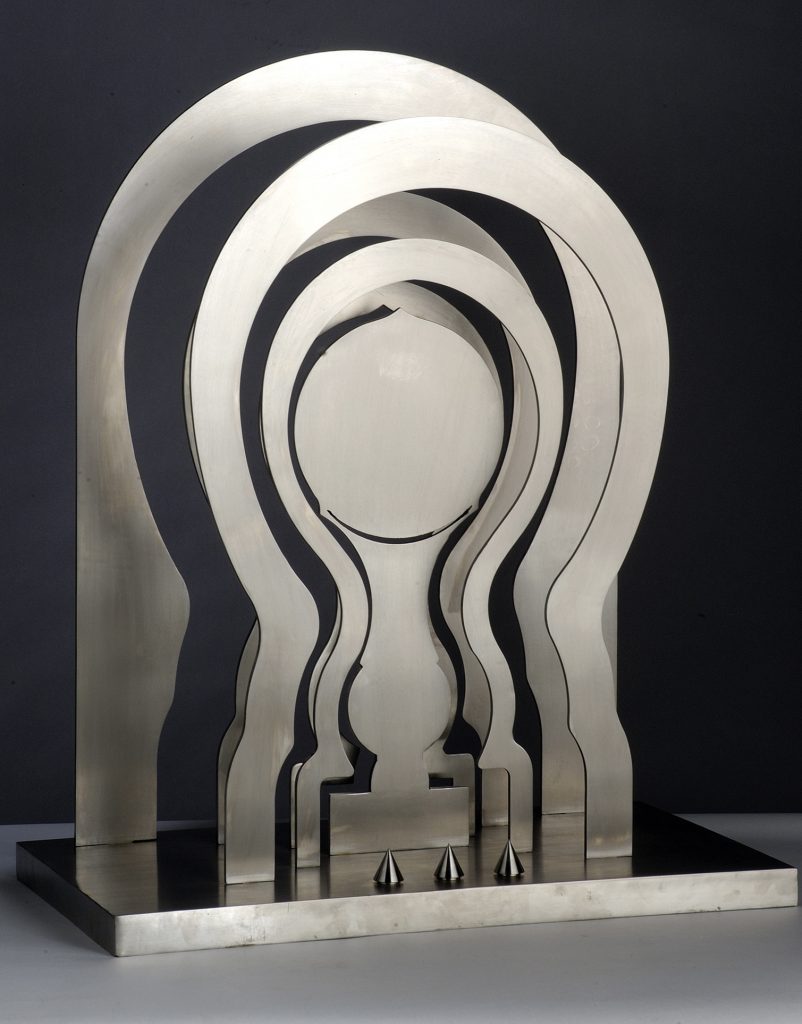
Ritual is only one strand of a much wider practice. Nambiar points to works such as Trajectory of Planets, Sky is the Limit, the Cactus series, 3D Spiral and Solar Spectrum as examples of sculptures that have no connection with ritual symbols. “My creative works related to rituals are not many,” he stresses. His sculpture draws on a range of visual, mathematical and natural phenomena.
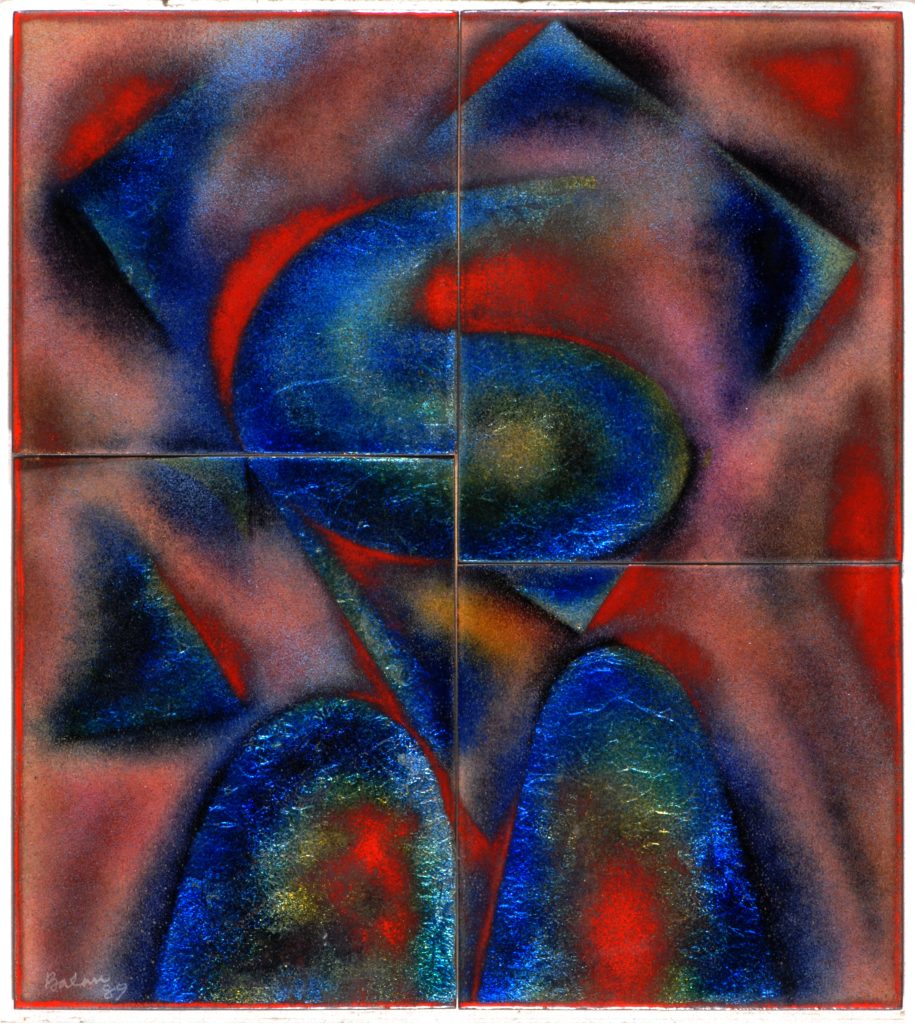
At the other end of the scale are his enamel works. Most are relatively small, intimate objects, their surfaces alive with colour and detail, and many are acquired by individual and institutional collectors.
Nambiar learnt the possibilities of the medium from his father-in-law, the Italian artist Paolo De Poli. The contrast is compelling: from the intimacy of enamel to the ambition of monumental steel, the same restless intelligence moves between the miniature and the massive.
His wife Evelina, an Italian nuclear physicist, is now helping him document his archives. The partnership seems fitting in a life where artistic intuition and scientific enquiry repeatedly meet.
A Difficult Inheritance
THE movement of ritual forms into modern sculpture raises questions as well as possibilities. Theyyam is sustained by hereditary communities, many historically marginalised, whose bodies and knowledge carry the ritual. Nambiar has approached these traditions as an attentive observer and interpreter, and his work has helped bring their visual forms to audiences far beyond Keralam. At the same time, the question of whose voices shape public understanding of these practices cannot be set aside. He has spoken of his empathy for the communities that have safeguarded this cultural heritage and of his awareness of the inequities that inform ritual arts.
There is also a transformation in the passage from shrine to public space. A polished steel abstraction may retain the geometry of an altar or mirror, but it cannot contain the heat of the ritual, its trance, sound or intimate exchange between performer and community. Nambiar does not claim that it can. “My works do not seek to replicate ritual art forms. They are only a source of inspiration for my creative impulse.”
Many of his largest sculptures have been commissioned by institutions and corporations. Such commissions make possible works on a scale few individual collectors could support, but they also place the artist’s language in spaces shaped by institutional priorities. Nambiar acknowledges the importance of patronage, while insisting on artistic autonomy. Once discussions are complete and a design has been finalised, he says, “I do not entertain any interference from the sponsor during the execution of the sculpture.” It is another expression of the independence that has marked his career.
Nambiar’s work cannot be reduced to Theyyam, or even to ritual. It ranges across nature, mathematics, material experiment and the visual memory of many traditions. His photographs and writings preserve what he has spent a lifetime observing; his sculptures release these forms into new lives of their own.
AND so, the journey comes full circle. The drumbeat that sounded in the courtyard at Kannapuram has never quite fallen silent. Its rhythm has travelled through decades of looking and listening, through the measured turn of a logarithmic spiral, the curve of a conch, the intricate lattices and loops of steel. Beneath the precision of mathematics and the patient labour of the craftsman, the old rhythm endures. The chenda still beats in the dark.
 THE GREAT GOAN PARADOX: CHANGES THAT WE DO NOT NOTICE! By Arvind Pinto
 You GUT to GET This Right for Your BRAIN Health! By Dr Amit Dias
 ARE CHILDREN IS UNSAFE IN SCHOOLS?
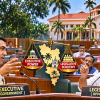 GOA’S ONE DAY WINTER SESSION… Sparks debate over executive power and legislative scrutiny!By Dr Olav & Deborah Albuquerque
 WEEKEND UPDATES
 LETTER TO THE EDITOR FOR THE ISSUE DATED NOVEMBER 14, 2026
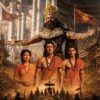 `RAMAYANA’ TURNS `RAVAYANA’?
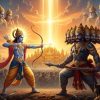 THE 10-HEADED RAVANA: WHEN DEMOCRACY LOSES ITS MANY VOICES
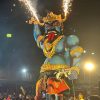 NARKASUR CELEBRATES BAHUJAN SAMAJ CREATIVITY!By Kaustubh Naik
 THE DIGITAL DIVIDE – BRIDGING THE GAP!By Arvind Pinto
 GOA AND MACAU: SHARED HERITAGE, DIFFERENT DESTINIES! By Dr RG Wiseman Pinto
 MUMBAI IS MORE HEALTH CONSCIOUS THAN GOA!
 MORTAL BY DAY, GODDESS BY NIGHT!By Prema Viswanathan
 MAMA MIA ‘UN-COLPO DI FULMINE’… A BOLT OF LIGHTNING!
 The Invisible Pandemic WHEN MEDICINES STOP WORKING Fight Anti-Microbial Resistance! By Dr Amit Dias
Goa is abuzz with excitement as vintage bike and car owners, users, collectors and fans are decking […]