Robert Enrico, János Vadász and their Indian counterparts:
From experimental cinema to the birth of parallel cinema
The history of the international short film in the 1960s becomes particularly interesting when placed alongside the emergence of India’s parallel cinema movement.
There was a remarkable convergence of cinematic ideas across France, Hungary, Czechoslovakia, Yugoslavia, Britain, Cuba and India. Filmmakers were questioning the conventional grammar of cinema. They were experimenting with time, memory, photography, sound, music, social reality and the relationship between images and ideas.
Two films provide an excellent starting point:
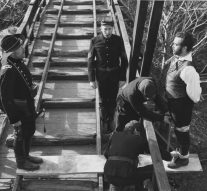
• Robert Enrico’s An Occurrence at Owl Creek Bridge (1961).
• János Vadász’s Overture (Nyitány, 1965).
Their Indian parallels are not necessarily direct adaptations or documented influences. They are films that explore similar cinematic possibilities.
The larger argument is that India’s parallel cinema did not emerge in isolation. It belonged to an international movement seeking to liberate cinema from commercial storytelling.
- Enrico and the Indian exploration of subjective time
Enrico’s film: An Occurrence at Owl Creek Bridge
A man sentenced to death imagines an elaborate escape during the final seconds of his life. The audience experiences the imagined escape as reality, only to discover that the entire adventure has taken place in the dying man’s consciousness.
The manipulation of time is the film’s greatest achievement.
The Indian parallel: Mani Kaul’s Uski Roti (1969).
Mani Kaul’s debut feature, produced by the Film Finance Corporation, broke with conventional narrative filmmaking.
The film follows a woman waiting by the roadside for her husband, a bus driver. But the waiting itself becomes the subject. Time is stretched, fragmented and experienced psychologically rather than through conventional dramatic action.
There is also an important connection with Kumar Shahani’s Maya Darpan (1972), in which architecture, silence, duration and interior consciousness become more important than conventional plot.
The difference is revealing:
• Enrico uses a psychological illusion to manipulate time.
• Kaul uses cinematic duration to make us experience time.
• Shahani uses space and composition to express the interior life of individuals.
All three challenge the assumption that cinema must follow the clock. - Vadász and the Indian experimental short-film revolution
Vadász’s Overture (1965) is particularly important because it demonstrates that a short film can be an independent work of art without relying on actors, dialogue or conventional narrative.
Nine minutes of time-lapse photography compress 21 days of embryonic development into a visual symphony, accompanied by Beethoven.
The Indian equivalent is not one single film but an extraordinary body of experimental work produced by the Films Division of India during the late 1960s and early 1970s.
Pramod Pati: India’s avant-garde pioneer
Pramod Pati deserves a much larger place in the history of Indian cinema.
His films included:
• Explorer (1968): an experimental exploration of cinematic images and movement.
• Claxplosion (1968): a very short, highly experimental work.
• Abid (1970): another important example of his experimental approach.
Pati was associated with the Films Division’s willingness to encourage unconventional cinematic forms. His work anticipated many of the techniques later associated with experimental video and digital art.
The comparison with Vadász is revealing. Vadász uses scientific photography and music to turn biological development into cinema. Pati uses manipulation, animation, montage and abstraction to turn cinema itself into an experimental object.
This is an important Indian parallel that deserves greater international recognition.
S.N.S. Sastry and the documentary as an experiment
Another important filmmaker was S.N.S. Sastry.
His I Am 20 (1967) explored the aspirations and anxieties of young Indians who had been born around Independence.
Rather than presenting a conventional official account of national achievement, it allowed young citizens to speak about their lives, expectations and frustrations.
This was a different form of cinematic experimentation: instead of compressing biological time, as Vadász did, Sastry examined the passage of historical and generational time.
Other significant Films Division works included:
• Thoughts in a Museum (1968), directed by S. Sukhdev.
• And I Make Short Films (1968), directed by S.N.S. Sastry.
• And the Stars Look On (1968), directed by Omprakash Mehra.
The Films Division programme Ministry of Light: Experimental State-Sponsored Films from India, 1968–1975, presented by Northwestern University’s Block Museum, is a useful rediscovery of this neglected tradition.
An important historical point: the Indian government was not simply sponsoring propaganda. Within Films Division, certain filmmakers were using the very institution of state-sponsored documentary production to question official ways of seeing India. - Chris Marker and the Indian exploration of memory
Another international masterpiece was La Jetée (1962), by Chris Marker.
Constructed almost entirely from still photographs, it is a story about memory, time travel, war and the persistence of an image in the human mind.
It is one of the most radical experiments in cinematic storytelling.
There are interesting Indian parallels.
Mani Kaul’s Duvidha (1973) uses folk narrative, stillness and an unusual treatment of time to explore desire, identity and the supernatural.
Kumar Shahani’s Maya Darpan (1972) uses architecture, silence and carefully composed images to create a cinematic experience in which psychological and social tensions matter more than plot.
These are not copies of Marker. They are part of a larger international questioning of the relationship between photographic images, memory and narrative. - Mrinal Sen and the political possibilities of montage
Mrinal Sen brought another dimension to experimental cinema: political intervention.
His Bhuvan Shome (1969) is often regarded as one of the starting points of the Indian New Wave.
It tells the story of an authoritarian railway official whose encounter with a village woman transforms his perspective. But its importance lies equally in its film language.
Freeze frames, animation, voice-over, abrupt editing and comic juxtaposition create a very different cinematic experience.
Sen subsequently pushed these experiments further in:
• Interview (1971), a satire on class, employment and urban aspiration.
• Calcutta 71 (1972), an examination of poverty, inequality and political unrest.
• Padatik (1973), exploring political commitment and the dilemmas of revolutionary activism.
The relationship with Santiago Álvarez’s Cuban political short films is particularly interesting. Both filmmakers understood that montage could be an instrument of political argument.
The difference is that Sen increasingly employed the feature film to construct a political collage of contemporary Indian society. - Satyajit Ray and Ritwik Ghatak: The Indian foundations
It would be historically incorrect to suggest that Indian alternative cinema began only in 1969.
Ray and Ghatak had already established a distinctive Indian art-cinema tradition in the 1950s.
Ray’s Pather Panchali (1955) demonstrated that Indian cinema could achieve international recognition through humanism, realism and extraordinary visual sensitivity.
His Kanchenjungha (1962) experimented with narrative structure, simultaneous stories and the unity of time and place.
Ghatak’s Meghe Dhaka Tara (1960) and Subarnarekha (1965) used melodrama, sound, music and montage to express the trauma of Partition and displacement.
Ghatak’s influence on the younger generation was particularly important. He taught at the Film Institute of India in Pune and influenced Mani Kaul and Kumar Shahani.
The younger filmmakers would go much further in dismantling conventional narrative structures, but they were building upon foundations already laid by Ray and Ghatak. - The watershed year: 1969 and the Indian New Wave
Three films are particularly associated with the emergence of the Indian New Wave:
Film Bhuvan Shome (1969)— Director Mrinal Sen– Distinguishing contribution Satire, montage and experimentation
Film Uski Roti (1969)— Director Mani Kaul— Distinguishing contribution Time, space and psychological duration
Film Sara Akash (1969)— Director Basu Chatterjee— Distinguishing contribution Middle-class domestic realism
Kantilal Rathod’s Gujarati film Kanku (1969) is another important contemporary landmark.
The Film Finance Corporation, established in 1960, was crucial in financing low-budget, unconventional cinema. The Film Institute in Pune also provided a generation of technically trained and intellectually adventurous filmmakers.
This institutional support was one of the distinguishing features of the Indian movement. - The international parallels: A comparative map
Here is how the major traditions fit together.
(International film / filmmaker) Enrico – Owl Creek Bridge,
(Indian parallel) Mani Kaul – Uski Roti, (Shared cinematic concern) Subjective time
(International film / filmmaker) Chris Marker – La Jetée
(Indian parallel) Kaul – Duvidha
(Shared cinematic concern) Memory and non-linear storytelling
(International film / filmmaker) Vadász – Overture
(Indian parallel) Pramod Pati’s experimental shorts
(Shared cinematic concern) Image, movement and time
(International film / filmmaker) Santiago Álvarez
(Indian parallel) Mrinal Sen – Calcutta 71
(Shared cinematic concern) Political montage
(International film / filmmaker) European experimental documentary
(Indian parallel) S.N.S. Sastry – I Am 20 (Shared cinematic concern) Documentary as social inquiry
(International film / filmmaker) European modernist cinema
(Indian parallel) Kumar Shahani – Maya Darpan
(Shared cinematic concern) Space, silence and duration
These are aesthetic comparisons, not claims of direct borrowing. The filmmakers often arrived at similar solutions through different cultural and intellectual traditions. - The forgotten role of Films Division
I would particularly emphasise Films Division in any serious history of this period.
It had a contradictory role. On one hand, it was the government’s documentary production and publicity apparatus. On the other, it provided employment, equipment, institutional resources and exhibition opportunities to experimental filmmakers.
Under the influence of Jean Bhownagary, experimental filmmaking received encouragement from within this state structure.
Pramod Pati, S.N.S. Sastry and S. Sukhdev became important contributors to a tradition that has not received the historical recognition it deserves.
This is a fascinating subject in itself: how an official state institution could inadvertently become a laboratory for radical film language. - The International Film Festival of India connection
There is another dimension worth investigating: the relationship between international film festivals, film societies and the development of Indian alternative cinema.
Cannes, Venice and other European festivals provided international visibility to experimental short films. Indian filmmakers and critics also encountered alternative cinematic traditions through festival screenings, retrospectives and film-society networks.
IFFI’s history in India provides an important avenue for examining how these cinematic ideas reached Indian audiences.
I would not assume that a particular short film was screened at a particular IFFI edition without checking the original programmes and catalogues. Those archives could yield some fascinating discoveries. - The larger argument: Why the short film deserves rediscovery
The short film was not merely a stepping stone towards feature filmmaking.
It was a laboratory.
It allowed filmmakers to experiment without the commercial pressures of a full-length production. It provided opportunities to explore subjects that mainstream producers might reject.
Consider the extraordinary range:
• Enrico explored the last seconds of human consciousness.
• Vadász transformed embryonic development into a symphony.
• Chris Marker converted still photographs into a science-fiction narrative.
• Pramod Pati explored abstraction and the possibilities of the cinematic image.
• S.N.S. Sastry used documentary filmmaking to interrogate the aspirations of a new generation.
• Mrinal Sen turned editing into political commentary.
• Mani Kaul challenged the very notion of cinematic time.
The common thread was the liberation of cinema from conventional storytelling.
And this is where the Indian parallel cinema movement belongs in international film history.
It was not simply a reaction against commercial Hindi cinema. It was part of a worldwide intellectual movement that questioned what cinema could be.
A research direction I would strongly recommend Proposed historical study
The Other Cinema: International Experimental Short Films and the Indian Parallel Cinema Movement, 1955–1975
One final observation: I think the most neglected part of this history is not even the feature-film movement. It is the experimental work of Pramod Pati and his contemporaries at Films Division. Internationally, Overture is remembered as a masterpiece. India produced comparable experiments, but we have not given them anything like the same sustained international recognition.
That is an important piece of film history waiting to be recovered.
 LETTER TO THE EDITOR FOR THE ISSUE DATED NOVEMBER 21, 2026
 MY TRYST WITH CINEMA
 THE GOAN WEALTH DIVIDE! By Our Special Correspondent
 THE GREAT GOAN PARADOX: CHANGES THAT WE DO NOT NOTICE! By Arvind Pinto
 BALAN NAMBIAR: RITUAL, NATURE & THE ALCHEMY OF FORM! By Prema Viswanathan
 You GUT to GET This Right for Your BRAIN Health! By Dr Amit Dias
 ARE CHILDREN IS UNSAFE IN SCHOOLS?
 GOA’S ONE DAY WINTER SESSION… Sparks debate over executive power and legislative scrutiny!By Dr Olav & Deborah Albuquerque
 WEEKEND UPDATES
 LETTER TO THE EDITOR FOR THE ISSUE DATED NOVEMBER 14, 2026
 `RAMAYANA’ TURNS `RAVAYANA’?
 THE 10-HEADED RAVANA: WHEN DEMOCRACY LOSES ITS MANY VOICES
 NARKASUR CELEBRATES BAHUJAN SAMAJ CREATIVITY!By Kaustubh Naik
 THE DIGITAL DIVIDE – BRIDGING THE GAP!By Arvind Pinto
 GOA AND MACAU: SHARED HERITAGE, DIFFERENT DESTINIES! By Dr RG Wiseman Pinto