Goa is abuzz with excitement as vintage bike and car owners, users, collectors and fans are decking […]
Old is Gold
October 4, 2016
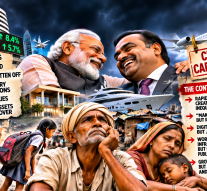
ONE of the central contradictions of modern capitalism in India today is the reality that the rich are getting richer and the poor find themselves becoming poorer. Just look around you and the stark reality is a part of our daily lives. While the rich live in tall towers and drive the latest cars, the poor crowd in sprawling slums and labour to make ends meet. India today is an interesting example of crony capitalism. Let’s look at how this works in India.
What is crony capitalism? It is an economic system where the success of business depends not only on efficiency, innovation of competition but on one’s proximity to the political masters of the day. It is such business groups that enjoy privileged access to contracts, licenses, land, natural resources, regulatory concessions, or government policy unavailable to others. Thus, businesses expand and grow not in terms of their own dynamics but because of their proximity to the power of the day. Is this the economic growth in India?
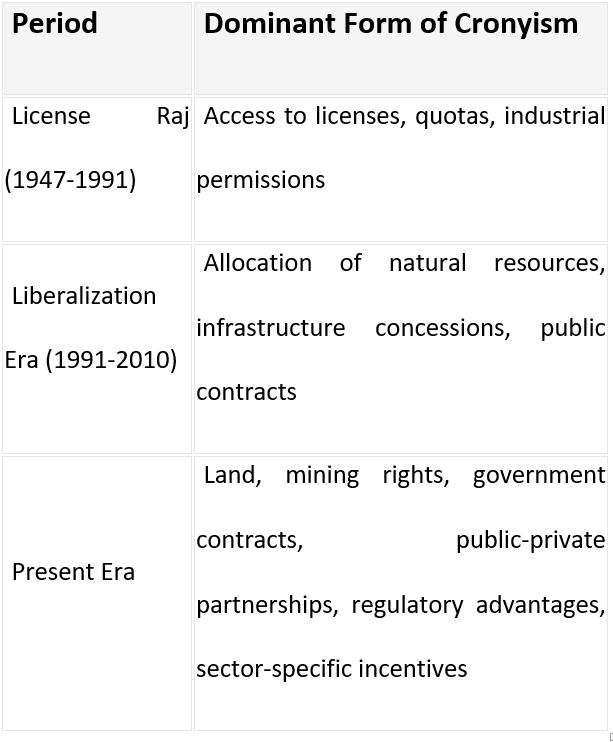
India has historically been vulnerable to cronyism for several reasons. Since Independence, the state has been and continues to be the driver of economic activity. While all land and mineral resources are state property, individuals or corporates require government leases to be able to exploit any of the nation’s mineral resources. This fact created the system of licensing – allowing government to decide quotas and to which of the business groups these licenses be given. Immediately after independence the country followed a socialistic policy, where the State controlled most of the major economic activity. This was the beginning of state crony capital build up since one had to obtain a licence for any project of importance. This continued until the ‘90’s when government realised that it needed to open the economy to ensure rapid economic development. The opening up of the economy in the ‘90s did ensure the growth of private capital but the allocation of natural resources, infrastructure concessions and public contracts still vested with government. In today’s era, several other areas that were the privilege of governmental agencies are now being open to private players, one recent example is the space sector and telecommunications. But in most of the bigger ventures, government has the final say. As, economic freedom expands the freedoms of speech, the right to dissent or congregate to espouse a cause are being whittled down.
India’s economic story over the past decades has been remarkable. While authentic figures are hard to come by, it is said, millions have been lifted out of poverty, World Bank June 2025 figures state that 269 million Indians have been lifted above the poverty line and extreme poverty rate has fallen from 27.1 % to 5.3% ; world-class companies have emerged, infrastructure has expanded, and Indian entrepreneurs now compete on a global stage. Yet beneath this success lies a question that is being asked with increasing frequency: why do corporate profits seem to be rising while wages, especially for ordinary workers, struggle to keep pace?
This is crony capitalism — a system in which proximity to political power becomes as important as entrepreneurial ability. Others argue that the charge is often overused and unfairly dismisses genuine business achievement. The truth, as is often the case, lies somewhere between the extremes.
At its core, capitalism works best when success is determined by competition, innovation, efficiency, and consumer choice. Crony capitalism, by contrast, occurs when access to government contracts, land, licenses, regulatory advantages, or political connections provides an edge that competitors cannot easily match. The concern is not that government and business interact. Modern economies require such interaction. The concern arises when those relationships distort competition.
India is hardly unique in facing this challenge. Every major economy wrestles with the tension between markets and influence. The United States has powerful lobby groups. Europe has long-standing industrial champions. East Asian economies often involve close coordination between government and large business houses. The real issue is therefore not whether influence exists, but whether institutions are strong enough to ensure a level playing field.
Supporters of India’s current economic model point to achievements that are difficult to ignore. Highways, airports, digital infrastructure, manufacturing incentives, and renewable energy projects require enormous investments and long-term vision. Large corporations often possess the scale and capital necessary to undertake such projects. Many of India’s leading companies have grown because they executed effectively, took risks, and delivered results.
Yet critics raise an equally important concern. When economic power becomes concentrated among a small number of players, competition may weaken. Smaller businesses can find it harder to access finance, government contracts, or market opportunities. Over time, concentrated market power can allow profits to grow even when wage growth remains subdued. Today the Ambani group and their flagship company Reliance has a market capital of 30.3 lakh crore, while the Adani group controls a capital of 16.8 lakh crore. Or take their economic spread: Adani controls 27% of the port cargo, 23% of air passengers, 24% of the private coal capacity, 16% of our cement capacity, together with a sizeable amount of the energy infrastructure. On the other hand Reliance controls 45% of the mobile revenue, 26% off the refining capacity together with their traditional textile trade. While it is true that there are other corporates in the fray, the phenomenal growth of these groups given their provenance to the state of our two political poles speak volumes for the ascendancy in the recent past.
This brings us to a paradox that affects ordinary citizens. Businesses depend on consumers. If wages stagnate while profits rise, households have less purchasing power. When people spend less, demand for goods and services weakens. An economy can sustain this imbalance for some time through credit, government spending, or exports. But eventually, broad-based prosperity requires broad-based purchasing power.
Henry Ford famously understood this principle when he paid workers enough to become customers of the products they manufactured. Workers are not merely a cost of production. They are the foundation of consumption.
The debate is particularly relevant in places such as Goa. Tourism revenues may rise, luxury hotels may flourish, and property values may surge. Yet if local families struggle with rising housing costs, stagnant incomes, and declining affordability, prosperity can begin to feel distant. The economy may look healthy from the top while a growing number of residents feel excluded from its gains.
This is why discussions about crony capitalism should not become ideological exercises. The choice before India is not between capitalism and socialism. That argument was settled long ago. The real choice is between competitive capitalism and connected capitalism.
Competitive capitalism rewards innovation, efficiency, and enterprise. Connected capitalism risks concentrating opportunity in the hands of those with access and influence. A healthy economy requires that success remain contestable, that regulations be transparent, and that institutions treat large and small players alike.
India’s next stage of development will depend not merely on creating wealth but on ensuring that wealth creation remains open, competitive, and capable of raising living standards across society. Rising profits are not a problem in themselves. The question is whether rising profits are accompanied by rising wages, expanding opportunity, and growing consumer prosperity.
ULTIMATELY, the measure of economic success is not how wealthy a few corporations become, but how widely the benefits of growth are shared. That is the debate India should be having. As we look for an inclusive economic growth, can crony capitalism be the solution?
(Arvind Pinto is the chairperson of citizencredit Cooperative Bank Ltd, he also practises at National Company Law Tribunal and is retired chief commissioner)
 HUMILIATING PUNISHMENT IN SCHOOLS!
 WATER QUALITY: UNDERSTANDING DRINKING WATER CHEMISTRY! By Dr Amit Dias
 CONCRETE OVER CANOPY: Goa’s New FAR Rules Risk Regularising Yesterday’s Overreach! By Dr Olav Albuquerque & Deborah Cordeiro
 WEEKEND UPDATES
 LETTER TO THE EDITOR FOR THE ISSUE DATED NOVEMBER 21, 2026
 MY TRYST WITH CINEMA
 ‘AN OCCURRENCE AT OWL CREEK BRIDGE’ MOST OUTSTANDING SUSPENSE FILM
 THE GOAN WEALTH DIVIDE! By Our Special Correspondent
 THE GREAT GOAN PARADOX: CHANGES THAT WE DO NOT NOTICE! By Arvind Pinto
 BALAN NAMBIAR: RITUAL, NATURE & THE ALCHEMY OF FORM! By Prema Viswanathan
 You GUT to GET This Right for Your BRAIN Health! By Dr Amit Dias
 ARE CHILDREN IS UNSAFE IN SCHOOLS?
 GOA’S ONE DAY WINTER SESSION… Sparks debate over executive power and legislative scrutiny!By Dr Olav & Deborah Albuquerque
 WEEKEND UPDATES
 LETTER TO THE EDITOR FOR THE ISSUE DATED NOVEMBER 14, 2026
Goa is abuzz with excitement as vintage bike and car owners, users, collectors and fans are decking […]