Goa is abuzz with excitement as vintage bike and car owners, users, collectors and fans are decking […]
Old is Gold
October 4, 2016
YOU do not need three-and-a-half hours or more to tell a good story. The most memorable film that I have seen is Robert Enrico’s “An Occurrence at Owl Creek Bridge” made in 1961. The film lasted all of an extremely suspenseful 28 minutes. The film opens with a man on a scaffold about to be hung to death. The film is set during the American Civil War some 300 years ago. The film opens with a civilian, Peyton, about to be hanged by the soldiers opposed to slavery in the United States. As he is dropped the rope apparently breaks and our hero plunges into the river, frees himself and escapes the gun fire of the soldiers. He swims through dangerous waters, struggles through a forest and eventually reaches his home. His wife comes running towards him. They are about to embrace….
In the 28th minute of the film comes the devastating revelation. He had never escaped. The entire journey home was a fantasy experience in the final moments of his life. At the end of the film he is still hanging from the bridge.
I SAW this film along with friends at the Film & Television Institute in Pune. In the early 70s when I got interested in cinema, a group of us would take a sharing taxi to the film institute in Pune. Book a room with Film Institute of India with friends like Arun Khopkar and Naseerudin Shah. You could watch any film you wanted from the vast archives for a normal amount. The archives were created by RD Nair, a legend. We watched the best of cinema from “Battleship Potomkin” to “The Motorcycle Diaries” of Che Guevera. Watching films back-to-back at the FTII auditorium and of course fiercely debating the films back in the room over army canteen Old Monk rum.
Then my tryst with cinema also began watching the films of Satyajit Ray and Mrinal Sen at the Tarabai Hall at New Marine Lines in Mumbai. My interest in cinema deepened when “The Financial Express” made me its film critic at the impressionable age of 24 years. Those were the days when the Film Finance Corporation, now called the National Film Development Corporation, which was started courtesy Gerson da Cunha, the ad man who was very close to the then Information & Broadcasting Minister IK Gujral.
The first CEO of the Film Finance Co-operation was Anil Dharker. Along with me and those who were part of the Left movement were very angry about the films financed by Anil Dharker. The corporation then in the 70s leaned towards esoteric art films like Mani Kaul’s “Duvidha.” I strongly believe that the FFC should finance the middle of the ground thematic commercial films like the “Namak Haram” made by Rishikesh Mukherjee.
THEORY & FANTASY
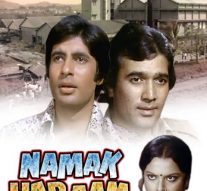
THE theory then was that even commercial Hindi films which related with the working classes were an escape into fantasy. To prove my point I organized a screening of “Namak Haram” at the Shanmanugam Hall in Matunga in what was then Bombay. The film was about the conflict between a textile mill owner played by Amitabh Bachchan and the Union led by Rajesh Khana. In association with the Tata Institute of Social Sciences we invited blue collar labor to see the film. After the film a questionnaire was conducted to find out if the audience only admired the stars or understood the theme of the film too?
Despite the presence of Amitabh Bachchan and Rajesh Khanna the working class viewers focused on the theme and not the stars. I wrote a 5,000 word essay quoting extensively from the survey. It was published in the “Screen Weekly” on November 17, 1974. It was called, Parallel Cinema. On the basis of this article I was invited to participate in a seminar on parallel cinema at the first competitive International Film Festival held in Delhi in 1975.
THIS was the first time I was visiting the national capital of Delhi. It was in winter and freezing cold. The opening film was “Godfather.” On the second day there was a seminar on parallel cinema where all the leading new wave film makers were present. Ironically, the keynote speaker was RG Sippy from commercial cinema. Sippy started his speech by insisting that “films were randi ka pesh” (prostitution business). All the eminent film makers led by Mrinal Sen and Ritwik Ghatak walked out. We had a parallel cinema on the lawns of the Vigyan Bhavan which was the venue for the festival.
I presented my paper on parallel cinema. Subsequently, David Robinson, the film critic of the London “Sunday Times” published it in his paper.
Bikram Singh, who was then the senior assistant editor in “Filmfare,” invited me to be part of the jury for the Filmfare Critics Award along with Dilip Padgaonkar, the then resident editor of “The Times of India.” Dilip Padgaonkar was a graduate of the Sorbonne University in Paris, France, which was seeing its own new wave in cinema. Over a 10-day period we watched 20 odd films in the plush Liberty Cinema preview theatre. Dilip Padgaonkar was obsessed with Mani Kaul’s “Suvidha,” an esoteric folk tale in brilliant color where a woman had a symbolic extramarital affair. It was beyond the comprehension of any common film viewer.
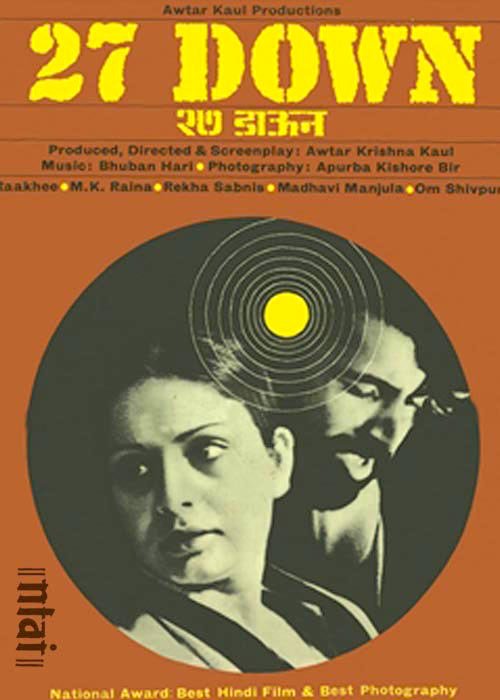
I opted for the classic “27 Down” which was a film by Aftar Kaul. The film was about the monotonous everyday life of a suburban working man in Bombay who took the local train 27 Down. The dullness in his life is broken when he meets a young, attractive, modern woman fellow commuter. The main proponent contrasts her with his wife back home in rural Bihar chewing the cud like a buffalo. The film resonated with the thousands of migrants who took the local train to work while their families were back in the villages.
Padgaonkar prevailed and the Critic’s Award went to “Duvidha” — Mani Kaul’s film. I was so angry that I wrote a column in “The Financial Express” condemning the choice. Dilip Padgaonkar in an edit page article in the TOI called me a young Judas at the feet of Indian cinema.
I worked with “The Financial Express” for eight years between 1968 and 1975. All the Indian publications including “Screen,” the film weekly broadsheet, occupied a large hall of the first floor adjacent to the “Financial Express” news desk. It was headed by the Ali Peter John, who started his life in cinema as a private secretary of to the filmmaker KA Abbas. Ali was present during Amitabh Bachchan’s first meeting with Abbas for auditioning for his first film “Saat Hindustani” – on the subject of Goa’s Liberation. All the film stars ranging from Dharmendra to Hema Malini to Amitabh Bachchan used to pass our desk to be interviewed by Ali Peter John. We had a rule that nobody should ogle the stars as we were journalists.
IN Goa I renewed my connection with the International Film Festival of India when Manohar Parrikar convinced Sushma Swaraj, the Union Information Minister, to shift IFFI from New Delhi to Goa. Atal Behari Vajpayee was the prime minister. Parrikar had only around four months to create the infrastructure for IFFI. The old Panjim market was demolished to make way for the INOX multiplex. The INOX multiplex was promoted by Indian Oxygen, a Gujarat-based company. Incidentally, it is still owned by the Entertainment Society of Goa and is only leased out to INOX.
The inaugural ceremony of the first IFFI was held at the Kala Academy which was renovated at a cost of Rs100 crore. Among the renovation was the creation of a jetty at the Kala Academy which is on the Mandovi riverfront. This was to enable delegates staying at the Taj Holiday Village to access the Kala Academy by taking the speed boats. The jetty was not ready on time and the IFFI film celebrities travelled by the CHOGM road.
Parrikar had a parallel entertainment festival at the National Institution of Sports grounds at Caranzalen for the aam janta. This venue was controlled by a close associate of Manohar Parrikar, the oncologist Dr Shekar Salkar. Dr Shekar Salkar had treated Manohar Parrikar’s wife who died early of cancer. The first CEO of the Entertainment Society of Goa was Sanjit Rodrigues who had been sent to the Cannes and Venice film festivals to learn how to conduct IFFI in Goa. The traditional chief minister’s farewell party was held on the then newly inaugurated bridge which linked Tiswadi to the Calangute and Candolim beach belt. Regrettably we missed it although we were invited.
COINCIDENTALLY, the preparation for IFFI started during the first year of the publication of the “Goan Observer” which was launched on November 15, 2003. We were witness both to the preparations for IFFI and the actual IFFI held from November 23 to December 3, 2004. It was later preponed to November 20 to 28 to avoid a clash with the St Xavier’s Feast at Old Goa. The year 2004 also marked the Decennial Exposition of St Francis Xavier.
 LETTER TO THE EDITOR FOR THE ISSUE DATED NOVEMBER 21, 2026
 ‘AN OCCURRENCE AT OWL CREEK BRIDGE’ MOST OUTSTANDING SUSPENSE FILM
 THE GOAN WEALTH DIVIDE! By Our Special Correspondent
 THE GREAT GOAN PARADOX: CHANGES THAT WE DO NOT NOTICE! By Arvind Pinto
 BALAN NAMBIAR: RITUAL, NATURE & THE ALCHEMY OF FORM! By Prema Viswanathan
 You GUT to GET This Right for Your BRAIN Health! By Dr Amit Dias
 ARE CHILDREN IS UNSAFE IN SCHOOLS?
 GOA’S ONE DAY WINTER SESSION… Sparks debate over executive power and legislative scrutiny!By Dr Olav & Deborah Albuquerque
 WEEKEND UPDATES
 LETTER TO THE EDITOR FOR THE ISSUE DATED NOVEMBER 14, 2026
 `RAMAYANA’ TURNS `RAVAYANA’?
 THE 10-HEADED RAVANA: WHEN DEMOCRACY LOSES ITS MANY VOICES
 NARKASUR CELEBRATES BAHUJAN SAMAJ CREATIVITY!By Kaustubh Naik
 THE DIGITAL DIVIDE – BRIDGING THE GAP!By Arvind Pinto
 GOA AND MACAU: SHARED HERITAGE, DIFFERENT DESTINIES! By Dr RG Wiseman Pinto
Goa is abuzz with excitement as vintage bike and car owners, users, collectors and fans are decking […]