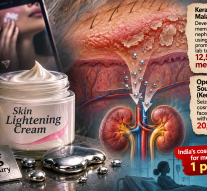
How a pursuit of fair skin can poison the body, damage kidneys and destroy the skin it promises to beautify
A teenager in Kerala has become the latest victim of a disturbing beauty industry scandal. A cream advertised through Instagram as a remedy for pimples, pigmentation and dark spots reportedly contained mercury at 12,500 parts per million. The permitted limit in Indian cosmetics is less than 1 ppm.
That is not a marginal violation. It is an extraordinary concentration of a toxic heavy metal in a product intended to be rubbed into the skin.
The case raises questions that go well beyond one manufacturer: Who tests the cosmetics sold online? How are influencers promoting products they may never have scientifically evaluated? Why does the Indian beauty market continue to exploit colour prejudice? And where is the accountability when a teenager suffers organ damage after following a beauty advertisement?
There is another important dimension: mercury does not merely affect the skin. It can enter the bloodstream and damage organs, particularly the kidneys and nervous system.
- Operation Soundarya: Kerala’s crackdown on the cosmetics trade
The Kerala government’s Operation Soundarya is particularly important because it demonstrates that the teenager’s experience may not be an isolated incident.
The operation, conducted by the Kerala Drugs Control Department, targeted counterfeit and unauthorised cosmetics, including skin-whitening creams and lipsticks.
The findings were alarming:
• Face creams seized from the market included Faiza and Goree.
• Laboratory tests reportedly detected mercury levels reaching 20,000 ppm.
• The permitted limit for ordinary finished cosmetics is 1 ppm.
• Cosmetics worth approximately Rs 9.64 lakh were seized in the reported operation.
• Products were allegedly being sold without proper purchase documentation and regulatory compliance.
The department collected samples for testing and initiated action to withdraw unsafe products and pursue those responsible.
This is a significant finding. It suggests that the problem is not simply one manufacturer making one dangerous cream. There is a wider distribution and enforcement problem involving unlicensed manufacture, imports, retail outlets and online marketing.
Operation Soundarya also raises a question: why should consumers have to wait for a medical emergency before discovering that a cosmetic product contains a dangerous chemical? - The Kerala teenager: From Instagram advertisement to kidney disease
The teenager from Areekode in Malappuram district was reportedly 17 when she began using the cream. Some subsequent reports describe her as 18.
Her story is particularly disturbing because she was not initially looking for an extreme skin-whitening treatment. She wanted relief from pimples, dark spots and pigmentation.
She came across the product through Instagram promotions and influencer recommendations.
The cream was advertised as a product containing natural ingredients. She was reportedly advised to apply it regularly, including overnight.
She began using it in August 2025 and continued for nearly a year.
The initial attraction was the promise of improved complexion. But the consequences were very different.
The symptoms
Her health gradually deteriorated.
She experienced:
• Swelling in her legs and other parts of her body.
• Sudden drops in blood pressure.
• Fainting episodes.
• Difficulty standing and walking.
• Problems associated with excessive protein loss through urine.
• Reported memory and concentration difficulties.
She was eventually admitted to Aster MIMS Mother Hospital in the Malappuram region.
Doctors diagnosed membranous nephropathy, a serious kidney disorder.
Investigations detected unusually high mercury levels in her body. When doctors examined the cream, laboratory testing reportedly found 12,500 ppm of mercury, equivalent to 1.25% of the product’s weight.
The Indian permissible limit for ordinary finished cosmetics is less than 1 ppm.
The concentration was therefore 12,500 times the permitted level.
The teenager’s family has sought accountability from the manufacturer and seller. Kerala police subsequently registered a case, according to reports dated November 23.
The Kerala State Commission for Protection of Child Rights has also taken up the matter and sought explanations from several authorities.
The critical issue: a product sold as a beauty treatment allegedly contained a concentration of mercury that would be unacceptable in a properly regulated cosmetic.
- Why manufacturers put mercury in fairness creams
Mercury is a heavy metal. It has no legitimate role as an active skin-lightening ingredient in ordinary consumer cosmetics.
Yet it has historically been used in some skin-whitening products because mercury compounds can interfere with the production of melanin.
Melanin is the pigment responsible for the colour of human skin.
The mechanism is particularly important.
Melanin is produced by specialised cells called melanocytes. The pigment helps protect the skin against ultraviolet radiation.
Some mercury compounds interfere with the biological processes involved in melanin production.
The result can be a lighter-looking complexion.
This apparent improvement is precisely what makes mercury-containing products dangerous commercially. Consumers may interpret a rapid change in complexion as proof that the product works.
But the process is not a healthy form of skin rejuvenation.
It interferes with a natural protective mechanism.
What happens to the skin?
Excessive mercury exposure can produce several dermatological problems:
- Irritation and inflammation: The skin may develop redness, irritation and rashes.
- Discolouration: Skin pigmentation can become uneven or abnormal.
- Damage to the skin barrier: Repeated exposure can aggravate irritation and compromise normal skin function.
- Increased sensitivity: Damaged or irritated skin may become more vulnerable to other cosmetic ingredients and environmental exposure.
- Secondary infection: Severe irritation and damage can increase the risk of complications, particularly where the skin barrier is broken.
There is another paradox. A cream marketed as a means of improving complexion can eventually leave the user with abnormal pigmentation and visible skin damage.
However, it is important to distinguish direct mercury-related skin injury from the more serious internal poisoning that may occur through repeated exposure.
The most dangerous effects are not necessarily visible on the face. - How mercury travels from the skin to the kidneys
The skin is not an impermeable wall.
Certain mercury compounds can penetrate the skin and enter the bloodstream. Repeated application increases the opportunity for exposure and accumulation.
Once absorbed, mercury can affect several organ systems.
The kidneys are particularly vulnerable because they filter blood and can accumulate certain forms of mercury.
The Kerala teenager’s diagnosis illustrates this mechanism.
Understanding membranous nephropathy
The kidneys contain millions of microscopic filtering structures called glomeruli.
Their job is to remove waste products from the bloodstream while retaining essential proteins.
When the glomerular filtration barrier becomes damaged, proteins such as albumin escape into the urine.
This condition can produce nephrotic syndrome.
Symptoms include:
• Swelling of the feet, legs and face.
• Foamy urine caused by protein loss.
• Reduced blood albumin.
• Fluid retention.
• In some cases, complications affecting kidney function.
Membranous nephropathy can have several causes, including autoimmune disorders, infections, medicines and toxic exposures.
Mercury exposure is a recognised potential cause of secondary membranous nephropathy.
In severe or prolonged cases, kidney damage can become chronic and may progress to kidney failure.
The teenager’s doctors linked her condition to the mercury-containing cream after investigating her exposure and testing the product.
Thiruvananthapuram News – The Indian Express+1
This is an important medical distinction: a person can be suffering from serious internal poisoning without having any obvious external evidence of it. - The danger extends beyond the kidneys
Mercury toxicity is not confined to dermatology or nephrology.
The nervous system is another important target.
Depending on the chemical form, dose and duration of exposure, mercury can cause:
• Tremors.
• Tingling and numbness.
• Headaches.
• Memory and concentration problems.
• Mood changes.
• Impaired coordination.
• Neurological injury.
The digestive and immune systems can also be affected.
The US Food and Drug Administration warns that repeated application of mercury-containing skin-lightening products can lead to absorption into the bloodstream and potentially serious, sometimes permanent, health consequences.
Children and adolescents deserve particular protection. They should not be exposed to untested cosmetic products simply because an influencer claims that a cream is natural or effective\ - This is not the first case: Kerala’s earlier medical warning
One of the most disturbing aspects of the current controversy is that the medical community has encountered similar cases before.
A 2022 paper in the Indian Journal of Dermatology, titled Beautification Gone Awry: Membranous Glomerulonephritis Following Use of Skin Lightening Cream Containing Mercury, documented a 47-year-old woman who developed membranous nephropathy after using a skin-lightening cream.
She had applied the cream to her face and forearms for approximately two years.
She subsequently developed swelling in her feet. A kidney biopsy confirmed membranous nephropathy.
Chemical analysis of the cream found mercury at 7,590 mg/kg, or 7,590 ppm.
The cream had reportedly been recommended by a local chemist.
This is a particularly revealing case because it demonstrates that the problem predates the current Instagram-driven cosmetics market.
There is further evidence of a wider pattern.
According to the nephrologist cited in the November 2026 Indian Express investigation, one hospital in Kerala recorded 13 similar cases between 2021 and 2023.
These patients had purchased creams through both conventional retail channels and online platforms.
In other words, the medical warning was already available. The question is why the cosmetics market continued to expose consumers to the same danger. - The chemistry of deception: What does 12,500 ppm actually mean?
The numbers deserve closer examination.
Mercury concentration —Meaning
Indian permissible limit for ordinary cosmetics — 1 ppm
Kerala teenager’s cream— 12,500 ppm
Some products seized under Operation Soundarya— Up to 20,000 ppm
Earlier cream in published medical case— 7,590 ppm
At 12,500 ppm, mercury constitutes approximately 1.25% of the product.
At 20,000 ppm, it constitutes 2%.
These are extraordinary quantities for a substance that should not be deliberately incorporated into ordinary skin-whitening cosmetics.
The difference between the legal limit and the detected concentrations is so large that it cannot reasonably be dismissed as an insignificant manufacturing variation. - The regulatory loophole: Who is policing online cosmetics?
India has a regulatory framework for cosmetics.
The Cosmetics Rules, 2020, prescribe safety and labelling requirements. The permissible level of unintentional mercury in ordinary finished cosmetics, other than products intended exclusively for the eye area, is 1 ppm.
The eye-area exception is 70 ppm under the relevant provisions.
The rules also establish responsibilities for manufacturers, importers and licensing authorities.
Yet the Kerala case demonstrates the gap between having regulations and enforcing them.
Consider the journey of an online cosmetic product: - A manufacturer produces a cream.
- A seller distributes it through social media or an online marketplace.
- An influencer promotes its supposed benefits.
- A consumer places an order through a WhatsApp number or online link.
- The product reaches the consumer, potentially without meaningful independent safety verification.
At which point is the product chemically tested?
Who verifies the manufacturing licence?
Who checks whether the declared ingredients match the actual composition?
And who is responsible if the product causes serious injury?
These questions are particularly important when a product has incomplete labelling or is imported through informal channels.
The marketplace accountability problem
An online marketplace may claim that it merely provides a platform for third-party sellers.
An influencer may claim that they were paid to promote a product and are not responsible for its manufacture.
The manufacturer may claim that its product is safe.
The consumer is left trying to establish where responsibility lies.
The Kerala teenager’s experience makes this accountability chain an urgent subject for investigation.
The government must examine not just the product but its entire commercial journey.
- Influencers: The new, unregulated cosmetic sales force?
The Kerala case also exposes a significant change in the way cosmetics are marketed.
Traditional advertising relied on newspapers, magazines, television and retail outlets.
Today, the beauty industry has a powerful additional channel: social media influencers.
Their commercial advantage is that they appear to be ordinary consumers sharing personal experiences.
A teenager watching an influencer demonstrate a cream may not distinguish between:
• An independent product review.
• A paid advertisement.
• An affiliate marketing arrangement.
• A scientifically tested medical claim.
• An unsupported claim made by a seller.
The teenager reportedly discovered the cream through influencer promotions on Instagram.
The packaging reportedly described natural ingredients, including turmeric, without adequately disclosing the mercury identified by subsequent laboratory testing.
The family has complained about the product and its marketing. The girl has also reportedly avoided publicly naming individual influencers while pursuing accountability.
The responsibility of influencers
There is a strong case for requiring influencers to establish basic product credentials before promoting cosmetics that make medical or skin-treatment claims.
A paid partnership disclosure is not enough.
An influencer promoting a cream that claims to remove pigmentation should be able to establish:
• Who manufactures the product?
• Is the manufacturer licensed?
• Are the ingredients properly declared?
• Has the product undergone appropriate safety testing?
• Are claims about its effectiveness scientifically supported?
Influencers are increasingly becoming an informal sales force for products that would otherwise struggle to obtain mainstream retail credibility.
That commercial power should carry responsibility. - The colour prejudice behind the fairness industry
The mercury scandal cannot be understood purely as a chemical safety issue.
It is also a social and commercial issue.
India has a long history of associating lighter skin with beauty, marriageability, status and social advancement.
The cosmetics industry has capitalised on this prejudice.
For decades, advertisements suggested that fairer skin could improve a person’s professional prospects, romantic relationships and social acceptance.
Even when companies changed the terminology from fairness to glow, radiance or brightening, the underlying aspiration often remained the same.
The message to consumers was that their natural complexion needed improvement.
The result is a huge market for creams promising rapid changes in skin tone.
This is particularly troubling for adolescents.
Teenagers already experience intense social pressure over appearance, acne, pigmentation and perceived attractiveness. Social media intensifies these insecurities by presenting carefully edited images and apparently effortless beauty transformations.
A product promising a lighter complexion and clear skin can appear irresistible.
But there is a fundamental difference between treating a medical skin condition and suppressing the body’s natural pigmentation to satisfy a social preference.
Melanin is not dirt. Dark skin is not a medical disorder.
A healthy complexion does not require chemical bleaching. - The business of imported and counterfeit cosmetics
Operation Soundarya raises another important question: the origin of the products.
Kerala authorities reportedly found high mercury concentrations in some imported face creams, including products identified as Faiza and Goree.
The November 2026 reporting also describes concerns about products entering the Indian market without proper licensing and documentation.
This is not proof that every imported cosmetic is dangerous. Nor should a product’s country of origin be treated as evidence of contamination.
The real issue is traceability.
Every cosmetic entering India should have an identifiable manufacturer, importer, declared formulation and appropriate regulatory documentation.
If a product is being sold without these safeguards, the consumer has no reliable way of establishing its safety.
Authorities should investigate:
• Import documentation and customs declarations.
• Whether products have valid registrations and licences where required.
• Whether the manufacturer and importer can be identified.
• Whether laboratory tests are independently conducted.
• Whether the same formulation is being sold under different brand names.
• Whether seized products have reappeared under new packaging.
This last question is especially important. Seizing one batch does not dismantle a distribution network.
- What should consumers do?
Consumers should be cautious about products promising dramatic skin-lightening results.
A few practical precautions are essential.
Examine the packaging. Look for the manufacturer’s full name and address, batch number, manufacturing licence details, ingredient list and expiry information.
Avoid products with unclear origins. A cream sold through an anonymous social-media account or WhatsApp number, with no reliable manufacturer information, is a serious warning sign.
Be sceptical of instant results. Rapid and dramatic whitening claims should invite questions, not enthusiasm.
Do not assume natural means safe. Turmeric, herbal extracts and other natural ingredients do not establish that a finished product is safe.
Do not rely on influencers for medical advice. Acne, pigmentation and other skin conditions should be assessed by qualified dermatologists.
Stop using a suspicious product. Anyone concerned about mercury exposure should seek medical assessment rather than trying to treat the problem with another cosmetic product.
If there is a history of prolonged use of a suspected mercury-containing cream, a doctor may consider appropriate blood or urine mercury testing and assess kidney function.
People should not attempt to diagnose mercury poisoning from skin appearance alone. - What should the Kerala government investigate next?
The government’s response must go beyond registering cases and seizing cosmetics.
Hospitals should be encouraged to ask patients with unexplained kidney disorders about their use of skin-lightening products.
This is especially important because a dermatologist may not be the first doctor consulted by someone experiencing mercury poisoning.
A patient may initially visit a general physician or nephrologist complaining of swelling, weakness or urinary abnormalities.
The cosmetic exposure may not immediately be suspected. - The larger question: Is the beauty industry selling insecurity?
The Kerala teenager’s experience raises a question that goes beyond one dangerous cosmetic.
Why is there such a lucrative market for products that persuade people to change their natural skin colour?
The answer lies partly in social prejudice and partly in commercial exploitation.
The industry does not simply sell creams. It sells the promise of social acceptance, attractiveness and confidence.
Social media has made this business more intimate and persuasive. A young consumer is no longer just watching a celebrity advertisement. She is watching someone who appears to be her contemporary, demonstrating a product and promising results.
The distance between advertising and personal recommendation has almost disappeared.
But the responsibility for safety cannot disappear with it.
The cosmetics industry must be held to the same basic principle as the pharmaceutical industry: a product applied to the human body must be safe, its ingredients must be honestly declared and its claims must be supported by evidence.
A cream cannot be allowed to masquerade as a harmless beauty product when it contains a toxic heavy metal. - Conclusion: The price of wanting fair skin
Wanted to improve her appearance. She was not seeking a dangerous chemical treatment. She was responding to a commercial promise promoted through social media.
She ended up in hospital with a serious kidney disorder.
The reported mercury concentration in her cream was 12,500 times the ordinary permitted cosmetic limit.
Operation Soundarya subsequently revealed products with concentrations reaching 20,000 ppm.
The two developments expose a disturbing failure of consumer protection.
India cannot claim to have a functioning cosmetics safety regime merely because it has rules on paper. Those rules must reach the online sellers, importers, manufacturers, influencers and retail networks that put products into consumers’ hands.
There is also a social responsibility.
A person’s natural skin colour should never be treated as a defect requiring correction.
The real measure of beauty should not be how much lighter a person’s skin becomes, but how healthy it remains.
The most dangerous ingredient in the fairness industry may ultimately be the insecurity it manufactures. Mercury merely makes that exploitation physically visible.
These questions could turn a news report about one teenager into a national investigation of the cosmetics industry.

 LETTER TO THE EDITOR FOR ISSUE DATED NOVEMBER 28, 2026
 SONIA DEMONISING JP, MANEKA!
 57th IFFI 2026: IT’S BEEN A YEAR OF RECOGNITION FOR GOAN CINEMA! By Our Special Correspondent
 IFFI 2026 EATING OUT QUITE GRACIOUS!
 HUMILIATING PUNISHMENT IN SCHOOLS!
 WATER QUALITY: UNDERSTANDING DRINKING WATER CHEMISTRY! By Dr Amit Dias
 CONCRETE OVER CANOPY: Goa’s New FAR Rules Risk Regularising Yesterday’s Overreach! By Dr Olav Albuquerque & Deborah Cordeiro
 THE CONTRADICTIONS OF INDIAN CRONY CAPITALISM! By Arvind Pinto
 WEEKEND UPDATES
 LETTER TO THE EDITOR FOR THE ISSUE DATED NOVEMBER 21, 2026
 MY TRYST WITH CINEMA
 ‘AN OCCURRENCE AT OWL CREEK BRIDGE’ MOST OUTSTANDING SUSPENSE FILM
 THE GOAN WEALTH DIVIDE! By Our Special Correspondent
 THE GREAT GOAN PARADOX: CHANGES THAT WE DO NOT NOTICE! By Arvind Pinto
 BALAN NAMBIAR: RITUAL, NATURE & THE ALCHEMY OF FORM! By Prema Viswanathan