Goa is abuzz with excitement as vintage bike and car owners, users, collectors and fans are decking […]
Old is Gold
October 4, 2016
How safe is the water we drink? Recent reports of bromate and PAHs in packaged drinking water bring the spotlight on the science of water safety.
A BOTTLE of drinking water is often perceived as the safest and most convenient option, especially when travelling, during emergencies, or when the quality of Municipal water is uncertain. Recent reports concerning chemical contaminants detected in a sample of packaged drinking water have, however, raised questions about what exactly makes water safe.
Let us not get into the controversy regarding the reported levels of bromate and polycyclic aromatic hydrocarbons (PAHs). These matters must be examined through appropriate scientific and regulatory processes. Instead, let us use this opportunity to understand the chemicals involved, their potential health implications and why even minute quantities of certain substances in drinking water deserve our attention.
Understanding Bromate: A chemical that can emerge during water treatment
Bromate is an inorganic chemical containing bromine and oxygen. It is not normally added to drinking water as an ingredient. It can, however, be formed during water treatment, particularly when ozone is used for disinfection.
Ozone is a powerful disinfectant that effectively destroys microorganisms. However, when it reacts with naturally occurring bromide ions in source water, it can sometimes produce bromate. The formation depends on several factors, including bromide concentration, ozone dose, pH, temperature and characteristics of the water.
This presents an interesting paradox in public health: a process introduced to make water microbiologically safe may, under certain conditions, generate a chemical by-product that requires careful monitoring.
Bromate is classified by the International Agency for Research on Cancer (IARC) as a Group 2B carcinogen—possibly carcinogenic to humans. This classification is based principally on evidence from animal studies, where prolonged exposure has been associated with tumours involving the kidneys, thyroid and other tissues. Experimental studies have also demonstrated oxidative stress and DNA-damaging potential.
Human evidence linking ordinary drinking-water exposure to cancer remains limited. Therefore, the presence of bromate above a regulatory limit should not be interpreted as meaning that a person who consumed a bottle will develop cancer. The concern is primarily about unnecessary and repeated exposure over a long period.
How much bromate is permissible?
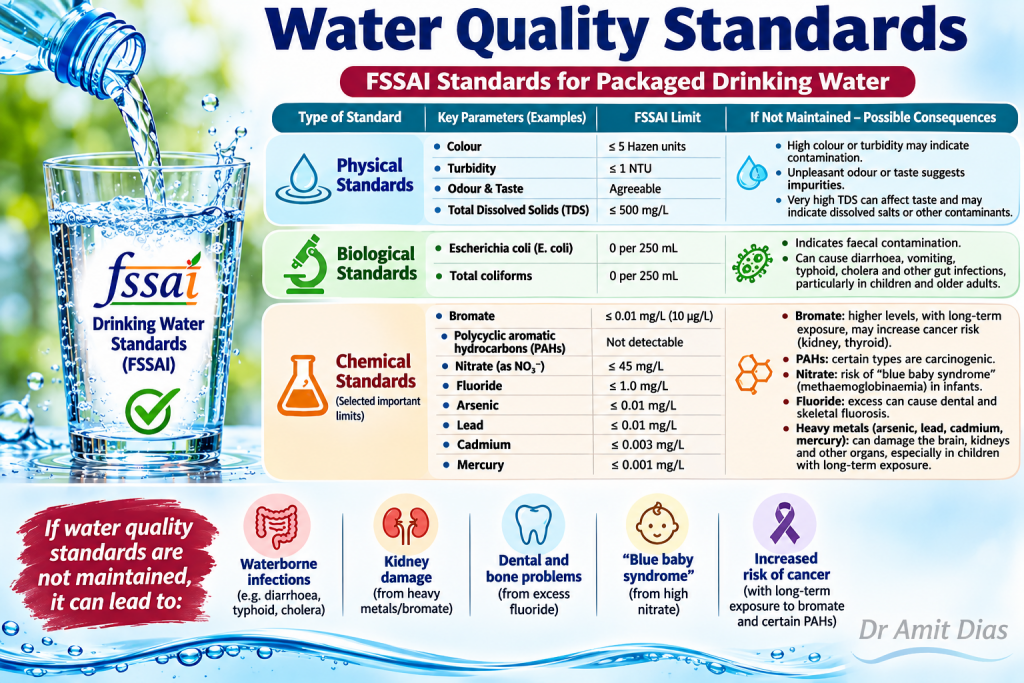
THE World Health Organization (WHO) has established a provisional guideline value of 10 micrograms per litre (µg/L), equivalent to 0.01 milligrams per litre (mg/L) for bromate in drinking water. Indian food safety standards prescribe the same maximum limit for packaged drinking water. To appreciate how tiny this quantity is, 10 micrograms in one litre is approximately ten parts per billion. It is a very small amount, but regulatory limits for potential carcinogens are designed to minimise lifetime exposure rather than identify a threshold at which illness suddenly occurs.
The WHO guideline is provisional because of limitations in analytical and treatment methods. Bromate is also difficult to remove once formed. Prevention—through controlling the treatment process—is therefore more important than attempting to remove it afterwards.
Understanding PAHs:
Polycyclic aromatic hydrocarbons, commonly abbreviated as PAHs, are a group of chemicals formed mainly during incomplete combustion of organic materials such as wood, coal, petroleum and other fuels. Certain PAHs are recognised carcinogens.
Their presence in water may arise through environmental contamination or other sources of contamination during processing and handling. The health implications depend on the specific PAH detected, its concentration, the duration of exposure and the route of exposure.
Indian standards for packaged drinking water require polynuclear aromatic hydrocarbons to be not detectable. This is an important distinction: unlike bromate, which has a specified numerical permissible limit, PAHs are listed under the toxic-substance parameters with a requirement of non-detection.
The mere mention of “PAHs” does not tell us the toxicological significance without knowing which compounds were detected, the analytical method used and the concentrations measured.
Learning from our past:
In 2004, a major bottled-water company in the United Kingdom recalled hundreds of thousands of bottles of drinking water after bromate levels exceeded the legal limit. The problem was associated with the treatment process. The incident raised questions about the adequacy of quality control and demonstrated how a chemical by-product can become a significant food-safety concern even in a product marketed as purified water.
More recently, in July 2025, elevated bromate levels were detected at the Ashford Common water treatment works in the United Kingdom. The maximum reported concentration was 56.9 µg/L, against the prescribed value of 10 µg/L. The incident was attributed to a fault in the ozonation process, resulting in unstable and excessive ozone dosing. The problem was subsequently corrected, and bromate levels returned to expected values. Authorities reported that the concentrations remained below short-term health-based guidance values, although the incident highlighted deficiencies in monitoring, alarms and process control.
These incidents reinforce an important principle: chemical contamination can arise not only from the source water but also from the treatment and bottling process.
What does the recent Indian episode teach us?
RECENT regulatory reporting concerning a sample collected from a packaged drinking-water manufacturing facility in Goa has brought these issues into public discussion. The initial laboratory report indicated bromate above the prescribed limit, while subsequent testing reportedly found bromate within the limit but detected PAHs. The findings and their interpretation have been disputed, and regulatory action has followed.
The episode illustrates the importance of reliable sampling, validated laboratory methods, independent confirmation and transparent communication. A finding in one sample or batch should not automatically be generalised to every bottle or every production facility. Equally, regulatory scrutiny should not be dismissed. The appropriate response is scientific investigation, traceability and corrective action wherever a process failure is identified.
What can consumers do?
CONSUMERS need not panic or abandon packaged water indiscriminately. Instead, they should look for products from regulated manufacturers, check packaging integrity, avoid storing bottles in direct sunlight or excessive heat, and follow credible updates from food safety authorities.
Manufacturers must ensure that treatment systems are appropriately monitored, especially where ozonation is used. Bromide levels in source water, ozone dosing, pH and finished-water bromate concentrations need appropriate control. Routine testing must include both microbiological safety and chemical quality.
The Food Safety and Standards Authority of India (FSSAI) has strengthened its testing requirements for packaged drinking water and mineral water. Testing and compliance are essential because consumer confidence cannot be based solely on a brand name, attractive packaging or the clarity of water.
The bigger lesson:
We often think of drinking-water safety in terms of microbes—bacteria, viruses and parasites. But chemical safety is equally important. A clear, colourless and pleasant-tasting bottle of water may still require sophisticated laboratory testing to establish its chemical quality.
The recent episode should not become a battle of brands or a source of unnecessary fear. It should become an opportunity to strengthen surveillance, improve transparency and remind us that safe drinking water is not merely water that looks clean — it is water that meets microbiological, chemical and physical standards. The safest water is not simply the water that quenches our thirst; it is the water whose quality we can confidently verify.

(Dr Amit Dias is an Assistant Professor in Community Medicine at Goa Medical College, Goa. His areas of interest include public health, epidemiology, ageing, dementia prevention and health promotion. He is actively involved in research, teaching and community-based public health initiatives.)
 57th IFFI 2026: IT’S BEEN A YEAR OF RECOGNITION FOR GOAN CINEMA! By Our Special Correspondent
 IFFI 2026 EATING OUT QUITE GRACIOUS!
 HUMILIATING PUNISHMENT IN SCHOOLS!
 CONCRETE OVER CANOPY: Goa’s New FAR Rules Risk Regularising Yesterday’s Overreach! By Dr Olav Albuquerque & Deborah Cordeiro
 THE CONTRADICTIONS OF INDIAN CRONY CAPITALISM! By Arvind Pinto
 WEEKEND UPDATES
 LETTER TO THE EDITOR FOR THE ISSUE DATED NOVEMBER 21, 2026
 MY TRYST WITH CINEMA
 ‘AN OCCURRENCE AT OWL CREEK BRIDGE’ MOST OUTSTANDING SUSPENSE FILM
 THE GOAN WEALTH DIVIDE! By Our Special Correspondent
 THE GREAT GOAN PARADOX: CHANGES THAT WE DO NOT NOTICE! By Arvind Pinto
 BALAN NAMBIAR: RITUAL, NATURE & THE ALCHEMY OF FORM! By Prema Viswanathan
 You GUT to GET This Right for Your BRAIN Health! By Dr Amit Dias
 ARE CHILDREN IS UNSAFE IN SCHOOLS?
 GOA’S ONE DAY WINTER SESSION… Sparks debate over executive power and legislative scrutiny!By Dr Olav & Deborah Albuquerque
Goa is abuzz with excitement as vintage bike and car owners, users, collectors and fans are decking […]