Goa is abuzz with excitement as vintage bike and car owners, users, collectors and fans are decking […]
Old is Gold
October 4, 2016
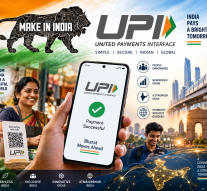
THE Unified Payments Interface (UPI) was launched in April 2016 by the National Payments Corporation of India (NPCI), under the regulatory oversight of the Reserve Bank of India (RBI). Conceived as part of India’s broader push toward financial inclusion, UPI was designed to simplify digital transactions by allowing instant transfers between bank accounts using a smartphone.
Unlike traditional payment systems that required bank account numbers, IFSC codes, or credit or debit card details to make a transaction, UPI works with a Virtual Payment Address (VPA) — a simple identifier like name@bank. For most people all that was required was their mobile with a scan application. All one did was to scan a QR code. In an instant money was transferred from your bank to the bank of the receiver. This innovation removed the necessity of remembering a bank number or code, making digital payments accessible to our illiterate millions. Further for the number of Indians who cannot read, the UPI system allows them to scan and pay rather than input some number or digit.
How does the UPI work. It allows instant peer-to-peer (P2P) and person-to-merchant (P2M) transactions via phones, using a simple UPI ID instead of card details or account numbers. It’s core function lies in the transfer of money between two bank accounts instantly using a smartphone app. With most Indians possessing a phone, a person is able to pay another through a phone number. Today, UPI is the world’s largest instant payment system, processing billions of transactions monthly.
The vision was clear: create a digital public infrastructure (DPI) that was interoperable, inclusive, and scalable. NPCI, a not-for-profit entity promoted by RBI and the Indian Banks’ Association, became the architect of this transformation.
LAUNCH & EARLY ADOPTION (2016–2017)
IRONICALLY, India’s financial disaster, the government demonetization drive in November 2016, was the event that helped the growth of UPI transactions. As cash shortages gripped the nation with people having to tender their high denomination notes into the bank, there was little currency left with the public. It was then that the UPI emerged as a lifeline, enabling seamless digital transactions, to buy their daily bread, so as to speak. During the time when cash was short, payments made through digital transfers were a lifeline to those who were unable to access cash.
The government launched the BHIM app in December 2016 to popularize UPI among ordinary citizens. Banks and Fintech players like PhonePe, Paytm, and Google Pay quickly integrated UPI, creating a competitive ecosystem that accelerated adoption. By 2017, UPI had processed over 100 million transactions, signaling the beginning of India’s digital payments revolution.
UPI’s Rise (2017–2020)
UPI’s growth was exponential. QR codes became ubiquitous, allowing even small roadside vendors to accept digital payments without costly point of sale (POS) machines. UPI payments have moved into several financial settlements. In 2018, UPI payments were permissible to subscribe to an Initial Public Offering IPO in the share market and then was permitted to make payments for bills. In a move to integrate other national systems, in 2019, the Indian UPI system cross-border linkages began with Singapore’s PayNow. During the pandemic in 2019-20, UPI payments grew since the public was happy that the payments were contactless. The UPI’s success lay in its zero-cost model — consumers paid nothing, and merchants faced no MDR (Merchant Discount Rate). This government-backed incentive ensured mass adoption, unlike Visa and Master card networks that charged 1.5–2.5% as commission to be paid by Merchants.
PRESENT ECOSYSTEM (2026 SCALE, MDR INTRODUCTION)
TODAY in 2026, UPI has become the world’s largest instant payment system, processing 24.5 billion transactions worth Rs29.8 lakh crore in August 2026 alone. Over 95% of transactions are below Rs2,000, highlighting its dominance in everyday retail payments.
NPCI’s business model is a not-for-profit “utility” model: it runs India’s retail payment system at an ultra-low cost, reinvests surpluses into infrastructure, and earns revenue mainly through switching fees, RuPay card charges, IMPS, FASTag, and bill payment services — while keeping UPI transactions largely free to users. This is to change on, 15 October 2026, NPCI introduced a 0.4% MDR on person-to-merchant transactions above Rs2,000, capped at Rs300 per transaction. Small merchants, P2P transfers, and low-value transactions remain exempt. This move balances financial inclusion with ecosystem sustainability, ensuring funds for fraud monitoring, cybersecurity, and infrastructure upgrades. However the move to charge UPI transactions has brought mixed reactions While fintech leaders and payment firms see it as a necessary step for sustainability, while some entrepreneurs and merchants criticize it as an unnecessary burden or “tax maximisation. Some industry experts call the MDR “a sustainable foundation” to fund fraud prevention, infrastructure in smaller towns, and innovation. Others Believe it will incentivize new players to enter the market and expand UPI adoption. Further others believe that a dedicated fund (5% of MDR collections) will support small merchants in transitioning to digital payments. Many in the fintech world support the charge in principle acknowledging that UPI needs a revenue model, since balancing affordability with sustainability will drive innovation and long- term growth. However the merchant community is against this imposition. Many merchant groups believe that this imposition will see the return to cash transactions. Larger retailers worry about added costs to their sale as compared to the zero MDR era.
WOULD the success rate of UPI in India, decline, if government goes ahead with the MDR charges in October 2026? UPI transaction volumes are unlikely to decline significantly due to the 0.4% MDR, because the charge applies only to merchant payments above Rs2,000, leaving ~96% of transactions unaffected. However, some short-term resistance from merchants —especially larger retailers — may occur, with possible shifts toward cash for high-value purchases. Analysts believe that UPI volumes are likely to hold steady since these charges applies only to Person-to-Merchant (P2M) transactions above Rs2,000. Further the charges are capped at Rs300 per transaction for payments above Rs75,000. Besides there are exemptions for small merchants (Rs1 lakh/month), utilities, telecom, fuel, railways, and insurance (flat Rs5 fee). Finally Person-to-Person (P2P) transfers remain free. Looking at the transaction profile, over 95% of UPI transactions are below Rs2,000 — meaning the vast majority remain unaffected. Everyday retail payments (kirana stores, local vendors) continue to enjoy zero MDR. Further the MDR cost for UPI transactions are lower than those for credit or debit cards.
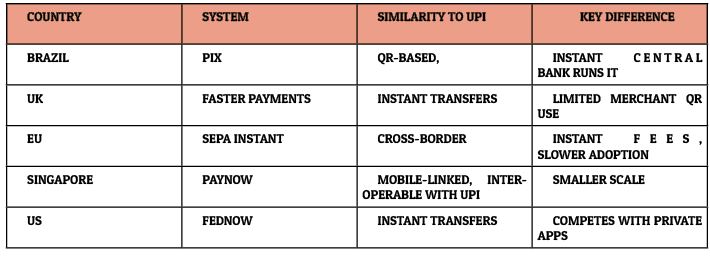
COMPARATIVE GLOBAL SYSTEMS (Pix, SEPA, PayNow)
WHILE UPI is unique to India, other countries have developed similar systems:
Despite these parallels, none match UPI’s scale, inclusivity, and zero-cost model. UPI is not just a payment app— it is a digital public good.
Future Outlook (Cross-Border, Sustainability, Cybersecurity)
The next phase of UPI’s journey lies in global expansion and resilience. NPCI International Payments Limited (NIPL) is forging partnerships to make UPI usable abroad, especially for the Indian diaspora. Several countries have already tied up with the UPI system making it grow globally. However this expansion is still in its nascent stage, since each country has regulatory and compliance compulsion in currency transactions.
What are the Challenges ahead
The success of the UPI system, depends upon acceptance where the Merchant community plays an important role. Should merchant bodies decide to revert to cash, this system would lose its lustre. Cybersecurity threats would make the system vunerable should merchants withdraw from using it. Then there could be Global adoption barriers, with entrenched card networks and regulatory hurdles. Today however the UPI’s trajectory is clear: it has redefined digital payments in India and is now positioning itself as a template for inclusive fintech worldwide.
CONCLUSION
UPI’s story is one of vision, timing, and scale. From its origin in 2016 to its dominance in 2026, UPI has transformed India’s economy, empowered millions, and set a benchmark for the world. As India balances inclusion with sustainability through MDR, UPI remains a symbol of how digital public infrastructure can reshape societies. It is not just a payment system — it is a social and economic revolution in motion.
(Arvind Pinto is the chairperson of Citizencredit Cooperative Bank Ltd, he also practises at National Company Law Tribunal and is retired chief commissioner.)
 LETTER TO THE EDITOR FOR ISSUE DATED SEPTEMBER 26, 2026
 DIVIDED EVEN IN DEATH!By Rajan Narayan
 IF YOU CLAIM THE CREDIT, TAKE THE RESPONSIBILITY!By Joquim Goes
 8 EMAILS IN 7 DAYS, BUT VALID GOA VOTERS STILL LEFT OUT: EC’S FLAWED SYSTEM!By Ritika Chopra
 BRING BACK THE FLATBREADS OF INDIA!
 EARLIER YOU KNOW, THE MORE YOU CAN DO Dementia diagnosis matters… By Dr Vailanki Nazira Raposo
 YOUNG LOVE IS A CRIME IN BIHAR!
 THE BOAT BECKONS, THE UNICORN WATCHES! By Prema Viswanathan
 WEEKEND UPDATES
 LETTER TO THE EDITOR FOR ISSUE DATED SEPTEMBER 19, 2026
 ELEVATED HIGHWAY TO HELL!
 MEDICAL DEVICES LOOT!By GS Mudur
 HOSTILE ACT BY PAKISTAN: `PNS HUNAIN’ TRIED TO DISRUPT OUR NAVAL SURVEILLANCE! By Dr Olav Albuquerque & Deborah Albuquerque
 BLACK MONEY IN POLITIAL PARTIES: ADR’s Alarming Revelations By Arvind Pinto
 `KHANDVI MILLE-FEUILLE’ AT BRICS ALL VEG BUFFET!
Goa is abuzz with excitement as vintage bike and car owners, users, collectors and fans are decking […]