Goa is abuzz with excitement as vintage bike and car owners, users, collectors and fans are decking […]
Old is Gold
October 4, 2016

In 1973, on completion of my graduation degree at St. Xavier’s College, Bombay, now Mumbai, I did not find a suitable job in the city. I did what most students do- decided to study further. Reading the daily newspapers, I happened to find an advertisement from Delhi University and Jawaharlal Nehru University (JNU) calling for students for their post degree courses. Sociology was my subject and I applied to both Universities- since both offered scholarships – while JNU offered 2nd class train fare for those coming to attend the interview-an offer too good to refuse. I applied to both Universities – was called for their interviews and took the train to Delhi – to see a city I had heard so much about – given a round trip to the capital city of the country! I was accepted for the Master’s program in Social Sciences in JNU, which offered me a scholarship, and decided to begin life in this new University. More than fifty years have passed since, and here I look at how has the University done over the decades?
Founded in 1969, by an Act of Parliament, JNU was envisaged as a world class University with interdisciplinary studies. It was to act as a crucible of critical thought, pluralism, and democratic debate. It quickly became India’s most respected public university, producing scholars, diplomats, activists, and thinkers who shaped national and global discourse. For decades, JNU embodied the Nehruvian ideal of a university as a space for dissent, diversity, and discovery. Under its first Vice Chancellor, the diplomat G Parthasarathy, and the Rector Professor Moonis Raza, JNU attracted the crème-de la crème of academicians to its Schools. In Sociology, we had Professor Yojendra Singh, as the Chairman. One of the best faculties was probably History, where the doyens of Indian history, Romila Thapar, Bipin Chandra, S Gopal and Satish Chandra. These historians helped establish JNU’s reputation as a hub for critical historical scholarship. Their work shaped debates on nationalism , medieval India and India politics. Similarly at the Centre for Economic Studies and Planning, there was Prabhat Patnaik, who was a specialist in Marxist economics, monetary theory. Another professor of note was Krishna Bharadwaj, who was an expert in classical political economy and Indian development theory. Then you had Amit Bhaduri, who focussed on developmental economic and agrarian structures. Then there was Deepak Nayyar, a specialist in international economics and trade. JNU in the early 70’s was indeed a hub of learning, debate and scholarship. Founded with a vision of interdisciplinary and research driven education, JNU encouraged debate and discussion both in the class room as also around the University, be it in the canteens, hostels and even the lawns. I remember that the classrooms were always in a discussion mode, where both professors and students engaged in a dialogue on the issues that were being discussed. Among the more outstanding students of the 70’s are the External Affairs Minister, Mr S Jaishanker, and the Finance Minister Smt. Nirmala Sitharaman. Besides the bureaucracy still has several in its folds that have passed from the portals of this University.
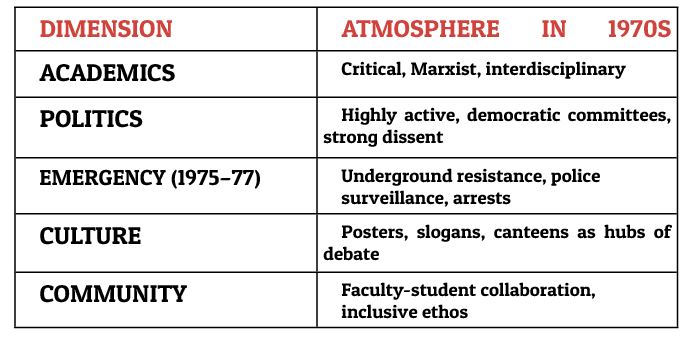
JNU right from its inception was known for student activism. There was student -faculty committees that gave students a direct role in admissions and decision making reflecting JNU’s democratic ethos. On the walls of the canteen as also in the hostels, slogans and posters proclaimed various political ideologies. During the Emergency,(1975-77) student was active in helping activists, at times hiding them in the hostel rooms. Underground bulletins were printed and circulated at night. The government would send police informers to the campus, pretending them to be students. These were times , when the teaching faculty bonded with the student body, especially when the police raided the campus.
The Emergency tested JNU’s resilience, embedding a tradition of dissent and democratic resistance in its identity. JNU became known as the most politically conscious and intellectually vibrant university.
Yet, over the past decade, JNU has faced a systematic erosion of its autonomy, funding, and intellectual vibrancy. What was once a symbol of India’s democratic spirit now stands as a cautionary tale of how political interference, budgetary strangulation, and ideological policing can hollow out an institution.
The degeneration of JNU has been driven by four major causes: political interference in faculty hiring, chronic underfunding and crumbling infrastructure, dilution of its inclusive admissions system, and erosion of academic autonomy. Together, these factors have weakened its reputation as India’s premier hub of critical scholarship.
Over the decades, faculty hiring has witnessed political interference. Once where professors were hired on the basis of their scholarship and renown, today, much of the academicians are brought on the rolls because of either their political affiliations or their connections. This has led to mediocre talent, coming into the University. Recently there have been reposts on irregularities and corruption in appointments. These instances have undermined academic standards. Sadly the shift towards ideological loyalty over scholarly merit has eroded JNU’s intellectual credibility.
In the ‘70s I remember, as post graduate students we moved into a new Campus with hostels that were in building. Today, both hostels and class rooms suffer from leaking ceilings, broken windows, rusted emergency exist and fans that do not work. Over the years, the infrastructure is crumbling, but there are no funds to carry out repairs and renovations. One of the unique features of the University, was its admission policy, that ensured having students from all over the country. Many of the students who came from backward regions of the country were given ‘deprivation points’ in the system. Unfortunately this was challenged and subsequently withdrawn, thereby denying bright students from the backward districts from receiving a quality education. With increasing governmental control over the University, there has been increasing bureaucratic control over the curriculum, research topics as also faculty positions. Today professors are required to toe the government line, both in what is being taught as also the topics for research.
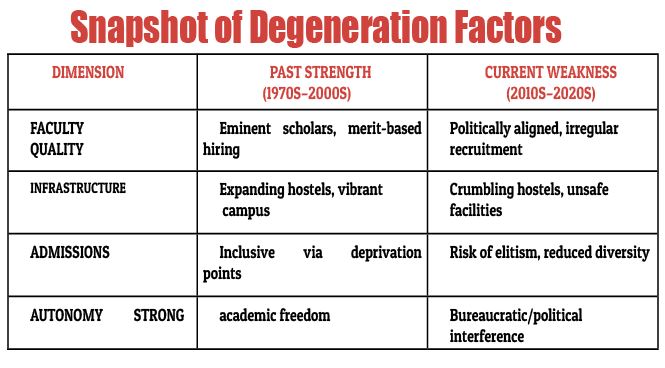
JNU that was once a university of eminence, has over the decades lost its sheen. With governmental interference, and a lacklustre mediocre teaching staff, JNU today has become yet another Indian institution of higher learning. Among the Indian Universities students still prefer joining JNU since many of the students look at its portals as a gateway to cracking the Indian Civil Services. Even today, several of its students finally land up in the IAS and other Civil Services. For JNU among the Indian Universities is still considered better than other Indian Universities in Social Studies. But its premier standing for intellectual debate, discussion and thought has long gone!
(Arvind Pinto is the chairperson of Citizencredit Cooperative Bank Ltd, he also practises at National Company Law Tribunal and is retired chief commissioner.)
 LETTER TO THE EDITOR FOR ISSUE DATED OCTOBER 03, 2026
 GEN-Z BLOCKED FROM VOTING BY GYANESHWAR MODI!
 THE FORAL OF 1526 Five Hundred Years Later, What Does Goa’s Oldest Village Charter Really Mean?
 20 YEARS IN ‘HERALD’, 43 IN GOA!
 THE WOMEN WHO LOOK BACK! By Prema Viswanathan
 GOA IS CELEBRITY STATE!
 HI MUMBAI MERI JAAN BUT…
 WEEKEND UPDATES
 LETTER TO THE EDITOR FOR ISSUE DATED SEPTEMBER 26, 2026
 DIVIDED EVEN IN DEATH!By Rajan Narayan
 IF YOU CLAIM THE CREDIT, TAKE THE RESPONSIBILITY!By Joquim Goes
 8 EMAILS IN 7 DAYS, BUT VALID GOA VOTERS STILL LEFT OUT: EC’S FLAWED SYSTEM!By Ritika Chopra
 MAKE IN INDIA: UNITED PAYMENTS INTERFACE India’s digital local leap to global benchmark…By Arvind Pinto
 BRING BACK THE FLATBREADS OF INDIA!
 EARLIER YOU KNOW, THE MORE YOU CAN DO Dementia diagnosis matters… By Dr Vailanki Nazira Raposo
Goa is abuzz with excitement as vintage bike and car owners, users, collectors and fans are decking […]