Goa is abuzz with excitement as vintage bike and car owners, users, collectors and fans are decking […]
Old is Gold
October 4, 2016
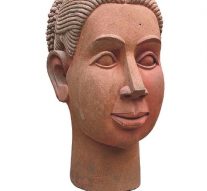
Ravinder Reddy’s monumental women challenge conventional ideas of beauty through their sensuality, defiance and self-awareness.
There is something almost disconcerting about walking into a gallery filled with Ravinder Reddy’s women. They are enormous, brilliantly coloured and unapologetically assertive. Their luminous, piercing eyes stare straight back at us. Their faces are composed, their lips sensual, their bodies monumental. They seem at once familiar and strange — drawn from the visual vocabulary of India and yet transformed into something unmistakably Reddy.
At first glance, it is tempting to see these women as exoticised versions of Indian femininity: idealised, voluptuous and adorned, their sexuality impossible to miss. But look deeper and that first impression begins to shift. The women acquire personalities. The apparent artifice gives way to individuality. What initially seems like an exaggerated fantasy of the Indian woman becomes something more complicated — an assertion of female presence, beauty and self-possession.
This is the territory explored by G. Ravinder Reddy in In Search of the Perfect Image, his solo exhibition at Gallery Sumukha in Bengaluru which ends on October 3. The exhibition brings together works from 2011 to 2026, including the monumental Portrait of Parvati and a series of new wall-mounted reliefs. And of course, the stunning Standing Radha in Blue.
Reddy has spent decades returning to the female figure. His women are not portraits of particular individuals. As he puts it, “I never personalise any sculptures. They’re universal.” Yet there is an intriguing contradiction here: although they are supposedly universal, they rarely feel anonymous. Each work seems to possess an inner life.
Perhaps that is because Reddy does not simply reproduce a particular kind of woman. He observes, absorbs and recombines. He has spoken of looking at women and pondering “what they are, what is special about them”, combining characteristics from different people rather than copying one face.
The result is a kind of composite femininity — neither realistic portraiture nor conventional idealisation.
And then there is the colour.
Reddy’s women do not inhabit the muted palette one might expect from sculpture. They blaze. Turquoise, orange, yellow, red, gold and pink intensify their presence until the sculptures begin to hover somewhere between the physical and the fantastical. The effect is almost surreal. These are clearly not attempts at realistic representation. Reddy is creating images rather than imitating appearances.
His explanation is characteristically straightforward: “Why monochrome when there are colours?” He has pointed to the long Indian tradition of painted sculpture and to the use of strong primary colours in saris, temples and folk art.
That decision is crucial. Colour doesn’t merely decorate these women; it changes the way we perceive them. Their monumental scale, exaggerated features and the saturated fibre glass surfaces push them beyond realism into something closer to an icon — but an icon with a distinctly contemporary, even playful, sensibility.
This tension between the sacred and the sensual runs through Reddy’s work. His women can resemble goddesses, village women, film stars or women encountered in everyday life. They are simultaneously monumental and ordinary.
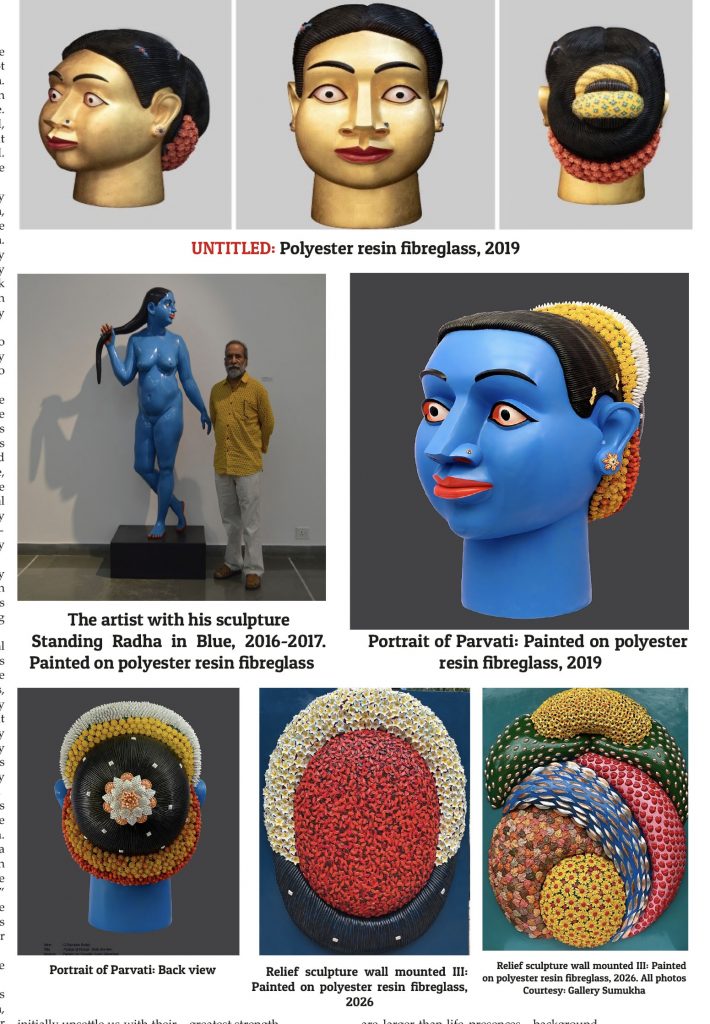
Curator Anish Gawande describes Reddy’s figures as carrying an inheritance that reaches from Mesopotamian votive figures and the Indus Valley figurines to the yakshis of Mathura. Yet he also observes that no two of the heads are really alike, with differences in proportion, hairstyle, jewellery and sringar — the elaborate adornment traditionally associated with Indian femininity and the divine.
The full-figure of Standing Radha in Blue is perhaps the most intriguing departure in the exhibition. Radha is an iconoclastic figure in Indian mythology — a woman who steps outside the sanctioned boundaries of marriage and social convention through her consuming love for Krishna. Her desire is not neatly contained by the rules governing respectable womanhood. In Reddy’s hands, that tension between devotion and desire becomes particularly potent.
His Radha is not a demure mythic heroine but a monumental female presence, sensual and self-possessed, occupying space with the same unapologetic confidence as his larger-than-life heads. Seen alongside the adivasi and rural women in the exhibition, she extends Reddy’s exploration of a femininity that refuses to be reduced to passive beauty.
There is something remarkably contemporary about this reading of Radha. In an India where questions of women’s autonomy, sexuality and the right to determine her own identity continue to provoke debate, Radha can be seen not merely as a figure from an ancient devotional tradition but as an enduring symbol of female desire that refuses easy containment.
Radha becomes a bridge between Reddy’s contemporary women and the older Indian visual traditions from which he draws. What might initially be read through a Western lens as sexualisation or exoticisation can acquire another dimension when placed within an Indian tradition in which female desire, sensuality, devotion and transgression have long existed in uneasy proximity.
Reddy himself has spoken about the relationship between women and nature in India: “I believe women in India surround themselves with Nature.” He has referred to women farming, tending to household chores and adorning themselves, bringing flowers and other elements of nature into their hair and dress.
That observation opens another door into these works.
The flowers, elaborate hairstyles and jewellery are not simply decorative embellishments. They become signs of identity. They speak of women who, despite the limitations imposed on them by circumstance, continue to recreate themselves through dress, adornment and self-presentation.
This is particularly striking when one thinks of the adivasi and rural women who seem to inhabit some of Reddy’s visual vocabulary. Their beauty is not presented as passive prettiness. There is something rebellious about the gaze, the directness and the sheer physical confidence of these women. Seductiveness and defiance coexist.
Indeed, Reddy has described his women as women who are not ashamed of themselves and are proud of their bodies. That assertion matters because the female body in Indian visual culture has so often been mediated through mythology, male desire or prescribed ideals of beauty. Reddy’s women may be highly stylised, but they do not appear to apologise for occupying space.
And perhaps this is why the apparent exoticism of the first encounter can be misleading.
The more one looks, the less these women seem to be objects for the viewer’s gaze. They begin to look back.
That reversal is important.
Their enormous eyes are not coy. Their faces do not invite easy consumption. They confront us with an almost unnerving composure. The women are adorned, sensual and beautiful, but they are also self-contained. They do not seem to need the viewer’s approval.
There is humour too. Reddy is not afraid of exaggeration, nor of what might once have been dismissed as kitsch. His figures deliberately occupy an uncertain territory between popular culture, folk traditions, classical Indian sculpture and contemporary art.
It is precisely this refusal to remain within one category that makes the work so compelling.
Reddy’s influences are wide-ranging — from the Egyptian and Benin heads he encountered in museums during his years of study and travel to Indian sculpture, folk and tribal traditions. He has said that his principal inspirations remain “my culture and surroundings — what I see around me every day.”
There is consequently something deeply Indian about these sculptures without their being conventionally traditional.
They belong to a visual India that encompasses temples and cinema, village women and goddesses, flowers in the hair and brightly painted surfaces, ancient sculpture and contemporary popular imagery. Reddy takes these disparate elements and enlarges them until they become impossible to ignore.
Perhaps that is what makes In Search of the Perfect Image such a satisfying exhibition. Reddy is not searching for a single perfect woman, or even a fixed definition of feminine beauty. The “perfect image” keeps changing because, as he has said, perception changes as we grow and encounter new things.
His women therefore remain open-ended.
They can be read as goddesses or village women, as objects of beauty or statements of power, as embodiments of tradition or products of an increasingly contemporary India. They can initially unsettle us with their exaggerated sexuality and then surprise us with their individuality.
And that, perhaps, is their greatest strength.
Ravinder Reddy’s women may be monumental, but they are not monuments to a single idea of womanhood. They are larger-than-life presences — sensual, flamboyant, vulnerable, proud and sometimes rebellious — who refuse to disappear into the background.
They demand to be looked at.
And, just as importantly, they look back.
 LETTER TO THE EDITOR FOR ISSUE DATED OCTOBER 03, 2026
 GEN-Z BLOCKED FROM VOTING BY GYANESHWAR MODI!
 THE FORAL OF 1526 Five Hundred Years Later, What Does Goa’s Oldest Village Charter Really Mean?
 20 YEARS IN ‘HERALD’, 43 IN GOA!
 THE DEGRADATION OF JNU – MY ALMA MATER! By Arvind Pinto
 GOA IS CELEBRITY STATE!
 HI MUMBAI MERI JAAN BUT…
 WEEKEND UPDATES
 LETTER TO THE EDITOR FOR ISSUE DATED SEPTEMBER 26, 2026
 DIVIDED EVEN IN DEATH!By Rajan Narayan
 IF YOU CLAIM THE CREDIT, TAKE THE RESPONSIBILITY!By Joquim Goes
 8 EMAILS IN 7 DAYS, BUT VALID GOA VOTERS STILL LEFT OUT: EC’S FLAWED SYSTEM!By Ritika Chopra
 MAKE IN INDIA: UNITED PAYMENTS INTERFACE India’s digital local leap to global benchmark…By Arvind Pinto
 BRING BACK THE FLATBREADS OF INDIA!
 EARLIER YOU KNOW, THE MORE YOU CAN DO Dementia diagnosis matters… By Dr Vailanki Nazira Raposo
Goa is abuzz with excitement as vintage bike and car owners, users, collectors and fans are decking […]