Goa is abuzz with excitement as vintage bike and car owners, users, collectors and fans are decking […]
Old is Gold
October 4, 2016
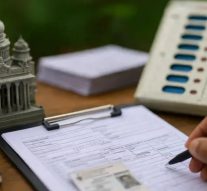
SIR KARNATAKA: Almost a crore of the six crore voters have been deleted in the SIR carried out by the Election Commission in the Congress-ruled state of Karnataka.
India’s electoral history raises a fundamental question: Was the Special Intensive Revision (SIR) of electoral rolls necessary to protect the integrity of elections, or an exercise intended to clean up voter lists and become a potential instrument for excluding legitimate voters?
The question is particularly important for senior citizens, people with disabilities, migrant workers, tenants who have changed residences, and citizens who lack digital literacy. A voter who has exercised the franchise for decades should not have to fight an opaque bureaucratic system to establish the right to vote.
Three questions must be examined separately:
Summary Revision
Under a Special Summary Revision, the existing electoral roll is updated. Eligible voters can apply for inclusion, corrections or changes of address. Officials also process deletions and other corrections according to the applicable rules.
This is a continuing administrative process, not a complete re-enrolment of the entire electorate from scratch.
Intensive Revision
An Intensive Revision involves more comprehensive enumeration and verification. It is intended to reconstruct or thoroughly verify the electoral roll rather than merely update the existing list.
The Election Commission’s June 2025 order explained that intensive revisions had previously been conducted in various years, including 1952–56, 1957, 1961, 1965–66, 1983–84, 1987–89, 1992–95 and 2002–04. The Commission identified the 2003 exercise in Bihar as the state’s previous intensive revision.
This historical record establishes an important distinction: SIR was not invented by the BJP government. The Election Commission had used intensive revisions long before the present political controversy.
But the fact that a procedure existed before the BJP does not establish that its current implementation is fair, necessary or proportionate.
That must be judged on the evidence.
The case for SIR
The strongest arguments in favour of SIR are straightforward:
• Deceased voters should not remain on active electoral rolls indefinitely.
• Duplicate registrations should be identified and resolved.
• People who have moved should be able to register at their new ordinary residence.
• Ineligible entries should be corrected through lawful procedures.
• A reliable electoral roll is essential to free and fair elections.
A poorly maintained roll can also facilitate impersonation, administrative confusion and disputes over election results.
Consequently, it would be wrong to argue that every comprehensive revision is inherently undemocratic.
The case against an unnecessarily burdensome SIR
The opposite danger is equally serious.
Suppose an existing voter has been registered for 20 or 30 years. The person’s identity has already been verified, the name appears on successive electoral rolls, and the person has voted in previous elections.
If that individual is suddenly required to establish eligibility through an unfamiliar documentation process, the burden shifts from the state to the citizen.
This is especially problematic when the voter is elderly, disabled, poor, digitally illiterate or unable to obtain documents that may have been lost decades ago.
The Election Commission should explain why its existing records are insufficient, what additional verification is necessary and what safeguards protect people whose documentation is incomplete.
The burden of maintaining accurate electoral rolls belongs primarily to the electoral administration. It should not become an arbitrary test of a citizen’s ability to navigate bureaucracy.
Why deletion figures are not enough
Suppose an electoral revision removes 100,000 entries.
That figure tells us very little without further information.
• How many belonged to deceased people?
• How many were confirmed duplicate registrations?
• How many belonged to people who had permanently moved away?
• How many were removed because officials could not establish contact?
• How many belonged to eligible citizens who were incorrectly classified?
• How many of those citizens subsequently recovered their registration?
The last two questions are crucial.
A large number of deletions does not, by itself, prove that SIR was successful. Nor does it prove that the exercise was fraudulent.
The relevant test is the accuracy of individual decisions and the overall effect on eligible voters.
The danger of treating absence as ineligibility
A voter may be absent from home when a booth-level officer visits.
That does not establish that the person is dead, has permanently shifted residence or is otherwise ineligible.
People travel. They visit relatives. They are admitted to hospitals. They work away from home. Some live in apartment complexes where access is restricted.
A locked door is evidence that the person was not contacted at that moment. It is not proof that the voter has ceased to exist.
Reasonable verification should include follow-up attempts and appropriate checks of available records, rather than treating unsuccessful contact as conclusive evidence of ineligibility.
The applicable rules and instructions must be examined to determine what checks were actually required and performed in a particular case.
Can an existing voter be required to establish eligibility again?
Yes, the law permits electoral verification and revision. Previous inclusion does not make a person’s entry permanently immune from scrutiny.
But there is a difference between conducting a lawful verification and making it practically impossible for a genuine voter to remain registered.
That distinction becomes particularly important when long-standing voters are asked to produce documents they never previously needed.
The process should provide accessible assistance, clear reasons for proposed deletions, adequate opportunities to respond and a workable appeal mechanism.
Without these protections, an exercise designed to improve electoral accuracy can unintentionally become a mechanism of exclusion.
Proposition one: SIR can cause wrongful exclusion
This is a genuine administrative risk.
Wrongful exclusion can occur through inaccurate records, inadequate verification, mistaken classification, inaccessible procedures or failures to notify affected voters.
Such failures should be documented and corrected regardless of which party benefits.
Proposition two: Wrongful exclusion may have partisan consequences
This is also entirely plausible.
Electoral outcomes depend on the geographical distribution of voters. If eligible voters are disproportionately removed from particular communities, neighbourhoods or constituencies, the consequences may not be politically neutral.
For example, removing 5,000 eligible voters from a constituency where the winning margin was 2,000 could be electorally significant.
But the number alone would not establish which candidate would have benefited, because not every excluded voter would necessarily have voted, and their political preferences cannot simply be assumed.
The correct analysis requires constituency-level data, reliable information about the affected voters and a comparison with electoral margins.
Proposition three: The process was deliberately manipulated to benefit the BJP
This is a stronger allegation.
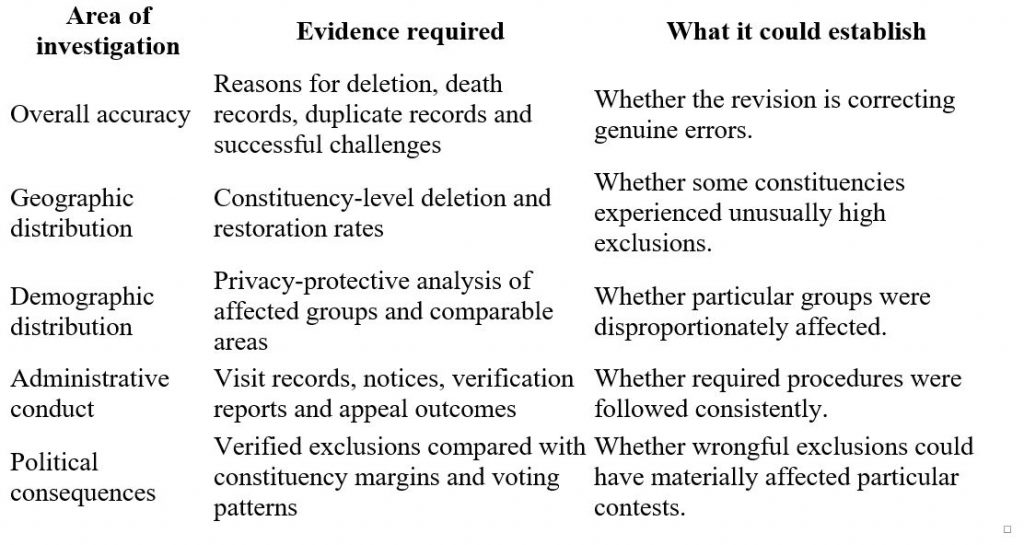
To establish deliberate partisan manipulation, investigators would need evidence such as:
An electoral process can produce a partisan advantage without a centrally directed conspiracy.
If the rules impose disproportionate burdens on particular groups, if local officials apply them inconsistently, or if the appeals system is inaccessible, the resulting exclusions may have political consequences even without evidence of explicit orders from party leaders.
The institutional question is therefore not merely whether the BJP ordered manipulation. It is whether the Election Commission has designed a process that is demonstrably impartial, transparent and capable of correcting errors.
That is a legitimate subject for investigation.
First, assisted verification. Booth-level officials should provide meaningful assistance to voters who cannot reasonably complete the process independently.
Second, reliable communication. Proposed deletions should be communicated in a way that the affected person can understand and respond to.
Third, accessible appeals. Telephone assistance, physical facilitation and other appropriate channels should complement digital systems.
Fourth, reasoned decisions. Where an entry is challenged or proposed for deletion, the affected voter should be able to find out why and how to contest the decision.
Fifth, continuity of registration. A genuine voter should not be forced to start from zero merely because the administration failed to complete a verification visit.
These are not special privileges. They are reasonable safeguards for a system that claims to serve every eligible citizen.
• A correction to an existing registration: for example, correcting an address or shifting a name to the appropriate part of the roll.
• A fresh application for inclusion: which may be required where a person’s name has been omitted and the applicable procedure requires a new application.
A voter should not be forced into the second process merely because the administration has made an error if an appropriate correction or restoration procedure is available.
Nor should an appeal depend entirely on the citizen’s ability to access a digital portal.
The responsibility for making the process workable rests with the electoral administration.
A sixth area is also essential: the institutional independence of the Election Commission.
Were the rules applied equally? Were complaints investigated promptly? Were officials held accountable for incorrect deletions? Were the same standards applied in constituencies held by the BJP and those held by opposition parties?
These questions can be investigated through official records, court proceedings, statistical analysis and carefully documented field reporting.
A convincing investigation should examine both evidence supporting partisan bias and evidence that might disprove it.
That is how an allegation becomes a defensible finding.
Conclusion: Clean electoral rolls must not come at the cost of clean elections
India’s electoral system began with an ambitious democratic promise: every eligible adult citizen would have an equal opportunity to participate in choosing the government.
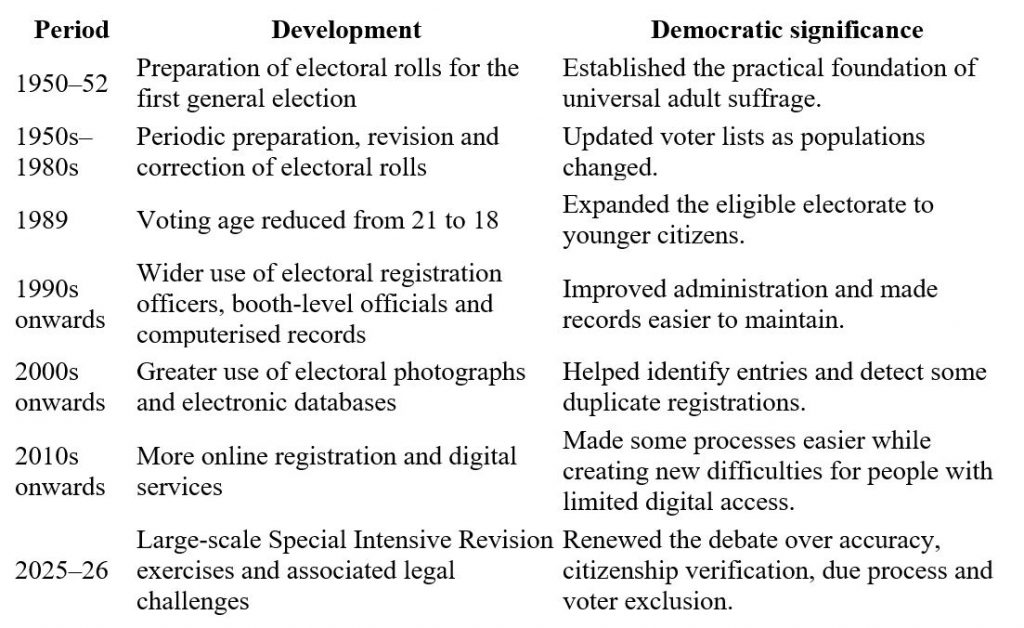
The history of electoral registration shows that intensive revision is not inherently illegitimate. The Election Commission has used it before, and the Supreme Court has upheld the legal validity of the Bihar SIR.
But neither historical precedent nor judicial validation removes the obligation to examine individual deletions, administrative failures and possible patterns of unequal treatment.
The question of partisan manipulation must be answered with evidence. It would be premature to declare that SIR is conclusively a BJP-directed exercise in electoral manipulation without demonstrating the necessary link between administrative decisions and partisan intent.
Equally, it would be complacent to assume that a process is fair simply because the Election Commission conducts it under statutory authority.
The decisive test is whether every eligible citizen can remain on, or regain access to, the electoral roll through a fair, transparent and practically accessible process.
If SIR removes ineligible entries while protecting every genuine voter, it serves democracy.
If it systematically excludes eligible voters because of inadequate verification, inaccessible procedures or discriminatory implementation, it undermines democracy.
And if reliable evidence establishes that such exclusions were deliberately engineered to secure a partisan advantage, the matter would go beyond administrative failure and become a serious threat to electoral integrity.
The Election Commission should not expect citizens to accept assurances of neutrality. It should provide the evidence that demonstrates it.
The right to vote must never become a privilege reserved for citizens who can satisfy an increasingly complicated bureaucracy.
Editorial note: This assessment distinguishes established electoral law and the Supreme Court’s ruling from allegations about the political effects or possible manipulation of SIR. A definitive finding of partisan manipulation would require further verified evidence.
 LETTER TO THE EDITOR FOR ISSUE DATED OCTOBER 31, 2026
 COMMERCE MINISTER PIYUSH GOYAL, CA TO DB BUILDERS, AWARDED CONVENTION DEAL?
 DONA PAULA CONVENTION CENTRE!By Our Special Correspondent
 THE SWAN TELECOM–2G SPECTRUM CASE!By Our Special Correspondent
 ALDEIA DE GOA: THE LAND, PLANNING PERMISSIONS AND THE 2022 HIGH COURT JUDGEMENT!By Our Special Correspondent
 RE-DEVELOPMENT DREAMS OR RE-DEVELOPMENT NIGHTMARES?By Arvind Pinto, Our Legal Consultant
 FOUND! `MILLET UPMA’ AND `NACHNE IDLI’…
 DEMAND PROOF OR “REFUSE TO SIGN”!
 WEEKEND UPDATES
 LETTER TO THE EDITOR FOR THE ISSUE DATED OCTOBER 24, 2026
 THERANOS MULTI-BILLION US PATHOLOGY COMPANY EXPOSED!
 INDIA’S PATHOLOGY LABORATORY SCANDAL! By Our Special Correspondent
 MUKESH, ADANI CONTROL MODI?By Our Special Correspondent
 “FRANCE KE SCHOOL THIK KARO”By Paris Correspondent
 INTEGRITY MUST BE CONDiTION FOR POWER!By Ranadhir Mukhopadhyay
Goa is abuzz with excitement as vintage bike and car owners, users, collectors and fans are decking […]