Goa is abuzz with excitement as vintage bike and car owners, users, collectors and fans are decking […]
Old is Gold
October 4, 2016
We often say that the way to a person’s heart is through the stomach. Science is now revealing something equally fascinating: the road to a healthy brain may also pass through the gut! What happens in our digestive system can influence our mood, sleep, immunity and possibly even our risk of neurological disorders.
The gut is no longer viewed merely as a food-processing factory. It is a sophisticated biological system, home to trillions of microorganisms, millions of nerve cells and a complex network of immune and hormonal signals. Understanding this connection, known as the gut-brain axis, opens exciting possibilities for protecting both digestive and brain health.
Your gut: Much more than a digestive organ
The gastrointestinal tract does far more than digest food and absorb nutrients. It houses a complex ecosystem of bacteria, viruses, fungi and other microorganisms collectively known as the gut microbiota. The term gut microbiome refers to their collective genetic material.
These microorganisms help break down dietary fibre, produce beneficial substances, support immunity and protect against harmful organisms. A healthy gut is not a bacteria-free gut, but one with a balanced and diverse microbial community. An unhealthy imbalance is called dysbiosis. Think of these microorganisms as microscopic partners that help maintain our health.
The gut-brain axis: A two-way communication pathway
One of the most fascinating developments in modern medicine is the discovery of how closely the gut and brain communicate. This relationship is not one-way. The brain influences digestion, while signals from the gut can influence brain function.
There are four important pathways through which this communication occurs.
Can an unhealthy gut affect memory and brain health?
Could the health of our gut influence our risk of Alzheimer’s and Parkinson’s disease? This is an exciting area of current research.
Studies have identified differences in gut microbial composition in people with these neurological conditions. Researchers are investigating whether dysbiosis, intestinal barrier dysfunction and inflammation contribute to disease processes.
In Parkinson’s disease, scientists are exploring whether abnormal accumulation of a protein called alpha-synuclein may begin in the gut in some individuals before affecting the brain.
In Alzheimer’s disease, researchers are examining how microbial changes and inflammatory pathways may influence amyloid and tau pathology, the characteristic abnormalities associated with the disease.
However, an important distinction is necessary: much of this evidence is still emerging, and human studies have largely identified associations rather than proving cause and effect. We cannot yet claim that an unhealthy gut causes dementia or that correcting the microbiome can prevent Alzheimer’s disease.
Nevertheless, nurturing gut health is a sensible part of a broader strategy for healthy ageing and brain health.
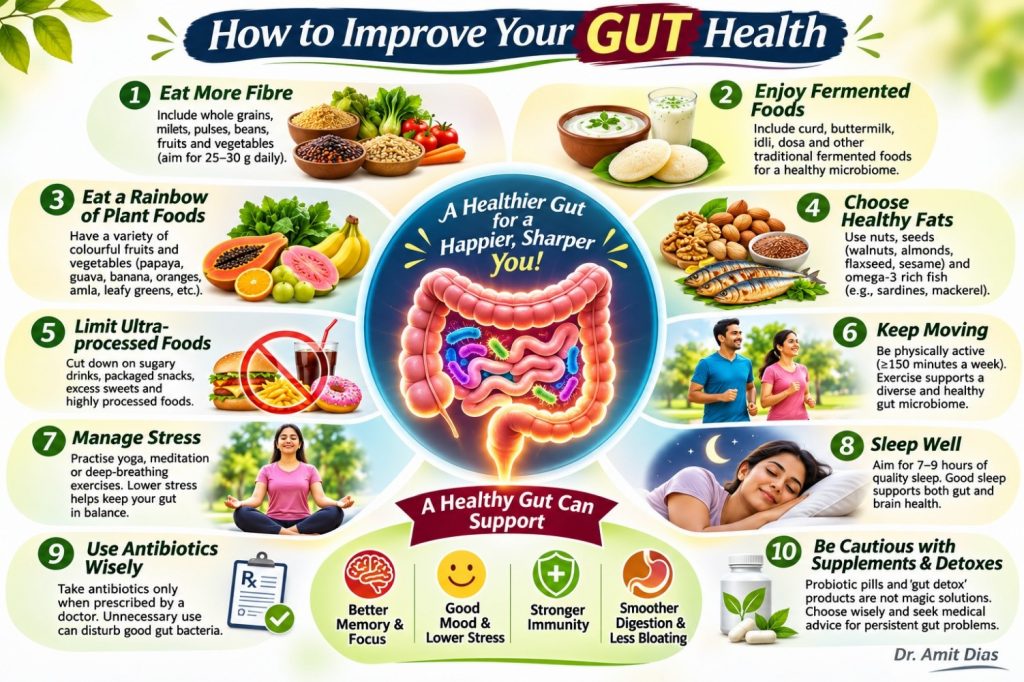
Food for thought: Ten ways to keep your gut and brain healthy
The good news is that we do not need expensive supplements or exotic foods. Many solutions are already available in your kitchen at home!
The future: Can we treat the brain through the gut?
Scientists are exploring targeted probiotics, prebiotics, dietary interventions and faecal microbiota transplantation (FMT) as ways of modifying the gut microbiome. Another emerging concept is psychobiotics—specific microorganisms or their products that may influence mental health through the gut-brain axis.
Vagus nerve stimulation is also being investigated for its potential to influence inflammation and communication between the gut and brain.
These developments are promising, but most are still under investigation. They should not replace established treatments for neurological or psychiatric conditions.
A healthy gut for a healthy brain
Gut health is not simply about avoiding acidity, constipation or indigestion. It is about maintaining an ecosystem that supports digestion, immunity, metabolism and potentially brain function.
We often invest in expensive skincare products and fitness programmes but overlook the microscopic community living inside our intestines. Perhaps it is time to give these tiny residents some attention!
Remember: Feed your gut well, keep moving, manage stress and sleep adequately. Your gut and your brain may thank you for it.
After all, when it comes to brain health, you GUT to GET this right!

(Dr Amit Dias is an Assistant Professor in the Department of Preventive & Social Medicine at the Goa Medical College & Hospital. He is a public health researcher with special interests in lifestyle diseases, ageing, dementia prevention, Alzheimer’s disease and healthy longevity. His work focuses on translating scientific evidence into practical public health messages.)
 THE GREAT GOAN PARADOX: CHANGES THAT WE DO NOT NOTICE! By Arvind Pinto
 BALAN NAMBIAR: RITUAL, NATURE & THE ALCHEMY OF FORM! By Prema Viswanathan
 ARE CHILDREN IS UNSAFE IN SCHOOLS?
 GOA’S ONE DAY WINTER SESSION… Sparks debate over executive power and legislative scrutiny!By Dr Olav & Deborah Albuquerque
 WEEKEND UPDATES
 LETTER TO THE EDITOR FOR THE ISSUE DATED NOVEMBER 14, 2026
 `RAMAYANA’ TURNS `RAVAYANA’?
 THE 10-HEADED RAVANA: WHEN DEMOCRACY LOSES ITS MANY VOICES
 NARKASUR CELEBRATES BAHUJAN SAMAJ CREATIVITY!By Kaustubh Naik
 THE DIGITAL DIVIDE – BRIDGING THE GAP!By Arvind Pinto
 GOA AND MACAU: SHARED HERITAGE, DIFFERENT DESTINIES! By Dr RG Wiseman Pinto
 MUMBAI IS MORE HEALTH CONSCIOUS THAN GOA!
 MORTAL BY DAY, GODDESS BY NIGHT!By Prema Viswanathan
 MAMA MIA ‘UN-COLPO DI FULMINE’… A BOLT OF LIGHTNING!
 The Invisible Pandemic WHEN MEDICINES STOP WORKING Fight Anti-Microbial Resistance! By Dr Amit Dias
Goa is abuzz with excitement as vintage bike and car owners, users, collectors and fans are decking […]