Goa is abuzz with excitement as vintage bike and car owners, users, collectors and fans are decking […]
Old is Gold
October 4, 2016
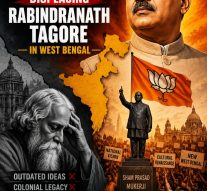
The BJP has dedicated its victory in West Bengal to Shyama Prasad Mukherjee, who is claimed to be the founder of the Jana Sangh, which later became the BJP. Rabindranath Tagore, who historically has been the icon of the state, has been displaced. Goa has a stadium named after Dr Shyama Prasad Mukerjee in Bambolim….
IN a rain-soaked Bengal village, where the scent of wet earth rises with the evening breeze, and the rhythm of monsoon droplets mingles with distant songs of Baul wanderers, the spirit of Rabindranath Tagore still breathes quietly through the landscape. Beneath swaying banyans and besides overflowing ponds, Tagore’s vision of humanity — rooted in compassion, freedom, dignity and harmony with nature — feels startlingly contemporary. At a time when the world wrestles with division, noise, and restless ambition, Tagore returns not as a memory from the past, but as a prophetic voice for the future.
As the world marks the birth anniversary of Rabindranath Tagore (1861–1941), his relevance extends far beyond literature and music. He remains one of the few modern thinkers whose ideas continue to illuminate contemporary debates on nationalism, education, environment, culture, democracy, and the meaning of being human.
Tagore’s greatest contribution was perhaps his radical humanism. He believed that humanity must always rise above narrow identities of nation, race, religion, or ideology. In an age increasingly marked by political polarisation and identity conflicts, his warning against aggressive nationalism feels deeply relevant. Tagore loved India passionately, yet he feared nationalism becoming an idol that overshadows ethics and compassion. He argued that patriotism must never come at the cost of humanity.
This makes Tagore strikingly contemporary. Across the world, societies are struggling with exclusionary politics, cultural anxieties, and ideological rigidity. Tagore offers an alternative vision — one rooted not in uniformity, but in coexistence. His idea of India was plural, open, and civilizational rather than sectarian. He imagined a society where cultural confidence could coexist with intellectual openness.
HIS educational philosophy was equally ahead of its time. Through Visva-Bharati and Santiniketan, Tagore rejected rote learning and mechanical schooling. He believed education should nurture creativity, curiosity, imagination, and a deep relationship with nature. Students learned under open skies, through music, art, literature, and dialogue.
Today, as education systems across the world re-evaluate exam-centric models and emphasise interdisciplinary and experiential learning, Tagore’s ideas seem remarkably modern. He saw education not merely as a route to employment, but as a process of becoming fully human.
Tagore also anticipated contemporary environmental concerns long before climate change entered global discourse. The culture of Santiniketan reflected ecological sensitivity and harmony with nature. In his poetry and essays, rivers, forests, rain, birds, and seasons were not decorative images but living presences.
In today’s era of environmental crisis, Tagore’s philosophy offers an ethical framework for sustainability. He questioned blind industrialism and warned against a civilisation driven solely by material progress. He was not anti-modern, but he believed that scientific advancement without moral restraint could damage both society and the environment.
His critique feels especially relevant in a technological age dominated by consumerism, automation, and restless economic growth. Tagore reminds us that progress without humanity becomes mechanical.
Yet Tagore was never isolationist. He believed India must engage confidently with the world while remaining rooted in its own civilizational ethos. He advocated a cultural globalisation that absorbed global influences without surrendering identity. In today’s hyper-connected world shaped by migration, digital culture, and globalisation, this balance between rootedness and openness remains one of humanity’s greatest challenges.
Tagore’s art itself embodied this universality. His poetry, songs, stories, and paintings continue to inspire musicians, filmmakers, scholars, and writers across generations. Rabindra Sangeet remains emotionally alive because it speaks not only to Bengal, but to the human condition itself—love, longing, loss, freedom, and transcendence.
His literary themes also remain contemporary. Questions of gender, social reform, individuality, and moral courage appear throughout his works. Modern cinema and literature continue to reinterpret Tagore because his characters confront dilemmas that remain unresolved even today.
Politically, Tagore occupies a unique space. He does not fit neatly into any modern ideology, which is precisely why he remains important.
His relationship with Mahatma Gandhi reflected this complexity. The two respected each other deeply but disagreed openly on nationalism and mass politics. Gandhi saw nationalism as a mobilising force against colonialism, while Tagore worried about emotional excess and conformity. That disagreement feels especially meaningful today, when public discourse often reduces dissent to disloyalty. Tagore demonstrated that disagreement need not lead to hostility. Intellectual debate, for him, was essential to democracy and civilisation.
Gandhi embraced mass nationalism, collective activism, and idealised village life; Rabindranath Tagore differed from Gandhi in this regard, preferring cautious humanism, rationality, global openness, and dignified rural progress without romanticising poverty.
Tagore shared Nehru’s pluralism and Ambedkar’s anti-injustice ideals, yet critiqued technocracy and centralised power, and emphasised moral and cultural transformation over structural or industrial solutions.
TAGORE also insisted that freedom meant more than political independence. His dream was of a “mind without fear” — a society where individuals could think freely, free from intimidation or conformity. In contemporary debates around free speech, dissent, and public discourse, this ideal remains profoundly relevant.
Similarly, his ideas on rural development anticipated modern discussions on sustainability and decentralisation. At Sriniketan, he experimented with models of rural reconstruction based on dignity, self-reliance, and education rather than dependency. He believed villages should not merely survive; they should flourish culturally and intellectually.
Tagore’s political relevance today lies not in providing a ready-made ideology, but in correcting the excesses of all ideologies. When nationalism becomes exclusionary, Tagore reminds us of humanity. When liberalism becomes shallow or excessively legalistic, he restores cultural and spiritual depth. When welfare politics creates dependency, he emphasises dignity and empowerment. When ideology becomes rigid, he reasserts freedom of thought and creativity.
Tagore and Subhas Chandra Bose shared anti-colonial patriotism, but Bose championed militant, assertive nationalism, while Tagore warned against nationalism’s violent, exclusionary, and oppressive excesses.
This great sage of India supported equality, cooperation, and resistance to exploitation, but rejected rigid socialism and the Left’s centralised control in favour of an ethical social transformation rooted in individual freedom, creativity, and cultural humanism.
Tagore valued spirituality and cultural identity, but opposed sectarian politics and using religion as a political weapon, advocating universal humanism over exclusive religious nationalism.
This refusal to fit into neat categories makes Tagore difficult to appropriate politically. He was too internationalist for hard nationalism, too culturally rooted for abstract liberalism, too individualistic for rigid socialism, and too pluralistic for sectarian politics.
ABOVE all, Tagore believed that lasting transformation comes not merely through laws or political movements, but through culture, education, ethics, and imagination. He saw art as a force capable of refining society and deepening human consciousness.
At a time when contemporary politics is increasingly loud, transactional, and polarised, Tagore reminds us that civilisation is sustained not only by power or economics, but by compassion, beauty, thoughtfulness, and the courage to remain human.
Tagore, perhaps, was never meant only for his own time. He belongs equally to tomorrow.
(Arunabha Roy is a former director, Prasar Bharati and currently editor of ` Melange’)
 LETTER TO THE EDITOR FOR ISSUE DATED SEPTEMBER 19, 2026
 ELEVATED HIGHWAY TO HELL!
 MEDICAL DEVICES LOOT!By GS Mudur
 HOSTILE ACT BY PAKISTAN: `PNS HUNAIN’ TRIED TO DISRUPT OUR NAVAL SURVEILLANCE! By Dr Olav Albuquerque & Deborah Albuquerque
 BLACK MONEY IN POLITIAL PARTIES: ADR’s Alarming Revelations By Arvind Pinto
 `KHANDVI MILLE-FEUILLE’ AT BRICS ALL VEG BUFFET!
 SATYA NIKETAN TRAGEDY: HOW GLOBAL STUDENT HOUSING MODELS COULD HELP INDIA FIX A BROKEN SYSTEM!By Sneha Swaminathan
 GANESH PANDALS HIJACKED BY ADANI, AMBANI
 WHY DOES A DEMENTIA DIAGNOSIS MATTER? By Dr Amit Dias
 WEEKEND UPDATES
 LETTERS TO THE EDITOR FOR ISSUE DATED SEPTEMBER 12, 2026
 GOAN TEACHERS ARE CONTRACT LABOR!
 THE COLOUR IS PRESTIGIOUS! THE PROCESS MUST BE EQUALLY SO!
 DOGS ATTACK GOANS, OWNERS GET ACQUITTED!By Dr Olav Albuquerque & Deborah Cordeiro
 CYBER FRAUD: A THREAT TO FINANCIAL SECURITY & MENTAL WELL-BEING! By Adv Vinayak (Mama) D Porob
Goa is abuzz with excitement as vintage bike and car owners, users, collectors and fans are decking […]