Goa is abuzz with excitement as vintage bike and car owners, users, collectors and fans are decking […]
Old is Gold
October 4, 2016
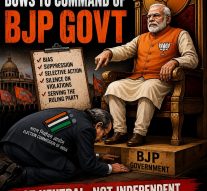
Democratic institutions have been systematically undermined. From the battle of Kurukshetra to Narendra Modi’s Kartavya Path represents the breakdown of democratic institutions such as the parliament, the judiciary, and the Election Commission.
HISTORY is not only shaped by those who act, but also by those who could have acted — and did not. The great tragedy of the Mahabharata was not inevitable; it was constructed through a sequence of silences, hesitations, and deferred responsibilities. Kurukshetra was less a sudden eruption of conflict than the cumulative outcome of missed interventions — moments when those with authority, wisdom or moral standing, chose restraint over action.
Modern India, standing today along the symbolic axis of Kartavya Path, is far removed from the absolutism of epic kingdoms. It is a constitutional democracy, anchored in institutions, procedures, and public accountability. Yet the analytical lens of missed opportunities remains strikingly relevant — not as an accusation, but as a diagnostic framework for understanding how institutions perform when confronted with moments that demand clarity.
A “missed opportunity” is not mere inaction. It is the presence of capacity without its timely exercise; authority without proportional response; awareness without consequence. It occurs when institutions designed to deliberate, moderate, or correct instead delay, defer, or dilute their role.
Consider first the legislature. The Parliament of India is not merely a law-making body; it is a deliberative forum meant to refine, contest, and legitimise policy through debate. In recent years, concerns have occasionally been raised about compressed legislative timelines and reduced committee scrutiny. When deliberation contracts, democracy retains its form but risks losing depth. Governments, of course, invoke urgency, mandate, and efficiency — arguments not without merit. Yet the missed intervention lies not in passing laws, but in failing to allow sufficient space for institutional reasoning to shape them.
THE executive presents a second domain. India’s quasi-federal structure requires a delicate balance between national coordination and regional autonomy. Tensions between the Union and the states are not new, but how they are managed determines the health of the system. When dialogue is delayed, and assertion precedes negotiation, conflicts harden. The missed intervention here is often temporal: the absence of early political engagement that could have prevented later confrontation. Strong governance is not only about decisive action — it is also about timely accommodation.
If the legislature embodies deliberation and the executive embodies decision, the judiciary embodies timing. The Supreme Court of India holds immense constitutional authority, but its effectiveness often depends on when it chooses to act. Delays in hearing constitutionally sensitive matters can render facts on the ground irreversible, diminishing the eventual impact of judgments. Justice, in this sense, is not only what is decided, but when it is decided. Courts, burdened by caseloads and guided by principles of restraint, must constantly negotiate this tension. Yet, the missed intervention is not about overreach — it is about recognising that timing itself is a form of constitutional power.
BEYOND these core institutions lie the guardians of accountability: bodies such as the Election Commission of India and the Comptroller and Auditor General of India. Designed as neutral correctives, they rely on timely, visible action. When interventions appear delayed or procedural rather than assertive, deterrence weakens — even if formal compliance remains intact. The challenge here is not legality, but perception: the credibility of oversight depends on both substance and immediacy.
The media, often described as the fourth pillar, occupies a more fluid space. In an era of rapid information flows and polarised ecosystems, the line between amplification and interrogation has blurred. The missed intervention occurs when narration substitutes investigation, and speed displaces depth. Yet it would be simplistic to frame this solely as a decline. Digital media has expanded voices, diversified perspectives, and enabled new forms of scrutiny. The real question is whether the ecosystem, in its entirety, sustains the slow, rigorous work of holding power accountable.
Civil society, too, has undergone transformation. Once a cohesive force of moral pressure and policy influence, it now appears more fragmented, shaped by regulatory frameworks and shifting modes of activism. The missed intervention here is structural: when collective voice dissipates into isolated efforts, its capacity to shape discourse and influence timing diminishes. At the same time, new digital forms of mobilisation suggest that civic engagement is not disappearing — it is evolving.
Yet, the most consequential actor remains the citizen. India’s electoral vitality is undeniable, with high voter participation and expanding political awareness. But democracy is not only periodic voting; it is continuous engagement. The missed intervention at the citizen level is the gap between electoral assertion and sustained civic participation. When engagement becomes episodic, institutions lose a crucial feedback mechanism that might otherwise prompt earlier course correction.
ACROSS these domains, a pattern emerges — one that echoes the moral architecture of the Mahabharata. Vidura’s wisdom went unheeded; Bhishma’s ethical clarity was constrained by institutional vows; Dhritarashtra’s awareness was paralysed by attachment. None lacked knowledge. What they lacked, at decisive moments, was the translation of that knowledge into timely action.
Modern India is not bound by epic inevitability. Its institutions are iterative, self-correcting, and embedded within a constitutional framework that allows for revision and renewal. Missed opportunities, therefore, are not final — they may be revisited. A delayed response, while imperfect, is not equivalent to permanent failure.
The policy implications are clear. First, procedural depth must be strengthened through robust parliamentary scrutiny and meaningful debate. Second, temporal sensitivity must be institutionalised—particularly in judicial processes dealing with constitutional questions. Third, ethical dissent must be protected, ensuring that internal critique is not penalised but valued. Finally, civic infrastructure must be nurtured to enable continuous public engagement beyond electoral cycles.
The deeper lesson, however, is philosophical. A republic is not weakened by disagreement; it is weakened when institutions hesitate at moments that demand clarity. Equally, it is strengthened when those same institutions learn, recalibrate, and act —even if not immediately.
Kurukshetra appears inevitable only in retrospect. In reality, it was the cumulative result of deferred responsibility. Kartavya Path, by contrast, is not a destination but a reminder: that duty in a democracy lies not only in possessing power, but in exercising it at the right time.
HISTORY will always record the actions of the powerful. But it is shaped, more quietly and more profoundly, by the moments when power hesitates. The task of a republic, therefore, is not merely to distribute authority, but to ensure that when the moment demands it, authority does not remain silent.
(The author is a scientist, mentor and policy analyst. He is currently a Fellow at the Centre for Contemporary Research, a policy think tank.)
 LETTER TO THE EDITOR FOR ISSUE DATED SEPTEMBER 19, 2026
 ELEVATED HIGHWAY TO HELL!
 MEDICAL DEVICES LOOT!By GS Mudur
 HOSTILE ACT BY PAKISTAN: `PNS HUNAIN’ TRIED TO DISRUPT OUR NAVAL SURVEILLANCE! By Dr Olav Albuquerque & Deborah Albuquerque
 BLACK MONEY IN POLITIAL PARTIES: ADR’s Alarming Revelations By Arvind Pinto
 `KHANDVI MILLE-FEUILLE’ AT BRICS ALL VEG BUFFET!
 SATYA NIKETAN TRAGEDY: HOW GLOBAL STUDENT HOUSING MODELS COULD HELP INDIA FIX A BROKEN SYSTEM!By Sneha Swaminathan
 GANESH PANDALS HIJACKED BY ADANI, AMBANI
 WHY DOES A DEMENTIA DIAGNOSIS MATTER? By Dr Amit Dias
 WEEKEND UPDATES
 LETTERS TO THE EDITOR FOR ISSUE DATED SEPTEMBER 12, 2026
 GOAN TEACHERS ARE CONTRACT LABOR!
 THE COLOUR IS PRESTIGIOUS! THE PROCESS MUST BE EQUALLY SO!
 DOGS ATTACK GOANS, OWNERS GET ACQUITTED!By Dr Olav Albuquerque & Deborah Cordeiro
 CYBER FRAUD: A THREAT TO FINANCIAL SECURITY & MENTAL WELL-BEING! By Adv Vinayak (Mama) D Porob
Goa is abuzz with excitement as vintage bike and car owners, users, collectors and fans are decking […]