Goa is abuzz with excitement as vintage bike and car owners, users, collectors and fans are decking […]
Old is Gold
October 4, 2016
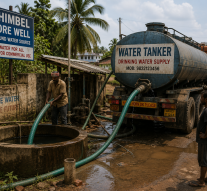
Under pressure from the local MLA Rudolf Fernandes, the sealing of the 70 illegal bore wells in Chimbel, has been stalled. But there is fear that there are thousands of illegal bore wells across the states providing tanker water to tower blocks….
IN the quiet, elevated terrain of Dharwadkar Colony in Chimbel, Goa, a crisis has been brewing beneath the surface — literally. What began as a struggle for basic survival has transformed into a high-stakes legal battle involving the high court of Bombay at Goa, the Water Resources Department (WRD), and a sophisticated network of illegal water extraction. At the heart of this controversy lie the 70 illegal bore wells, a desperate resident population, and the looming spectre of a “water mafia” that capitalizes on administrative failure.
The situation in Chimbel reached a breaking point in late April and early May 2026. Acting on public interest litigation and detailed Right to Information (RTI) findings, the high court issued a stern directive to the WRD to seal 70 unauthorized bore wells in Dharwadkar Colony. These wells, many of which had been operational for over a decade, were found to be in gross violation of the Goa Ground Water Regulation Act.
The discovery was startling not just for the volume of wells, but for the lengths to which operators went to hide them. During WRD inspections, officials found bore wells concealed under debris, wooden planks, and scrap metal to evade detection. The court expressed “grave concern” over how such a high density of illegal extractions could persist in a single colony without the knowledge — or perhaps with the unseen complicity — of local authorities.
For the residents of Dharwadkar Colony, the reality is survival. The colony is situated on a steep hill, a geographical feature that has historically hindered the Public Works Department’s (PWD) ability to provide consistent piped water. Residents claim that for years, their taps have run dry, leaving them with no choice but to dig deep into the earth.
STATE FAILURES
AS of May 2026, the water shortage has reached critical levels. Protesters who blocked WRD officials from sealing the wells argued that the government was “punishing the thirsty for the failures of the state.” They contend that while the 70 wells exist, they serve the domestic needs of approximately 45 householdswho have been abandoned by municipal infrastructure. However, the sheer number — 70 wells for 45 houses —suggests a ratio that goes far beyond individual domestic use, pointing toward commercial exploitation.
In Chimbel, RTI evidence revealed that several of these “domestic” wells were connected to high-capacity storage tanks and tanker loading points.
This “bore well mafia” operates in the gap between demand and supply. They extract groundwater from these residential areas and sell it to industrial units or private tanker. By selling a public resource back to the public at exorbitant prices, they create a perverse incentive for municipal water supplies to remain inefficient. Furthermore, the commercialization of these wells leads to continuous pumping, which prevents the natural recharge of the aquifer, effectively “mining” the water until the source is depleted.
The environmental impact of these 70 bore wells extends far beyond the borders of Dharwadkar Colony; such as:
 LETTER TO THE EDITOR FOR ISSUE DATED SEPTEMBER 19, 2026
 ELEVATED HIGHWAY TO HELL!
 MEDICAL DEVICES LOOT!By GS Mudur
 HOSTILE ACT BY PAKISTAN: `PNS HUNAIN’ TRIED TO DISRUPT OUR NAVAL SURVEILLANCE! By Dr Olav Albuquerque & Deborah Albuquerque
 BLACK MONEY IN POLITIAL PARTIES: ADR’s Alarming Revelations By Arvind Pinto
 `KHANDVI MILLE-FEUILLE’ AT BRICS ALL VEG BUFFET!
 SATYA NIKETAN TRAGEDY: HOW GLOBAL STUDENT HOUSING MODELS COULD HELP INDIA FIX A BROKEN SYSTEM!By Sneha Swaminathan
 GANESH PANDALS HIJACKED BY ADANI, AMBANI
 WHY DOES A DEMENTIA DIAGNOSIS MATTER? By Dr Amit Dias
 WEEKEND UPDATES
 LETTERS TO THE EDITOR FOR ISSUE DATED SEPTEMBER 12, 2026
 GOAN TEACHERS ARE CONTRACT LABOR!
 THE COLOUR IS PRESTIGIOUS! THE PROCESS MUST BE EQUALLY SO!
 DOGS ATTACK GOANS, OWNERS GET ACQUITTED!By Dr Olav Albuquerque & Deborah Cordeiro
 CYBER FRAUD: A THREAT TO FINANCIAL SECURITY & MENTAL WELL-BEING! By Adv Vinayak (Mama) D Porob
Goa is abuzz with excitement as vintage bike and car owners, users, collectors and fans are decking […]