Goa is abuzz with excitement as vintage bike and car owners, users, collectors and fans are decking […]
Old is Gold
October 4, 2016
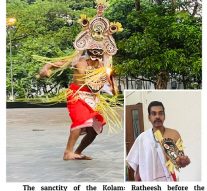
ON a warm Sunday evening at the National Gallery of Modern Art, Bengaluru, the ancient ritual performance tradition of Padayani briefly transformed the museum grounds into something older, stranger and more elemental.
Torchlight flickered against trees as the resonant rhythms of the thappu (a small circular drum) rolled through the darkening air. Equally evocative were the haunting songs intoned by Kadamanitta Raghu Kumar and his fellow singers, whose voices moved between chant, lament and invocation. The lyrics did not function merely as narrative accompaniment; they deepened the emotional and spiritual atmosphere of the performances, binding movement, rhythm and myth into a single immersive experience.
Organised by the South Zone Cultural Centre under the direction of KK Gopalakrishnan in collaboration with NGMA and the Ministry of Culture, the performance on May 10 brought one of Kerala’s most visually arresting rural ritual arts into a contemporary cultural setting — without entirely severing it from its sacred roots.
At the centre of the production was Padayani exponent Raghu Kumar, whose sensitive staging understood something crucial about the form: Padayani cannot be reduced to performance alone. It is an embodied ritual ecology, inseparable from landscape, rhythm, fire and collective memory.
The evening unfolded across two contrasting spaces.
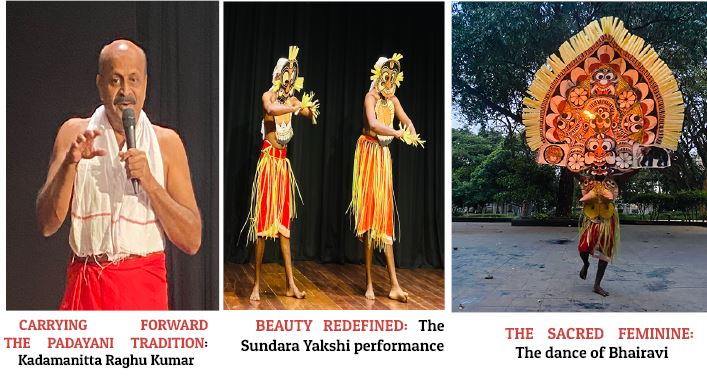
Unsettling Beauty of Sundara Yakshi
Inside the auditorium, the Sundara Yakshi performance possessed an intimate theatricality. Under controlled lighting, the Yakshi (a nature spirit) emerged as a figure of seductive beauty and unsettling power — graceful, elusive and faintly dangerous. But the performance also quietly overturned conventional ideas of beauty itself.
The “beautiful” Yakshi was never presented as merely ornamental or pleasing to the eye. Instead, the choreography and visual language fused beauty with distortion, seduction with decay, tenderness with menace. The exquisitely painted kolam (masks), elaborate costume and fluid movements of the two performers on stage coexisted with expressions and gestures that bordered on the grotesque. Beauty here was unstable, fractured and inseparable from mortality.
Beauty, Decay and Ecology
IN many ways, the Sundara Yakshi became a meditation on nature itself — ravishing and terrifying at once.
The performance seemed to suggest that modern culture’s attempt to separate the beautiful from the so-called ugly or monstrous is itself artificial. In the natural world, creation and decomposition coexist continuously. Flowers bloom even as leaves decay. Forests nourish life even as they consume it. The Yakshi embodied this uncomfortable wholeness.
As environmental destruction accelerates and humanity increasingly distances itself from ecological realities, the Sundara Yakshi appeared almost prophetic: a reminder that nature cannot be reduced to sanitized beauty. Its power also lies in wildness, excess, unpredictability, death and regeneration. The performance transformed the grotesque from something repellent into something sacred.
The enclosed auditorium intensified every gesture, every rhythmic sway, every fleeting expression. The audience was drawn not toward passive admiration, but toward confrontation — with desire, fear, fragility and the unsettling ambiguity of the natural world itself.
Padayani Returns to the Open Air
Outside, however, the performance expanded into something far more primal.
Against a natural backdrop of trees, the Markandeya performance seemed to recover Padayani’s original elemental force. Here, nature itself became part of the performance. Darkness gathered between branches. Torch flames illuminated leaves and masks in sudden bursts of orange and red. Drumming travelled outward into the night air rather than remaining trapped within walls. The earth itself appeared to absorb the rhythm.
The choice of space proved profoundly apt for the Markandeya story — the tale of the young devotee who triumphs over death through unwavering devotion to Shiva. Beneath living trees, the performance no longer felt like mere representation. It became invocation.
“Padayani belongs to open space,” Raghu Kumar observed before the performance. “The form comes from the earth, from the village, from ritual gathering. When the kolam moves under trees and firelight, the energy changes completely.”
Bhairavi and the Sacred Feminine
THAT relationship with nature lies at the heart of Padayani. Originating in Central Travancore in southern Kerala, the ritual is dedicated primarily to Goddess Bhadrakali in her fierce Bhairavi form.
Kerala was once referred to as Pennarashi Nadu — “the land ruled by women” — because it was believed to be a society where women held authority, explains Raghu Kumar, speaking to me after the performance.
“The worship of feminine power (Shakti) was deeply rooted in this culture. Evidence of this survives in figures such as Marutha, Yakshi, Bhairavi, and other female divinities. In Padayani, with the exception of characters like Kalan (god of death) and Madan (protector of cattle), almost all the ritual figures are female.”
A Ritual Beyond Caste Boundaries
UNLIKE many other ritual arts of Kerala, the centuries-old Padayani transcends caste barriers, says Raghu Kumar. Traditionally, there is historical evidence to show that performers were mainly soldiers belonging to the Nair community while the making of the kolam was done by members of the Kaniyar community (an OBC caste group). However, for more than fifty years now, people from other communities have also been performing and making the kolam, he says.
Raghu Kumar speaks passionately about the role of OBC and SC communities that have historically sustained the Padayani tradition.
“In earlier times, every community had its own designated role in the festival. The wooden frame of the kolam was made by the Asari (carpenter). The knives used for trimming and preparing the areca sheath were forged by the Kollan (blacksmith). Members of the Kuravar (hill tribe) and Pulayar (agricultural labour) communities tied the flaming bundles and carried them before the kolam, lighting the way with fire.”
Today, however, all these tasks are undertaken collectively by all members of the village, he says. Some of the performers at the NGMA event were from the SC community — a reflection of changing trends.
The Village as Performer
INDEED, today even Christians and Muslims in his native Kadamanitta village are coming forward to make the Padayani kolams, says Ratheesh, the artiste who donned the mask of Markandeya.
Unlike performance forms centred on individual virtuosity, Padayani remains deeply collective in spirit. “The whole village participates,” explains Raghu Kumar. “Padayani is not something performed by a few trained artists while others watch. Everyone has a role.”
That sense of shared ownership remains central to the ritual’s vitality.
Masculinity and Tradition
ONE trend that has remained unchanged is that performance of Padayani continues to be a male preserve. Raghu Kumar has an explanation. “Padayani is considered an art of strength and power. It demands intense physical labour and endurance. The performance style is based on jumping, shaking, and forceful bodily movement, and it is traditionally believed that the female body structure is not suited to this form.”
With women making inroads into various ritual arts which were traditionally performed by men, this interpretation, however, remains open to question.
Total Theatre and Ecological Ritual
TRADITIONALLY, performed in temple precincts, Padayani combines dance, music, mask-making, painting and possession into what scholars have often described as a form of “total theatre.”
Yet unlike modern theatre traditions, Padayani does not separate performer, audience and sacred presence. The community enters the ritual collectively.
The massive kolams — among the most striking visual elements of the tradition — are constructed on the day of the performance entirely from organic materials: areca spathes, bamboo, coconut fronds and natural pigments in red, black and white. They are not costumes imposed upon nature but extensions of it. Fire, earth, vegetal matter, rhythm and the human body converge within a single ritual vocabulary.
Commenting on the performance, NGMA director Priyanka Mary Francis reflected on the enduring contemporary relevance of the form. “Padayani reminds us of the importance of living in the present and of respecting and venerating nature,” she said. “In today’s world, that positive message feels more urgent than ever.”
The statement resonated deeply with the evening itself. The performances did not merely depict mythological narratives; they seemed to reactivate an older ecological consciousness in which human beings, trees, fire, rhythm and divinity existed within a shared sacred continuum.
Between Livelihood and Devotion
THAT continuity between ordinary life and sacred performance became especially clear in conversation with Ratheesh.
For over 20 years, he has practised Padayani with deep commitment. Yet like many traditional artists in India, sustaining the art alone is not economically viable. By profession, he works as an electrician.
“But Padayani is my real passion,” he said quietly before preparing for the performance.
The juxtaposition seemed almost symbolic. By day, Ratheesh works with electrical circuits and illumination. By night, he channels another form of energy altogether — ritual charge, inherited memory and sacred embodiment.
His words revealed an often-overlooked truth about ritual arts such as Padayani: they survive not because of institutions alone, but because ordinary working people continue to carry immense reservoirs of artistic, spiritual and performative knowledge within the pressures of everyday life.
Raghu Kumar himself has a postgraduate degree in Economics and worked as a teacher from 1984 until his retirement in 2018. But his life goal is promotion of Padayani, and he has been a performer for 46 years, earning the Kerala Folklore Academy Award in 2021 for his contribution to the art form.
Resisting Folk Exoticism
IN an era when many traditional forms risk being flattened into consumable “folk culture,” the NGMA presentation resisted easy exoticism. Instead, it allowed audiences to encounter Padayani as a sophisticated and living artistic language — one that engages sculpture, painting, choreography, music, mythology and ecology simultaneously.
What lingered most powerfully by the end of the evening was not simply spectacle, though there was plenty of that in the towering kolams and thunderous percussion. It was the sense that, for a few hours beneath the Bengaluru trees, an ancient ritual imagination had re-entered contemporary urban space without losing its mystery.
The drumbeats of the thappu faded eventually. The torchlight dimmed. The masks disappeared into darkness.
But Padayani had briefly transformed the museum grounds into a sacred landscape — and Bhairavi, it seemed, had returned.
( All pics by Prema Viswanathan)
 LETTER TO THE EDITOR FOR ISSUE DATED SEPTEMBER 26, 2026
 DIVIDED EVEN IN DEATH!By Rajan Narayan
 IF YOU CLAIM THE CREDIT, TAKE THE RESPONSIBILITY!By Joquim Goes
 8 EMAILS IN 7 DAYS, BUT VALID GOA VOTERS STILL LEFT OUT: EC’S FLAWED SYSTEM!By Ritika Chopra
 MAKE IN INDIA: UNITED PAYMENTS INTERFACE India’s digital local leap to global benchmark…By Arvind Pinto
 BRING BACK THE FLATBREADS OF INDIA!
 EARLIER YOU KNOW, THE MORE YOU CAN DO Dementia diagnosis matters… By Dr Vailanki Nazira Raposo
 YOUNG LOVE IS A CRIME IN BIHAR!
 THE BOAT BECKONS, THE UNICORN WATCHES! By Prema Viswanathan
 WEEKEND UPDATES
 LETTER TO THE EDITOR FOR ISSUE DATED SEPTEMBER 19, 2026
 ELEVATED HIGHWAY TO HELL!
 MEDICAL DEVICES LOOT!By GS Mudur
 HOSTILE ACT BY PAKISTAN: `PNS HUNAIN’ TRIED TO DISRUPT OUR NAVAL SURVEILLANCE! By Dr Olav Albuquerque & Deborah Albuquerque
 BLACK MONEY IN POLITIAL PARTIES: ADR’s Alarming Revelations By Arvind Pinto
Goa is abuzz with excitement as vintage bike and car owners, users, collectors and fans are decking […]