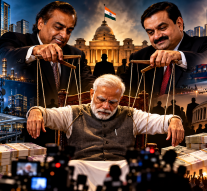
During the last two weeks, Elon Musk, who, besides being the rocket and electric vehicles king also controls the internet through Starlink, entered into a fight with Mukesh Ambani. Mukesh Ambani with his Jio now controls an internet network in the country, which is very convenient for Narendra Modi, as it can be shut down every time there is a protest, but Modi cannot say no to his boss, Donald Trump. The American Secretary of State Marco Rubio flew down to Jamnagar bypassing Modi, to strike a deal with Jio permitting Starlinks to operate in India. The deal is that Reliance will be allowed to process oil from Venezuela, which is now controlled by Donald Trump.
The most defensible answer is that India’s billionaires do not formally control Narendra Modi, but some of India’s largest corporate groups have considerable economic influence and privileged access to the government. The real question is whether that influence merely helps shape policy or sometimes determines policy.
Under Modi, the relationship between political power and big business has become a major issue in debates about crony capitalism, electoral finance, media independence and the concentration of economic power.
It is important, however, to distinguish documented facts from allegations. There is no publicly established evidence that India’s billionaires collectively direct Modi’s decisions. Nor is there sufficient evidence to conclude that every policy favouring a large corporation was made in exchange for political support.
- The principal centres of corporate power
Gautam Adani — infrastructure and strategic assets
Ports, airports, energy, coal, cement and renewable power. His businesses operate in sectors where government permissions, public-sector financing, regulation and contracts are particularly important. A 2025 Washington Post investigation reported an alleged government-backed plan involving approximately $3.9 billion in potential LIC investments in Adani businesses. Adani Group denied involvement in any plan to direct LIC funds.
Mukesh Ambani — telecommunications, energy and retail
Reliance has enormous economic reach through Jio, retail, refining and energy. Its importance to India’s digital economy and infrastructure gives it access and influence, although this does not prove that Ambani personally dictates government decisions.
Other major business interests also matter, including the Tata Group, infrastructure companies, pharmaceutical firms, mining interests and financial conglomerates. Their influence varies by sector and issue; they should not all be treated as a single political bloc.
- The strongest evidence: political funding
The electoral bonds controversy offers a concrete example of how corporate money can affect the political environment.
• On 15 February 2024, the Supreme Court struck down the electoral bonds scheme as unconstitutional, holding that anonymous political funding violated voters’ right to information. It also invalidated provisions permitting unlimited corporate contributions.
• Disclosed data showed that the BJP received approximately Rs 6,060 crore through electoral bonds between April 2019 and February 2024, the largest amount received by any political party under the scheme.
• Electoral bonds were not proof that every donation purchased a favour. But anonymity made it difficult for citizens to investigate whether donations were connected to contracts, regulatory decisions or government investigations.
The problem is structural: a company seeking government business may have a strong incentive to finance the party most likely to govern. A ruling party with superior financial resources can then enjoy an electoral advantage over its opponents.
Importantly, corporate donations have continued through other channels since electoral bonds were abolished. - The latest figures show how unequal the financial relationship is
The first full financial year after electoral bonds were abolished provides a revealing test of whether corporate political influence has diminished.
Electoral trust donations distributed in FY 2024–25 Rs 3,826 crore
Total distributed to political parties through electoral trusts, according to the Association for Democratic Reforms (ADR).BJP 82.5% Congress 7.8%
Source: ADR analysis of FY 2024–25 electoral trust reports. These figures cover electoral trusts, not every source of political funding.
The BJP’s share was approximately Rs 3,158 crore, against Rs 299 crore for Congress. This demonstrates the ruling party’s enormous financial advantage in this funding channel. It does not, by itself, establish that donors controlled individual government decisions. - Through which channels can billionaires influence Modi?
Political finance
Large donations help fund election campaigns, advertising, party organisation and political outreach. The greater the financial imbalance, the harder it becomes for opposition parties to compete.
Contracts, licences and public finance
Infrastructure, mining, energy, telecommunications and airports depend on government decisions. Companies can gain from policies that are legitimate in the public interest, but opaque processes can also create opportunities for favouritism.
Media and public opinion
Corporate ownership, advertising expenditure and access to influential platforms can affect which issues receive sustained attention. This is a potential source of influence, not proof that every business-owned outlet follows government instructions.
Access to the political leadership
Major investors can obtain meetings and present their concerns to ministers and officials. Ordinary citizens, small businesses and workers rarely enjoy comparable access. - Does Modi control the billionaires, or do they control him?
The relationship is better understood as mutual dependence, with the balance of power varying by issue.
Modi has substantial political power. His government can change regulations, allocate public resources, enforce tax and competition laws, and determine the direction of national infrastructure policy. Billionaires cannot simply compel him to comply with their wishes.
But large corporate groups possess resources that governments also want: investment capital, employment, technology, infrastructure and the ability to execute projects on a national scale.
This creates a potential bargain:
• The government offers a stable policy environment, approvals and opportunities to invest.
• Corporations supply investment, jobs and sometimes political donations.
• The danger arises when access becomes preferential treatment, competition is weakened, or public resources are used to protect particular private interests.
The 2025 Washington Post investigation into proposed LIC investments in Adani companies raises precisely these questions. The report described internal government documents suggesting a strategy to support the conglomerate during a period of financial pressure. Adani Group and LIC disputed the suggestion of improper government direction. The reporting is significant evidence to examine, but it is not a judicial finding that Modi personally ordered a favour. - The critical test: what happens when a billionaire’s interests conflict with the public interest?
A government genuinely independent of corporate pressure should be willing to:
• Investigate alleged wrongdoing irrespective of the businessman’s political connections.
• Award public contracts through transparent, competitive procedures.
• Prevent monopolistic concentration and enforce competition law.
• Protect public-sector institutions such as LIC from politically motivated investment decisions.
• Publish political donations and investigate credible evidence of a connection between contributions and government favours.
The distinction between ordinary business-government cooperation and crony capitalism lies in whether these safeguards work in practice.
My assessment
There is strong evidence of corporate financial dominance in political funding and unequal access to economic decision-making. There is also serious investigative reporting raising questions about preferential treatment for particular business groups.
What remains harder to establish is the precise extent to which Modi personally changes decisions at the direction of individual billionaires. Donations, business growth and political proximity alone cannot prove that.
The deeper democratic danger may be more subtle than a billionaire issuing orders to a prime minister: government policy can increasingly reflect the priorities of a small group of large economic interests without any explicit instruction or bargain.
The ultimate question is not whether billionaires can telephone Modi. It is whether ordinary citizens, Parliament, independent regulators and the courts can compel the government to act against a billionaire’s interests when public accountability demands it.
That is the real test of who holds power in a democracy.

 LETTER TO THE EDITOR FOR THE ISSUE DATED OCTOBER 24, 2026
 THERANOS MULTI-BILLION US PATHOLOGY COMPANY EXPOSED!
 INDIA’S PATHOLOGY LABORATORY SCANDAL! By Our Special Correspondent
 “FRANCE KE SCHOOL THIK KARO”By Paris Correspondent
 INTEGRITY MUST BE CONDiTION FOR POWER!By Ranadhir Mukhopadhyay
 A PARADIGM SHIFT: POWER MOVES FROM POLITICS TO TECHNOLOGY AND TACTICS! By Arvind Pinto
 HI MUMBAI, MERI JAAN BUT…
 VILLAINOUS MUSK, ALTMAN, ZUCKERBERG, HOLMES!
 OPTOGENETICS AND THE RAY OF HOPE: LIGHT MEETS THE BRAIN! By Dr Amit Dias
 WEEKEND UPDATES
 LETTER TO THE EDITOR FOR THE ISSUE DATED OCTOBER 17, 2026
 AZAD MAIDAN NO LONGER FREE!
 AZAD MAIDAN CRACKDOWN! Goa’s crackdown on protesters raises grave questions about democracy! By Our Special Correspondent
 INDIAN WOMEN ARE ON THE STREETS AGAIN. EVERYTHING HAS CHANGED BUT NOTHING HAS CHANGED!By Shilpa Phadke
 RBI TIGHTENS SCREWs ON ECONOMY!By Arvind Pinto