“FRANCE KE SCHOOL THIK KARO”By Paris Correspondent

“FRANCE KE SCHOOL THIK KARO”By Paris Correspondent

Oct 24- Oct 30, 2026, Protest

As in the case of India, students across France are on a violent protest against crumbling school buildings, a shortage of teachers and lack of jobs. The protest coincides with a cut in the education budget after a right-wing leader, Emmanuel Macron, who models himself on Narendra Modi, became president. There is also concern over the Muslim takeover of France…

The parallel with India is striking: France is protesting the deterioration of public education in a wealthy country; India faces many of the same problems, but with far greater disparities between states, social classes and school systems. In both countries, the central question is whether government spending is translating into good teaching and equal opportunity.
There is also a direct Indian connection. A report published by The Indian Express on 3 October 2026 explicitly compared the French school protests with the CJP movement’s “School Thik Karo” campaign in India.
The Indian government’s own UDISE+ 2025–26 figures record 100,843 single-teacher schools across India. This does not mean all are failing, but it illustrates the scale of the challenge.
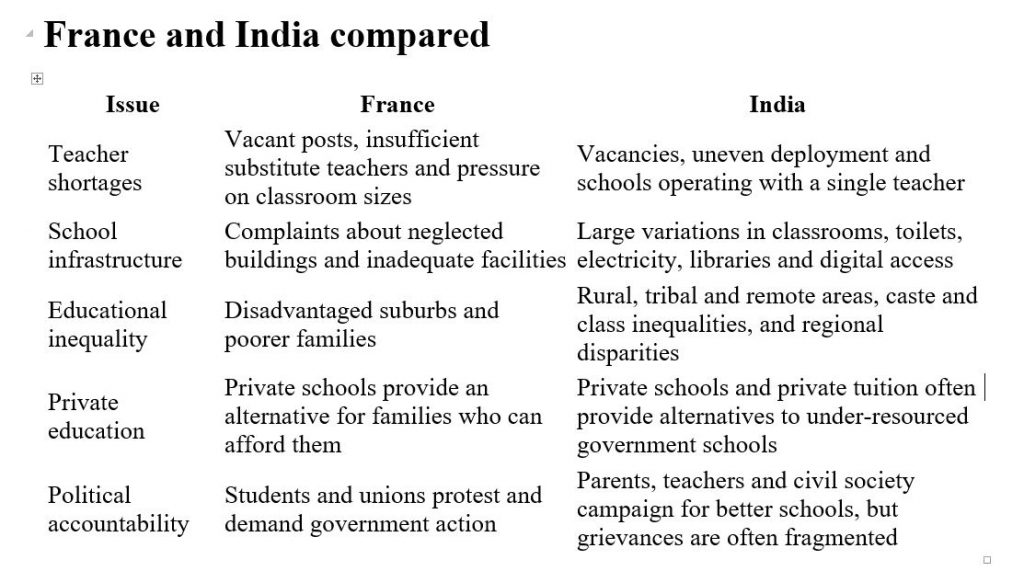

  1. The biggest difference: India spends less relative to its needs
    Public education expenditure as a share of GDP
    India 4.1% NEP target 6%
    India’s 4.1% figure is for combined Centre–state expenditure in 2022–23, as reported by PRS. The 6% target comes from the National Education Policy 2020.
    India’s Union education allocation for 2026–27 has increased, so it would be inaccurate to say that the present government has simply cut the education budget. The Ministry of Education received approximately Rs 1.39 lakh crore. Yet the combined public spending figure remains below the 6% policy target.
    The important question is whether allocations keep pace with inflation, enrolment, teacher salaries, maintenance and the cost of improving learning outcomes.
  2. India’s more serious problem: the gap between enrolment and learning
    The ASER 2024 survey found that only 23.4% of rural government-school children in Standard III could read a Standard II-level text. The figure had improved from 16.3% in 2022, but remained a major concern. Only 27.6% could solve a basic subtraction problem.
    These figures expose a fundamental weakness: getting children into school is not the same as ensuring that they learn.
    India has made progress in school infrastructure and foundational learning, and the ASER results show recovery after the pandemic. The challenge is to make those improvements universal rather than dependent on the state, district or family into which a child is born.
  3. Why India’s accountability problem is different
    France has a relatively centralised public education system, with national institutions and strong trade unions. India has a much more fragmented system in which states and Union Territories administer most government schools, while the Centre finances and coordinates national programmes.
    This division can make accountability diffuse:
    • The Centre announces schemes and allocations.
    • States are responsible for recruiting and deploying most government-school teachers.
    • District and local officials oversee implementation.
    • Parents may have limited access to reliable information about vacancies, expenditure and teaching quality.
    The result can be a gap between impressive national announcements and the actual experience of a child in a village school.
  4. What about privatisation?
    There is a further parallel. When government schools are perceived as inadequate, families who can afford it turn to private schools and tuition. Those who cannot afford alternatives remain more dependent on the public system.
    That creates a risk of a two-tier education system: one in which wealth buys better preparation, English-language exposure and access to competitive examinations.
    However, private schools are not uniformly better, and government schools have produced strong results in many places. The issue is unequal access to quality, not simply public versus private ownership.
  5. What should India learn from France?
    Three practical lessons stand out.
  6. Publish school-level accountability data. Every parent should be able to check sanctioned and vacant teacher posts, attendance, teaching days, infrastructure and learning outcomes.
  7. Measure actual outcomes, not just expenditure. Budgets should be assessed against improvements in reading, mathematics, retention and progression.
  8. Give disadvantaged schools priority. Teacher deployment and funding should reflect need, particularly in remote, tribal and economically deprived communities.
    For Goa, the same test applies: how many schools have adequate teachers, what do children actually learn, and how quickly are infrastructure complaints resolved?
    The central parallel is that both countries are confronting a crisis of public confidence in education. France’s protests have made that dissatisfaction visible in the streets. India’s challenge is to ensure that the problems in government schools are measured, reported and corrected before frustration becomes even deeper.

Search

Back to Top