Goa is abuzz with excitement as vintage bike and car owners, users, collectors and fans are decking […]
Old is Gold
October 4, 2016
Modi-controlled Chief Election Commissioner Gyanesh Kumar wants Gen-Z first time hostile voters kept out of the electoral rolls. Unlike in the past, the new voter cannot exercise democratic rights by simply filling Form 6 providing proof of age. Unless if he is a Muslim, the voter may be asked to prove he is not a Bangladesh or Pakistani. The new EC algorithm requires the age of parents, grandparents, siblings and proof that they were registered as voters. Proof that parents did not have more than six children, ‘Hum do Hamare do’. That the age gap between you and your brothers and sisters is not below eight months. Twins and preterm babies are not acceptable to the EC algorithm. All these considered illogical and grounds for exclusion from rolls. EC software can delete but cannot restore even if you have submitted proof of residence. You may be asked to register as new voter. Unravelling the new barriers created by ‘murkh’ voter unfriendly Chief Electoral Commissioner Gyanesh Kumar.
India’s electoral system is entering a new phase in which the humble Form 6 — the form through which a citizen becomes a voter — is no longer merely a declaration made by an individual to a local electoral officer. It is increasingly becoming an entry point into a large, interconnected digital database in which a new applicant may be tested against the electoral histories of parents, grandparents and siblings.
That change has acquired significance because of two developments taking place together: the addition of Special Intensive Revision (SIR)-related information alongside Form 6, and the growing role of ECINET, the Election Commission of India’s central digital platform for electoral administration.
The Election Commission says the objective is straightforward: clean electoral rolls, eliminate duplicate or erroneous entries and make administration more efficient.
Its official description of ECINET says that the platform integrates more than 40 earlier applications and portals and provides a unified system for voter registration, electoral-roll management, complaints and other election services.
But the controversy is not about whether electoral rolls should be accurate. It is about who ultimately controls the process of deciding whether an entry is acceptable — the statutory electoral officer in the constituency, or the centralised software architecture through which that officer must now work.
And that question becomes particularly important when the computer begins identifying perfectly possible family relationships as “logical discrepancies”.
The new arithmetic of a family
During the SIR process, the Election Commission’s software has been identifying relationships which it considers worthy of verification.
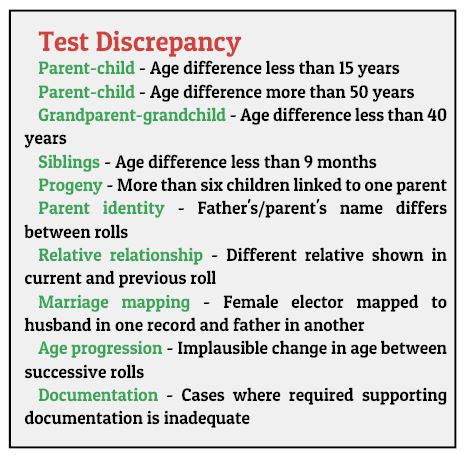
Among the discrepancies reported by election authorities are:
• an age difference of less than 15 years or more than 50 years between parent and child;
• an age difference of less than 40 years between an elector and grandparent;
• a sibling age gap of less than nine months;
• more than six children linked to the same parent;
• inconsistencies between the names of parents in different electoral records.
These are not rules saying that such families cannot exist. They are computer-generated flags for verification.
The distinction matters.
A woman could have a child at 15. A man could become a father at 51. A grandfather could have a grandchild less than 40 years younger than himself. Two siblings could be born within nine months, particularly where there are twins or errors in recorded dates of birth. A family could legitimately have more than six children.
The Supreme Court itself recorded that “logical discrepancies” included, among other things, a difference in grandparents’ ages of less than 40 years and more than six progeny. The Court directed that people falling into this category should be informed and given an opportunity to submit documents or objections.
In Meghalaya, for example, election authorities have specifically listed an age gap of less than nine months between siblings linked to the same parent, and an age difference of less than 40 years between elector and grandparent, among the discrepancies generated during mapping.
This is an important distinction from saying that the Election Commission has introduced a new law that siblings must be at least nine months apart or grandchildren at least 40 years younger than grandparents.
It has not.
The figures are apparently being used as triggers for investigation by the software.
But once a computer-generated anomaly becomes a notice, a hearing or a demand for documentation, the practical consequence for an ordinary citizen can be considerable.
Why should the Election Commission care about the gap between siblings?
This is where the debate becomes more complicated.
Electoral rolls contain enormous quantities of demographic information. Names, addresses, ages and relationships have historically been entered manually and subsequently digitised. Errors are inevitable.
The Election Commission has therefore attempted to use technology to detect improbable combinations.
The official description of the earlier ERONET system makes the rationale explicit. It describes a unified database covering all States and Union Territories, designed to identify duplicate and migrated electors and to generate “demographic similar entries” and “photo similar entries”.
In principle, that is sensible.
If two voters appear to be the same person in different constituencies, the system should flag them. If a child is recorded as being older than a parent, somebody should investigate. If an extraordinary number of people are linked to one individual as children, the record deserves checking.
The difficulty begins when a statistical probability is treated as though it were proof of electoral wrongdoing or ineligibility.
An anomaly is not necessarily an error.
And an error in a database is not necessarily an error in the underlying electoral entitlement.
The bigger Form 6 controversy
The sibling and grandparent tests are part of a wider story.
Form 6 is the statutory application for inclusion of a person in the electoral roll. The current Election Commission voter portal continues to describe it as the form for a person who is 18 or who will shortly turn 18.
In July 2026, however, The Indian Express reported that the online Form 6 on ECINET had acquired an additional declaration requiring a new applicant to indicate whether the applicant, a parent or a grandparent appeared in the previous SIR electoral roll. The applicant could be required to provide the old Assembly constituency, polling station and serial number.
That produced a fundamental legal question.
The Election Commissioners Sukhbir Singh Sandhu and Vivek Joshi reportedly objected that the statutory Form 6 could not simply be changed through the portal without following the prescribed legal procedure. Sandhu described the alteration as unauthorised and called for its removal.
The Election Commission subsequently took a different position.
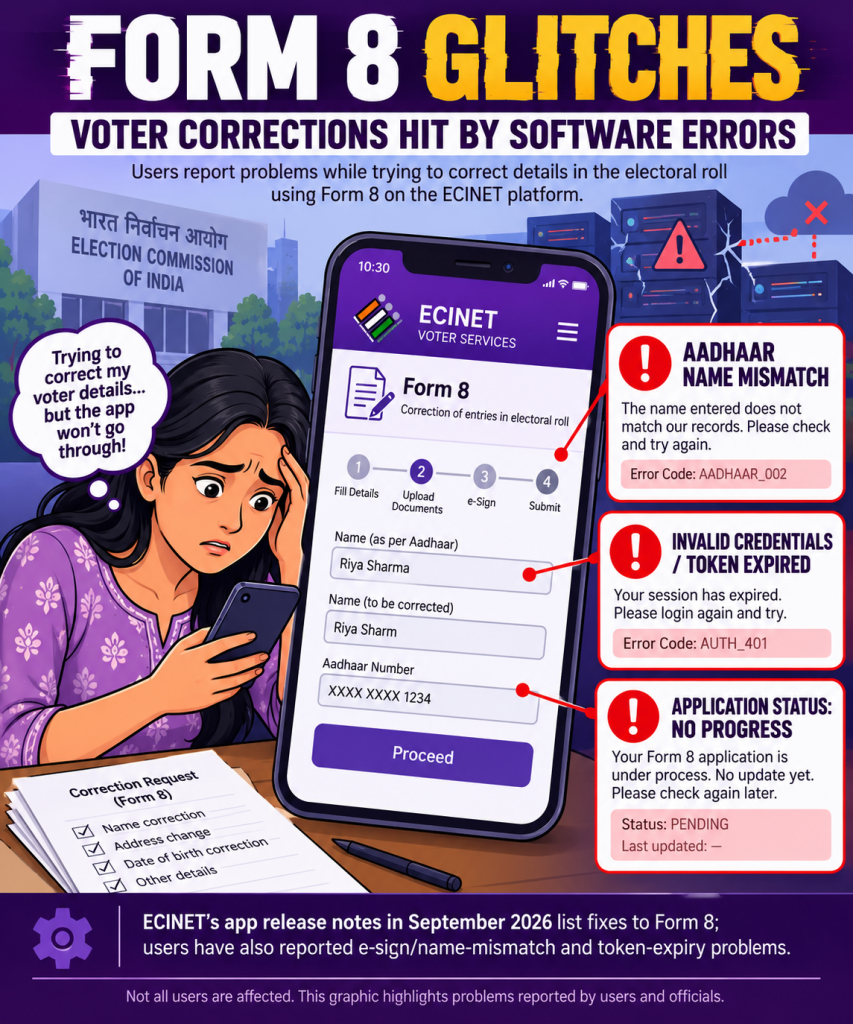
It said there had been no change to Form 6 itself. Instead, it described the new requirement as an additional declaration, Annexure D, required alongside Form 6 during SIR. The Commission pointed to its SIR instructions of June 24, 2025, which directed that Form 6 applications during the exercise be accompanied by the additional declaration.
That distinction — between changing Form 6 and adding an annexure to Form 6 — may appear technical.
It is not.
Forms prescribed under electoral law establish what a citizen must provide in order to seek enrolment. An additional mandatory declaration can therefore have consequences for access to the franchise even if it is not printed inside the statutory form itself.
The Supreme Court’s May 27, 2026 judgment recognised the SIR framework and the Commission’s authority to conduct the exercise. The judgment records that new voters were required to submit Form 6 along with the Declaration Form in Annexure D. It also records the Commission’s stated reasons for the SIR, including demographic change, migration and the need to ensure that only Indian citizens are on the electoral roll.
The question therefore moves from whether the EC can conduct an SIR to how the technological and administrative machinery implementing it should operate.
Enter ECINET
ECINET was launched in January 2026 as the Election Commission’s unified digital platform. The Commission says it integrates more than 40 applications and portals and provides services ranging from voter registration to electoral-roll searches, application tracking and communication with election officials.
The scale is enormous.
The Commission says ECINET processed more than 10 crore registration forms after its beta release, with more than 11 lakh Booth Level Officers registered on the platform. It also says more than 150 crore documents were digitised during SIR.
This is undoubtedly a technological transformation of election administration.
But there is another side to the transformation.
Traditionally, the electoral roll is deliberately decentralised. The Electoral Registration Officer for an Assembly constituency is responsible for preparing, revising and correcting that constituency’s roll. Claims and objections are heard locally.
Technology can assist that officer.
The constitutional and statutory question is whether technology can effectively constrain the officer’s statutory discretion.
The centralisation dispute
This has become one of the most serious issues surrounding ECINET.
According to an Indian Express investigation, Election Commissioners Sandhu and Joshi repeatedly raised concerns about what they described as the gradual centralisation of the electoral-roll database and restrictions on the ability of state-level officers to exercise their statutory functions. Joshi reportedly proposed an audit to ensure that only the legally authorised officials had credentials capable of changing electoral data.
Sandhu reportedly wrote that CEOs, DEOs and EROs are the statutory authorities responsible for electoral rolls, while access controls were being centralised at the level of the Commission’s IT division in Delhi.
The distinction is crucial.
Centralised technology is not necessarily the same thing as centralised decision-making.
A national database can be an efficient administrative instrument while decisions remain with legally authorised local officers.
Indeed, the Election Commission itself makes precisely this argument. Its September 26 statement says field officers have role-based access to ECINET according to their statutory powers, and announced a committee headed by a Senior Deputy Election Commissioner, with an independent IIT/IIIT expert, to review ECINET’s compliance with the Acts and Rules.
The Commission has also said that ECINET is a decentralised platform, despite being a unified digital system.
The dispute therefore cannot properly be reduced to “Delhi controls the voters” versus “local officers control the voters”.
The real issue is more precise:
Who possesses the technical power to permit, prevent, override or delay an action that the law assigns to the ERO?
That is a question that deserves a clear public answer.
The Goa lesson
The issue has acquired particular resonance in Goa.
The Indian Express has reported on 97 Goa voters whose cases were examined by local Electoral Registration Officers and who were found eligible, but whose names were reportedly caught up in problems involving the digital system. The report said Goa’s Chief Electoral Officer repeatedly contacted the Commission in Delhi over the cases.
The significance of those 97 voters is not their number.
It is the institutional principle involved.
Suppose an ERO hears a citizen, examines the documents, considers the objections and concludes that the person is eligible.
What happens next?
If the software accepts the decision, the statutory process works.
If the software prevents the decision from being implemented, the question changes from “What did the ERO decide?” to “What does the software permit the ERO to do?”
That is precisely the point at which technology ceases to be merely an administrative tool.
The danger of confusing an anomaly with a verdict
There is another principle which should not be lost in the technological debate.
The Supreme Court, dealing with logical discrepancies, directed that affected persons be given an opportunity to submit documents and objections and to be heard.
That means a computer-generated discrepancy cannot by itself become a finding that a voter is fraudulent, fictitious or ineligible.
This distinction is especially important in India because civil registration records, birth certificates, marriage records, school certificates and old electoral rolls are far from uniformly accurate.
Older citizens may have approximate dates of birth.
Women may have changed surnames after marriage.
Names may be transliterated differently between English and Indian languages.
Parents may have children from different marriages.
Adoptions, stepchildren and extended families complicate the neat mathematical relationships assumed by a database.
Migration creates another layer of difficulty.
A database likes clean relationships.
Human families rarely are.
The new danger: a young voter inherits an old database problem
The Form 6 controversy raises an even more fundamental question.
Why should an 18-year-old’s right to register as a voter depend upon whether his or her parent or grandparent appeared in an electoral roll prepared decades earlier?
The Election Commission’s answer is that SIR requires verification of electoral lineage and that the additional declaration provides a mechanism for establishing continuity.
Critics argue that the right to vote belongs to the eligible individual and should not become contingent upon the electoral history of a parent.
The two propositions are not necessarily mutually exclusive.
A voter can be required to establish identity, citizenship and residence under the law. But a system designed to prevent duplication must be careful not to convert absence from an old electoral roll into evidence of present ineligibility.
An 18-year-old obviously could not have appeared in an electoral roll prepared when his or her parents were young.
Nor can every family be expected to possess decades-old electoral-roll information.
What the EC should now make transparent
The controversy could be reduced substantially by publishing, in plain language, five things.
First, precisely which legal provision authorises every additional field or declaration attached to Form 6.
Second, which discrepancies are merely automated alerts and which have legal consequences.
Third, whether an ERO can override every automated discrepancy after considering evidence.
Fourth, exactly who has technical authority to add, delete, freeze or modify an electoral entry.
Fifth, an audit trail showing whether a change was made by the ERO, another authorised officer or an automated process.
The Election Commission’s September 26 decision to establish a committee including an independent technical expert is therefore significant. The Commission says the committee will examine ECINET’s compliance with the law and consider whether field officers require additional flexibility.
That review should ideally answer the questions publicly rather than merely internally.
Technology must serve electoral law, not silently rewrite it
There is a larger lesson here.
Digitisation of India’s electoral machinery is inevitable and, in many respects, desirable. A country with hundreds of millions of voters cannot administer its rolls through paper registers alone.
A unified system can identify duplicate entries, detect spelling variations, track applications, reduce delays and make it easier for citizens to monitor their cases.
But centralisation also creates a new institutional risk.
In the paper era, power was dispersed because records were dispersed.
In the digital era, power can become concentrated through permissions, databases, algorithms and software architecture even when the formal law remains decentralised.
That is why the controversy over the six-month sibling gap, the 40-year grandparent gap and the Form 6 declaration should not be dismissed as an argument about computer programming.
It is really an argument about the relationship between citizen, computer and constitutional authority.
A software programme may quite properly say: This relationship looks unusual.
It should not silently become the institution that says: Therefore this citizen is not entitled to vote.
The first is technology.
The second is adjudication.
And in a democracy, the difference between the two matters enormously.
 LETTER TO THE EDITOR FOR ISSUE DATED OCTOBER 03, 2026
 THE FORAL OF 1526 Five Hundred Years Later, What Does Goa’s Oldest Village Charter Really Mean?
 20 YEARS IN ‘HERALD’, 43 IN GOA!
 THE DEGRADATION OF JNU – MY ALMA MATER! By Arvind Pinto
 THE WOMEN WHO LOOK BACK! By Prema Viswanathan
 GOA IS CELEBRITY STATE!
 HI MUMBAI MERI JAAN BUT…
 WEEKEND UPDATES
 LETTER TO THE EDITOR FOR ISSUE DATED SEPTEMBER 26, 2026
 DIVIDED EVEN IN DEATH!By Rajan Narayan
 IF YOU CLAIM THE CREDIT, TAKE THE RESPONSIBILITY!By Joquim Goes
 8 EMAILS IN 7 DAYS, BUT VALID GOA VOTERS STILL LEFT OUT: EC’S FLAWED SYSTEM!By Ritika Chopra
 MAKE IN INDIA: UNITED PAYMENTS INTERFACE India’s digital local leap to global benchmark…By Arvind Pinto
 BRING BACK THE FLATBREADS OF INDIA!
 EARLIER YOU KNOW, THE MORE YOU CAN DO Dementia diagnosis matters… By Dr Vailanki Nazira Raposo
Goa is abuzz with excitement as vintage bike and car owners, users, collectors and fans are decking […]