Goa is abuzz with excitement as vintage bike and car owners, users, collectors and fans are decking […]
Old is Gold
October 4, 2016
THE world is filling up runaway technology marvels and our lives are changing beyond belief. I’m not sure if we should immerse ourselves from dawn to dusk in our new lifestyles of a smart phone in hand almost around the clock. It is very definitely affecting our organic senses not for the better but for the worse. For example, one when we used to sit together to talk, now we don’t even bother to do that for each is wrapped up in a private space of don’t-disturb-me and I’m on phone entertainment, mostly social media good, bad and ugly.
In the countries of the West now they are beginning to realize that too much technology engagement is not good and folk are actually trying to re-connect with the organic earth via gardening their front yards or back yards and having their own kitchen plots of herbs, fruit trees, even spices. In Goa we are still lucky to have so much of the natural earth around us even in our urban towns and I hope this never changes.
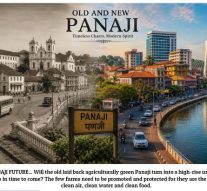
Take capital city Panjim. Despite the high rises steadily seeking to scrape the sky at ground level it is a treat to see the urban plots of farmland still being cultivated in Panjim or its outskirts, adjoining Taleigao, Santa Cruz, Merces, etc. Not only do these urbanized farms offer fresh veggies and fruit but also serve as open air lungs of fresh air, soaking in the rain during the monsoon season. If these urbanized farm landscapes were to disappear we would have nothing but ugly high rise shanty towns or ghettos. Goa would lose appeal even as a tourist destination! There should be a law promoting and protecting these urban farms dotted here and there for the larger good of Goa.
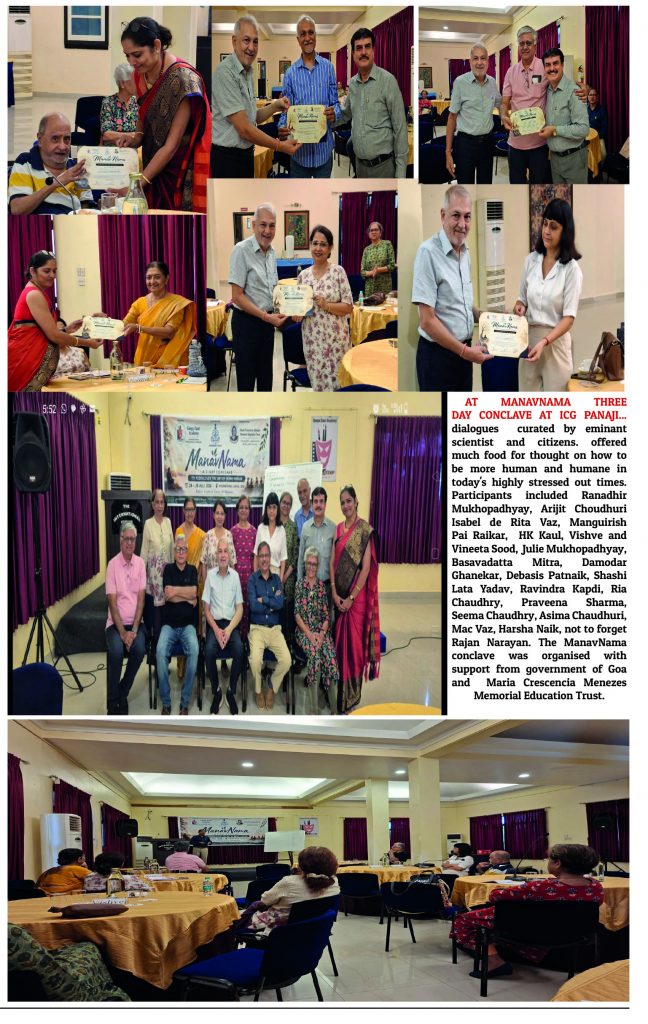
OVER weekend a very interesting dialogue took place at the International Center Goa from July 24 to 26, 2026. The ManavNama conclave was organized by Ganga Zuari Academy with the support of the government of Goa and the Maria Crescencia Menezes Memorial Education Trust. Over three days participants embarked on an immersive inner journey, “to become an active architect of a more humane self and, through that transformation , contribute to building a more compassionate society.” This is to quote the moving spirit behind the conclave, Ranadhir Mukhopadhyay.
There were several thought provoking discussions and take away messages on the subject of how we may be more human and humane in difficult times, especially the kind we’re seeing in recent times when climate change and shocking political changes are affecting everyone around the world and taking a toll on the natural environments of the earth.
Needless to say the conclave was the brainchild of former NIO scientist Ranadhir Mukhopadhyay who got the participants to share life’s experiences with openness, curiosity, humility and mutual respect. Recognizing that every participant is both a learner and a teacher. Familiar speakers were Arijit Choudhuri who is indeed very eloquently perceptive and there was Isabel de Rita Vaz who spoke on the subject of “Are our systems helping us to become more human?”
The focus of her dialogue on three interrelated questions: How can education cultivate imagination? Does modern society encourage imagination or conformity? And how can education promote collaboration rather than competition? Participants observed that imagination flourishes when learners are encouraged to question, explore, create and think independently rather than simply memorize information. Alas, many of our educational systems continue to reward conformity through standardized examinations, rigid definitions of success, and excessive competition. The session emphasized the need to foster collaborative learning environments where teamwork, mutual respect, shared problem-solving and collective achievement are valued alongside academic excellence.
Not to forget that in all this there is the growing incidence of student suicides, stress, anxiety and substance abuse – these subjects were also discussed and most felt these crises often arise from unrealistic expectations placed on young people by society, educational institutions and even parents, many of whom equate academic performance with personal worth and future success.
Most participants underscored the importance of celebrating the life journeys of individuals who, despite being average academically, underperforming students, who went onto make extraordinary contributions to society. The conclusion is that such examples reassure students and parents alike that examination results are only one chapter in life and that character, resilience, imagination and perseverance ultimately shape a meaningful and successful life.
Other speakers included Manguirish Pai Raikar, HK Kaul who along with Arijt Chaudhuri and Isabel de Santa Rita Vaz were the curators of the conclave; there were also Vishve and Vineeta Sood (who interestingly has authored a book on how to home educate children), there were Julie Mukhopadhyay, Basavadatta Mitra, Damodar Ghanekar, Debasis Patnaik, Shashi Lata Yadav, Ravindra Kapdi, Ria Chaudhry, Praveena Sharma, Seema Chaudhry, Asima Chaudhuri, Mac Vaz, Harsha Naik, not to forget Rajan Narayan.
The last word on this very out-of-the-box ManavNama conclave is that for the next 30 days everyone who participated should remember what was shared and be different human beings! That is the true test of such a conclave, quipped Ranadhir Mukhopadhyay, “Let us not let the spirit end here. Pick one idea. Practice it. Share it with one other person.”
I must say the ICG is the ideal place to think and muse over many things esoteric and not so esoteric, pertinent and not so pertinent, these final days of the monsoon on its way out — some like me will say without ever having arrived with any passion this year! On that note, it’s avjo, selamat malam, poite verem, au revoir, arrivedecci, hasta la vista and vachun yeta here for now!
 LETTERS TO THE EDITOR FOR ISSUE DATED SEPTEMBER 12, 2026
 GOAN TEACHERS ARE CONTRACT LABOR!
 THE COLOUR IS PRESTIGIOUS! THE PROCESS MUST BE EQUALLY SO!
 DOGS ATTACK GOANS, OWNERS GET ACQUITTED!By Dr Olav Albuquerque & Deborah Cordeiro
 CYBER FRAUD: A THREAT TO FINANCIAL SECURITY & MENTAL WELL-BEING! By Adv Vinayak (Mama) D Porob
 RUPEE IN FREE FALL: WHY THE SLIDE MATTERS MORE THAN THE NUMBER! By Arvind Pinto
 SHRAVAN BYE-BYE, CHOVOTH WELCOME!
 HUSBANDS SHOULD KNOW HOW TO COOK, BE WILLING TO WASH VESSELS!
 HOLD ON TO LIFE: CHANGING THE NARRATIVE ON SUICIDE! By Dr Amit Dias
 WEEKEND UPDATESLETTER TO THE EDITOR FOR THE ISSUE DATED SEPTEMBER 05, 2026
 WHEN A MOUNTAIN BECAME A RIVER!By Ranadhir Mukhopadhyay
 REAL GROUP TURNS 80!
 WHEN ‘I’LL MARRY YOU’ IS A LIE! Why Goa’s courts are failing women…By Dr Olav Albuquerque & Deborah Cordeiro
 WHEN THE LEGAL FRATERNITY TOOK TO THE FIELD IN GOA! By Adv Vinayak (Mama) D Porob
Goa is abuzz with excitement as vintage bike and car owners, users, collectors and fans are decking […]