Goa is abuzz with excitement as vintage bike and car owners, users, collectors and fans are decking […]
Old is Gold
October 4, 2016
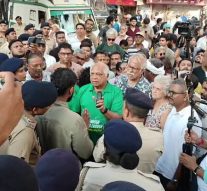
Justice Ferdino Rebello arrived at Azad Maidan during the CJP protest and questioned authorities on the legal basis of denying the permission to hold the protest, asking “under which law was permission denied?”
The detention of activists at Panaji’s Azad Maidan, allegations of the manhandling of Amreen Shaikh, and a High Court order directing the release of detainees have turned a protest over electoral accountability into a test of the Goa administration’s commitment to civil liberties.
The most disturbing question arising from the confrontation at Azad Maidan is not whether the government agreed with the protesters. It is whether the authorities respected their right to protest in the first place.
On October 11, 2026, Goa Police prevented a demonstration organised by the Cockroach Janata Party (CJP), which sought the resignation of Chief Election Commissioner Gyanesh Kumar amid controversy over the revision of electoral rolls. Police barricades restricted access to Azad Maidan in Panaji, activists were detained, and the planned gathering was forced to move to the nearby municipal garden.
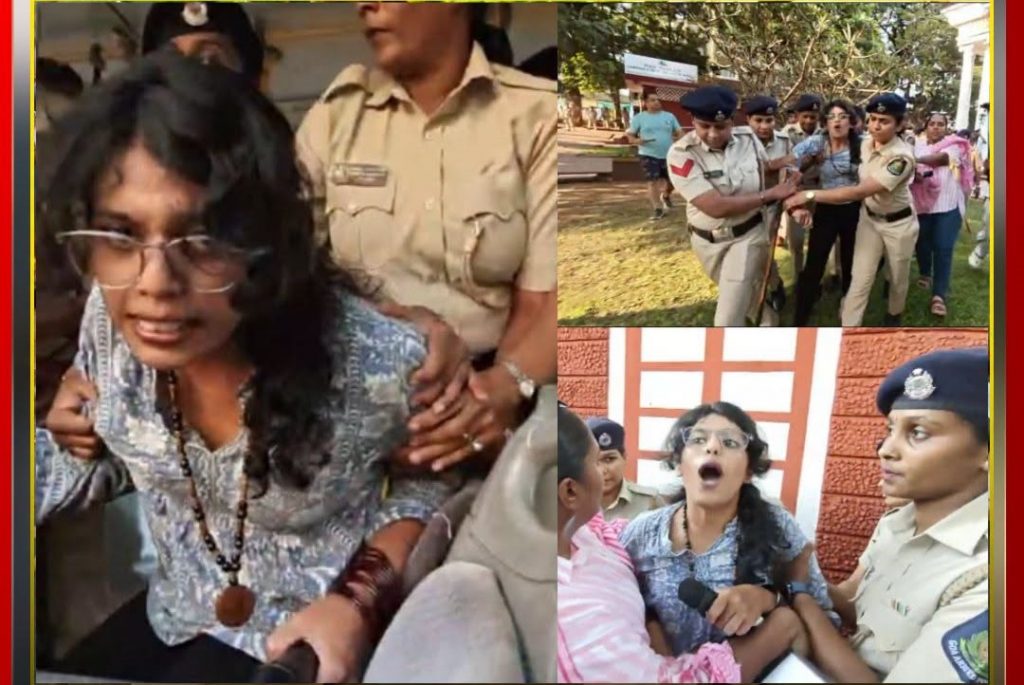
The confrontation took a more serious turn with allegations that activist Amreen Shaikh had been manhandled and that her clothes were torn during the police action. Congress leader Sunil Kawthankar publicly demanded an investigation. The allegations require a transparent inquiry and should not be treated as judicially established findings.
But the incident raises a question that goes well beyond one party, one demonstration or one police station: when the state deploys its coercive power against citizens exercising democratic rights, who holds the state accountable?
For a state that prides itself on its distinctive social character and democratic traditions, the question deserves more than official silence, political point-scoring or a routine departmental inquiry.
The day Azad Maidan became a battleground over civil liberties
Azad Maidan is not simply an open space in the heart of Panaji. It is associated with public meetings, political demonstrations and the expression of dissent. Its importance lies in what it represents: a place where citizens can assemble and make themselves heard.
The CJP demonstration was intended to challenge the Chief Election Commissioner over concerns about electoral-roll revisions. The organisers wanted to take their demand for accountability into the public domain. The administration had denied permission for the gathering, and police subsequently blocked entry to the venue.
The police version must be heard. Officers reportedly maintained that the organisers had previously violated protest conditions, that the activists attempted to enter Azad Maidan despite the refusal of permission, and that detention was necessary to maintain public order. Those are relevant claims, but they do not settle the legality or proportionality of every action taken against every individual.
That distinction is fundamental.
A refusal of permission is an administrative decision. It does not automatically answer whether every subsequent detention was lawful, whether the force used was necessary, or whether the rights of individual protesters were respected.
The proper test is not whether the police were inconvenienced or whether the administration disliked the protest. The test is whether the action taken was legally authorised, necessary, proportionate and open to independent scrutiny.
When those questions are left unanswered, public confidence suffers.
The High Court intervention that changed the course of events
The most consequential development came from the Bombay High Court at Goa.
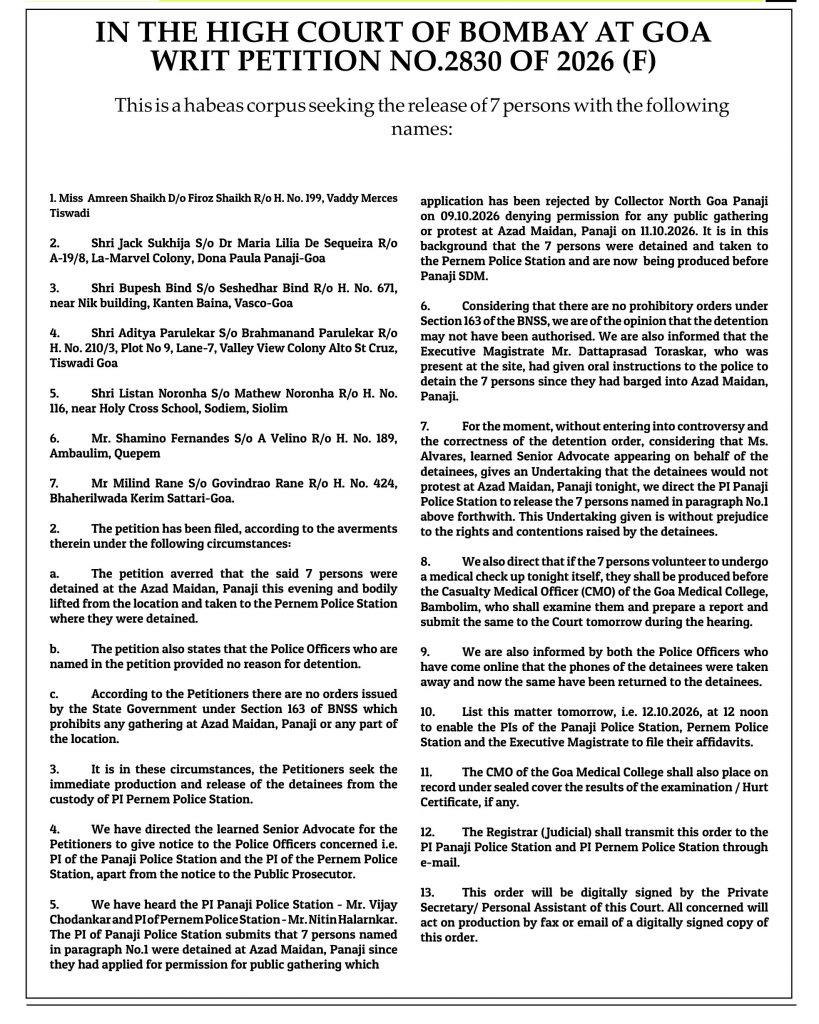
Seven people detained during the confrontation were ordered to be released following an urgent hearing on Sunday evening. The court observed that, in the absence of prohibitory orders under Section 163 of the Bharatiya Nagarik Suraksha Sanhita, the detention may not have been authorised. The court directed their immediate release while leaving the wider controversy unresolved.
That qualification matters. The court did not deliver a final judgment establishing that every aspect of the police operation was illegal. Nor did the release order, by itself, prove allegations of physical abuse.
Nevertheless, the intervention raises a serious issue for the administration: what was the precise legal basis for detaining these individuals, and was the procedure followed consistent with the law?
The police reportedly said that the protesters were detained after entering an area where permission for their gathering had been refused. The activists, meanwhile, disputed the justification for their detention.
The disagreement should be resolved through evidence, not competing assertions.
The detention order, the relevant administrative instructions, police station records, arrest or detention documentation, CCTV footage and body-camera footage, if available, should be examined. The officers responsible should explain their decisions. The activists should have access to legal remedies and independent medical assessment where injury is alleged.
A court’s intervention is not an embarrassment to be brushed aside. It is a reminder that executive power operates within legal limits.
Amreen Shaikh: the allegations that demand answers
The allegations concerning Amreen Shaikh are among the most troubling aspects of the confrontation.
Reports published after the protest said that Shaikh was among those detained. Subsequent political criticism alleged that she had been manhandled and that her clothes were torn during the police action. The circumstances of the alleged incident, the identities of any officers involved and the precise sequence of events require independent verification.
There is no justification for treating an allegation of this seriousness as either automatically proved or automatically dismissed.
If a woman protester was subjected to unnecessary force, humiliation or degrading treatment, the authorities must establish what happened and hold anyone responsible to account. If the police dispute the allegation, they should produce the available evidence and allow it to be examined independently.
The issue is not whether Shaikh belongs to a political organisation that the government approves of. It is whether she was treated lawfully and with dignity.
A person’s political associations cannot extinguish constitutional protections. Nor should a woman’s dignity depend on whether her political views are acceptable to those in power.
The demand for an inquiry must therefore be specific. Investigators should establish whether force was used, who authorised it, whether female police personnel were involved where required, whether the detention and handling of the protester followed applicable procedures, and whether any medical examination documented injuries.
The complainant should be able to give her account without intimidation. Witnesses should be interviewed, and relevant footage should be preserved before it disappears or is overwritten.
If the evidence establishes misconduct, disciplinary and criminal proceedings should follow wherever legally warranted. If particular allegations cannot be substantiated, the findings should explain why.
That is what accountability looks like. A press statement denying wrongdoing is not a substitute for an investigation.
The right to protest is not a favour granted by the government
India’s Constitution protects freedom of speech and expression under Article 19(1)(a), and the right to assemble peacefully and without arms under Article 19(1)(b).
These rights are subject to constitutionally permitted restrictions, including those concerning public order. The government can regulate demonstrations, impose lawful conditions and take action against violence or genuine threats to public safety.
But regulation is not the same as suppression.
A democratic administration must explain why restrictions are necessary, apply them fairly and consider whether less restrictive alternatives are available. The mere fact that a protest is inconvenient, embarrassing or politically uncomfortable cannot, by itself, settle the question.
This is particularly important when the protest concerns the functioning of a constitutional institution.
The CJP’s demand for the resignation of the Chief Election Commissioner was a political demand, not a judicial finding that the Commissioner had committed wrongdoing. Concerns about electoral-roll revisions likewise require examination of evidence and the Election Commission’s response.
Citizens are entitled to raise such concerns peacefully. The government and the Election Commission are entitled to respond and defend their actions. Neither side should be permitted to replace evidence with rhetoric.
A government that believes a protest is misguided should be able to withstand public criticism. It can answer the allegations, publish relevant information and defend its record.
Preventing a demonstration may stop a gathering temporarily. It cannot, by itself, resolve the underlying dispute.
When preventive policing becomes excessive
The Goa Police have cited previous alleged violations of protest conditions and concerns about public order in explaining the action against the CJP. Those explanations must be assessed on their merits.
Previous misconduct, if established, can be relevant to decisions about future demonstrations. But it does not give the police unrestricted authority over every subsequent gathering or justify treating every participant as responsible for every alleged breach.
Responsibility must be individualised. The conduct of organisers, the behaviour of particular demonstrators, the nature of the alleged threat and the orders actually in force all matter.
If a gathering is prohibited by a lawful order, police may have grounds to intervene. But the existence, scope and applicability of that order must be established. Officers must still comply with legal requirements governing detention, use of force and treatment of those in custody.
The High Court’s observation that the detention may not have been authorised makes the legal basis of the Goa operation a central question, rather than a technical detail.
The distinction between maintaining public order and suppressing dissent is not always determined by the intentions claimed by the authorities. It must be assessed against the actual legal powers exercised and the evidence of what happened.
A peaceful demonstrator, a person accused of obstructing police and a person suspected of committing a criminal offence cannot simply be placed in one undifferentiated category.
The rule of law requires distinctions, due process and evidence.
The treatment of detainees must also be investigated
The controversy did not end at Azad Maidan.
Reports said that the detainees were taken to Pernem Police Station, a considerable distance from Panaji. The activists’ side alleged that their phones were taken away and that they were not allowed to contact others. Police accounts disputed allegations of mistreatment and said the detainees were provided with basic facilities.
These competing accounts deserve proper examination.
Authorities should disclose the legal basis for taking the detainees to Pernem, the time of their detention and release, the records maintained at the station, and the arrangements made for communication with lawyers and family members. Any seizure of personal property should be documented and legally justified.
If a detainee alleges injury, the response should not be to argue that the person was given water or allowed to sit. Basic amenities are obligations, not evidence that every other aspect of detention was proper.
Medical records, contemporaneous photographs, witness accounts and available video footage can help establish the facts.
There is also a practical question of proportionality. If the objective was to prevent entry into Azad Maidan, why was detention necessary for each individual? Could lawful directions, dispersal or other less restrictive measures have achieved the same purpose?
The answers may differ from person to person. That is precisely why a credible investigation must examine individual circumstances rather than endorse or reject the entire police operation as a single block.
A former judge’s presence adds weight to the questions
Former Allahabad High Court Chief Justice Ferdino Rebello was among those who supported the protest and questioned the grounds on which access to Azad Maidan had been denied.
Rebello had publicly backed the demonstration through the Enough Is Enough movement. During the confrontation, he challenged the restrictions on entry and raised questions about the right to protest.
His presence does not, in itself, determine the legality of the police action. A retired judge’s view is not a substitute for a court’s ruling on the merits.
But the episode highlights a broader institutional concern: public authorities should be able to explain their decisions in clear legal terms, particularly when citizens and experienced legal figures question the basis for restricting a demonstration.
The High Court’s subsequent intervention made the question more urgent.
The administration should publish or otherwise make available the relevant permission decision and legal orders, subject to legitimate legal restrictions. It should explain the basis for the deployment, the instructions given to officers and the decision to detain the demonstrators.
If the action was lawful and proportionate, a transparent explanation would help establish that. If it was not, the public deserves to know what went wrong.
What the Chief Minister and police leadership must do
The responsibility for resolving this controversy cannot be left entirely to the officers who were present at the scene.
Chief Minister Pramod Sawant, who also holds the Home portfolio, and the senior police leadership should ensure that the allegations are investigated credibly and that the relevant records are preserved.
The immediate steps should include:
• An independent inquiry: An officer or investigating body sufficiently independent of the personnel involved should examine the allegations of manhandling and the circumstances of detention.
• Preservation of evidence: Secure CCTV footage, recordings from police vehicles, photographs, duty rosters, wireless communications, detention records and relevant orders.
• Medical documentation: Ensure that protesters alleging injuries can obtain appropriate examinations and that their records are considered by the investigating authority.
• A clear legal explanation: Publish the grounds for refusing permission, the legal authority relied upon during the operation and the reasons for transporting detainees away from Panaji.
• Accountability where misconduct is established: Initiate appropriate departmental or criminal proceedings, depending on the evidence and applicable law.
• Safeguards for future protests: Establish clear operational instructions on proportionality, detention, access to legal assistance and the treatment of women demonstrators.
An inquiry must not become a mechanism for postponing accountability indefinitely. It should have a defined scope, a reasonable timetable and a public report, subject to necessary protections for privacy and ongoing proceedings.
The government should also make clear that no protester will face retaliation merely for making a good-faith complaint about police conduct.
Goa cannot afford to normalise the suppression of dissent
There is a danger in treating every confrontation between police and protesters as a temporary political drama.
One day the demonstrators may belong to a party opposed to the government. On another, they may be students, workers, environmental campaigners, residents resisting a development project or citizens protesting an administrative decision.
The same principles must apply to all of them.
A government cannot insist that citizens respect the law while treating legal safeguards as optional when the authorities themselves are challenged. Nor can protesters claim immunity from lawful restrictions simply because their cause is political.
The standard must be consistent: peaceful assembly is protected; violence and criminal conduct may be addressed through lawful procedures; and allegations of abuse by public officials must be investigated impartially.
That standard protects the police as well. Officers performing their duties lawfully should not be condemned on the basis of unverified accusations. A transparent investigation protects honest personnel by distinguishing legitimate policing from individual misconduct.
But institutional credibility requires the police to welcome scrutiny rather than resist it.
The alleged treatment of Amreen Shaikh, the detention of activists and the High Court’s concern about the legal authorisation for those detentions together demand a clear public accounting. They do not justify declaring every allegation proved before an inquiry. Equally, they do not justify dismissing the controversy as a routine law-and-order matter.
The administration now has an opportunity to demonstrate that the law applies equally to the state and the citizen.
The final test: who guards the guardians?
The events at Azad Maidan have left Goa with questions that cannot be answered by barricades, detentions or political counter-accusations.
Was the refusal of permission legally justified? What precise order authorised the subsequent action? Were the detentions necessary and lawful? What happened to Amreen Shaikh? Were the applicable safeguards observed? And why did the High Court consider that the detention may not have been authorised?
These are questions for evidence, investigation and judicial scrutiny—not for partisan speculation.
The state has the power to deploy police personnel, control access to public spaces and intervene when public order is genuinely threatened. That power exists to protect citizens, not to place the government beyond criticism.
The true measure of a democratic administration is not how efficiently it can disperse a protest. It is how faithfully it can protect the rights of people whose views it rejects.
The police uniform carries authority, but also responsibility. If an officer crosses the law, the uniform cannot become a shield against investigation. If a detention lacks lawful authority, the inconvenience of the administration cannot make it legitimate. And if a woman is mistreated while exercising her rights, her complaint deserves a serious and impartial hearing.
Goa’s government must now answer the allegations with evidence, disclose the legal basis for its actions and ensure accountability wherever wrongdoing is established.
A democracy is not weakened when citizens question the police. It is weakened when the police, or the government controlling them, are allowed to escape legitimate scrutiny.
Editorial note: This article is based on reports available as of October 14, 2026. Allegations of physical mistreatment remain allegations unless established through reliable evidence or formal findings. The High Court’s reported observation concerning detention should not be represented as a final ruling on every aspect of the police operation.
 LETTER TO THE EDITOR FOR THE ISSUE DATED OCTOBER 17, 2026
 AZAD MAIDAN NO LONGER FREE!
 INDIAN WOMEN ARE ON THE STREETS AGAIN. EVERYTHING HAS CHANGED BUT NOTHING HAS CHANGED!By Shilpa Phadke
 RBI TIGHTENS SCREWs ON ECONOMY!By Arvind Pinto
 SSR OVERRULED SIR IN GOA!
 HI MUMBAI MERI JAAN BUT…
 RAJENDRA ARLEKAR WILL REPLACE PRAMOD SAWANT?
 MENTAL HEALTH ACROSS THE LIFESPAN! By Dr Amit Dias
 WEEKEND UPDATES
 LETTER TO THE EDITOR FOR THE ISSUE DATED OCTOBER 10, 2026
 WHEN THE MACHINE OVERRIDES THE LAW!
 HAS GOA BECOME MORE PERMISSIVE? By Special Correspondent
 BILLIONAIRES MULTIPLYING AT THE COST OF THE MIDDLE CLASS!
 THE SHADOW OF VOTE THEFT: WHY CEC GYANESH KUMAR MUST RESIGN!By Dr Olav Albuquerque & Deborah Cordeiro
 ULTRA MODERN ‘MID-DAY’ OFFICE
Goa is abuzz with excitement as vintage bike and car owners, users, collectors and fans are decking […]