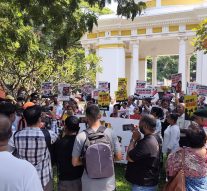
Despite being denied permission to hold an assembly at Azad Maidan, CJP Goa told its October 11 protest already proceed as planned. The team alleges that it followed the required process to obtain permission but was sent from one government office to another while pursuing its request. CJP Goa has invoked its constitutional right to peaceful protest and maintained that the denial will not change its plans. The organisation has reiterated that the protest took place on October 11, as scheduled.
Women seem to be the primary victim of the BJP goons who are defending the Chief Election Commissionor Gyanesh Kumar and the IT head Seema Khanna. All the anger against Neha Bora is being directed against young activist like Amreen Shaikh and Jack Sukhija grandson of Jack de Sequeira. Even the former chief justice of the Allahabad court Ferdino Rebello was challenged by some petty policers.
The confrontation involving former Chief Justice Ferdino Rebello, the detention of Amreen Shaikh and the allegations of police manhandling have raised serious questions about the limits of state power in a democracy. The events at Azad Maidan in Panaji on October 11, 2026, should concern every citizen who believes that the right to dissent is fundamental to democracy. A protest organised by the Cockroach Janata Party (CJP), demanding the resignation of Chief Election Commissioner Gyanesh Kumar over controversies surrounding the revision of electoral rolls, ended in a confrontation with the police. Among those detained was CJP volunteer Amreen Shaikh. Former Chief Justice of the Allahabad High Court Ferdino Rebello appeared at the site and questioned the legal basis for the police action. The episode subsequently acquired a more troubling dimension. A report published by Goa Khabar on October 12 quoted Goa Pradesh Congress Committee working president Sunil Kawthankar condemning the alleged manhandling of Shaikh, reportedly resulting in her clothes being torn. He demanded an inquiry and action against those responsible. The precise circumstances of the alleged incident, however, have not been independently established in the reports available to me. That distinction matters. An allegation of sexual assault or sexual humiliation is too serious to be sensationalised, dismissed or converted into an established fact without evidence. Equally, it is too serious to be brushed aside merely because the alleged perpetrators belong to a uniformed force. The central question is not whether the protesters were politically agreeable to the government, or whether the CJP’s demand was justified. It is whether the authorities acted within the law, whether the force used was proportionate, and whether the dignity and rights of every detained person, particularly a woman, were protected.
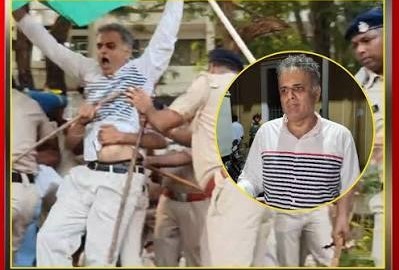
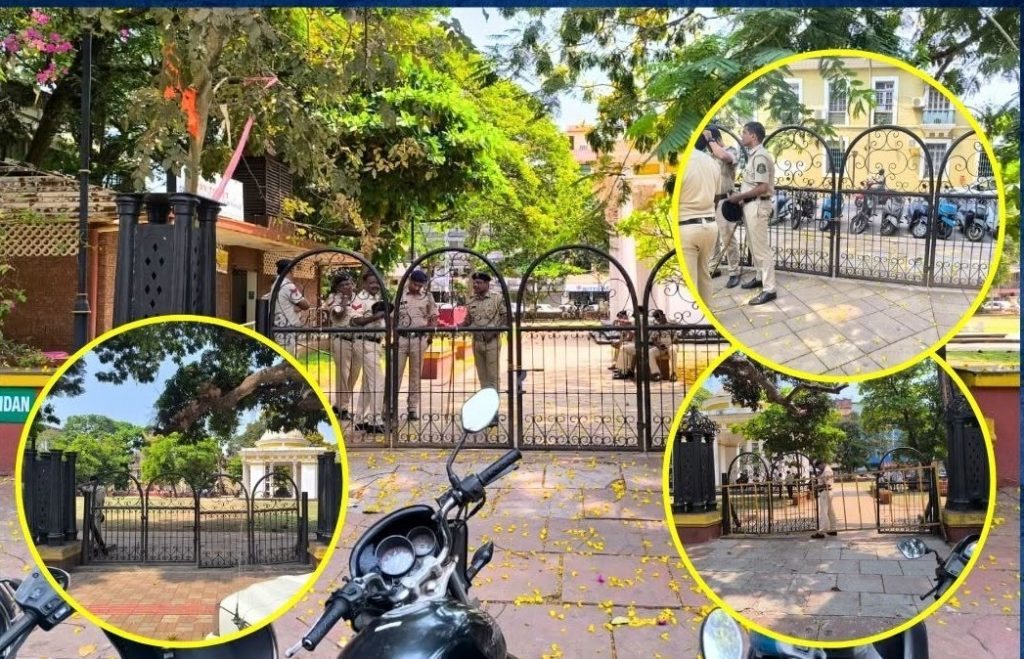
Azad Maidan becomes a battleground Azad Maidan is more than an open space in the state capital. It is associated with public meetings, political mobilisation and the expression of grievances. Its symbolic importance lies in the proposition that citizens must have places where they can assemble and make themselves heard. The CJP sought permission to hold a public assembly there on October 11. According to The Goan, the North Goa District Magistrate rejected the application, citing a negative report from the Superintendent of Police, North Goa. Despite the refusal, the organisers decided to proceed with their protest. Police personnel erected barricades and prevented demonstrators from entering the ground. The resulting confrontation led to the detention of several people, including Shaikh and Corporation of the City of Panaji corporator Jack Sukhija. The police were entitled to regulate public assemblies in accordance with the law. The administration was also entitled to assess genuine security risks and impose lawful, proportionate restrictions. The right to protest does not mean that every gathering must be permitted at every location and at any time. But the other side of the constitutional equation is equally important. An application being rejected does not automatically give the police unlimited authority to detain everyone who challenges the decision. Nor does a physical confrontation at a barricade, without more, establish that every person detained has committed an offence. The law must distinguish between an organiser who knowingly violates a lawful restriction, a demonstrator who attempts to enter a prohibited area, a person who peacefully questions a police officer and an individual who actually uses violence. A democracy cannot function if these distinctions disappear whenever the administration finds a protest inconvenient.
Ferdino Rebello: a former judge challenges the police The presence of Justice Ferdino Rebello transformed the confrontation from a local dispute over permission into a public examination of constitutional authority. Rebello had already announced his support for the CJP’s campaign. On October 9, he said the movement had his backing and argued that public concerns about the Election Commission could not simply be ignored because the issue was before the courts. He also cautioned that movements demanding the resignation of constitutional authorities must avoid descending into anarchy. His position raises an important distinction. A former judge has no executive authority to countermand a police officer at a protest site merely by virtue of having held judicial office. But a former judge has every right, as a citizen, to question the legality of official action and draw attention to constitutional principles. The significance of Rebello’s intervention lies in the questions it brought into the open. What was the legal order authorising the detention? Was there a prohibitory order covering Azad Maidan? Who took the decision to detain the protesters? Were the police implementing a lawful written order or relying on instructions communicated at the scene? These are not technical questions that can be dismissed as legal hairsplitting. They go to the heart of the relationship between the citizen and the state. According to The Indian Express, the Bombay High Court at Goa subsequently noted that no prohibitory order under Section 163 of the Bharatiya Nagarik Suraksha Sanhita (BNSS) was in force at the location. The bench observed that the detention “may not have been authorised”. It also recorded that Executive Magistrate Dattaprasad Toraskar had allegedly given oral instructions to the police to detain the seven people because they had entered Azad Maidan. The court ordered their release that night, while expressly declining, at that stage, to settle the entire controversy surrounding the detention. That qualification is important. The order should not be misrepresented as a final judgment on every aspect of the police action. Nevertheless, the court’s concern about the authority for detention is a serious matter that deserves a full explanation from the administration. If the police believed that the protesters had committed a specific offence, they should identify it and explain the legal basis for the action taken. If they were acting on an executive magistrate’s instructions, the administration should explain the authority under which those instructions were issued. The rule of law requires public officials to demonstrate that their actions are lawful. It does not require citizens to accept official assurances as a substitute for evidence.
Amreen Shaikh: the allegation that demands an independent inquiry The most disturbing aspect of the confrontation is the allegation concerning Amreen Shaikh. Goa Khabar reported on October 12 that Congress leader Sunil Kawthankar had condemned the alleged manhandling of the CJP volunteer, reportedly resulting in her clothes being torn. He called for a thorough inquiry and accountability. The report did not establish the precise sequence of events or independently verify the allegation. At this stage, the responsible course is to describe this as an allegation of physical mistreatment and possible sexual humiliation, not to pronounce that a sexual assault has been proved. But the absence of a completed investigation is not a reason for official silence. When a woman is detained during a public protest, the state assumes an immediate responsibility to protect her physical safety, privacy and dignity. If she alleges that police personnel used excessive force or handled her in a manner that exposed her body or damaged her clothing, the allegation must be examined promptly and impartially. The inquiry should establish exactly what happened at the barricades, during any physical struggle, and during transportation and detention. It should determine which officers were present, who gave instructions, whether force was used, and whether any officer acted outside the limits of lawful duty. The difference between an accidental tear in clothing during a chaotic struggle and deliberate conduct intended to humiliate or sexually violate a woman is substantial. The distinction cannot be resolved through political statements alone. It requires evidence. That evidence should include available CCTV footage, recordings made by protesters and journalists, police station records, vehicle logs, duty rosters and any medical examination conducted after detention. Relevant footage must be preserved before it is overwritten or lost. If Shaikh provides a formal complaint, her account should be recorded in a manner that protects her privacy and avoids unnecessary public exposure. Any medical examination should follow the applicable legal safeguards and be conducted with appropriate sensitivity. The investigation should also examine whether she was informed of the grounds for her detention, whether her access to legal assistance was facilitated and whether the statutory safeguards applicable to the detention of women were observed. No political party should be permitted to substitute its own version of events for a properly conducted inquiry. Equally, no police department should be allowed to investigate serious allegations against its own personnel without independent scrutiny. If wrongdoing is established, the officers responsible should face the appropriate criminal, departmental or other proceedings. If the allegation is not substantiated, that conclusion should also be based on transparent evidence rather than a blanket denial. The essential principle is simple: a woman exercising a political right does not surrender her dignity at a police barricade.
AAP leader Jack Sukhija was setenced to seven days in police custody for violating the ban on holding protest at Azad Maidan on October 11.
What the High Court’s intervention tells us The court’s response provides the clearest documented legal development in the episode. Two habeas corpus petitions were filed seeking the production and release of the detained protesters. The seven people had been taken from Panaji to Pernem, more than 30 kilometres away, according to contemporaneous reports. The court ordered their release and directed that those requiring medical examination be taken to Goa Medical College. It also directed the relevant police inspectors and executive magistrate to file affidavits. These directions matter for three reasons. First, they demonstrate that executive action is subject to judicial scrutiny even when the government invokes public order. Second, they show the practical importance of habeas corpus. A person who believes that someone has been unlawfully detained can ask the court to examine the legality of the custody. The remedy is particularly important when the detainee cannot readily communicate with family, lawyers or supporters. Third, the directions for affidavits and medical examination create an opportunity to establish what happened rather than allowing competing accounts to remain unresolved. The High Court’s observation that the detention may not have been authorised is not a declaration that the police have no power to regulate protests. It is a reminder that such power must be exercised under a valid legal framework. There is also a larger institutional lesson. The police, the executive magistracy and the courts each have distinct responsibilities. A magistrate cannot replace a lawful statutory basis with informal instructions where the law requires a specific order or procedure. The police cannot treat a rejected application for a gathering as a universal licence to detain people. And the judiciary must be able to examine these actions without intimidation or political pressure. The public should now be told what happened after the initial hearing. Were the required affidavits filed? What did the medical reports establish? Did the court examine Shaikh’s separate petition? What explanation did the authorities provide for taking the detainees to Pernem? Those questions require answers from the subsequent court record and official statements, not assumptions.
The legal safeguards surrounding the detention of women The detention of Amreen Shaikh also raises questions about the special safeguards that Indian law provides to women in police custody. Section 43(5) of the BNSS generally provides that a woman should not be arrested after sunset and before sunrise except in exceptional circumstances, with prior permission from a Judicial Magistrate of the First Class and a written report by a woman police officer. The provision concerns arrest; its precise application depends on the legal character of the action taken against the individual. In this case, the authorities must clarify whether Shaikh was formally arrested, preventively detained or otherwise taken into custody, and what legal procedure they relied upon. The High Court hearing brought this issue into the open. According to The Times of India, the lawyers appearing for the petitioners argued that Shaikh, being a woman, could not be detained beyond 6 pm. The court also directed the police inspectors and executive magistrate to file affidavits. The legal position should be established from the applicable statutory provisions and the court’s subsequent findings, rather than from generalised claims about what the police can or cannot do. But the underlying principle is beyond dispute: detention cannot become an opportunity for humiliation, intimidation or punishment outside the law. The government must explain whether the prescribed safeguards were observed. If any officer violated them, the consequences should follow through the appropriate legal process.
all four gates of the Azad Maidan had been barricaded and closed with heavy police deployed
From a dispute over permission to a question of democratic freedom The immediate confrontation occurred in Goa, but the protest was part of a wider national movement concerning the Election Commission and the revision of electoral rolls. The CJP’s demand for Gyanesh Kumar’s resignation is rooted in allegations concerning the Special Intensive Revision (SIR) process. Critics have questioned the deletion of names from electoral rolls and raised concerns about the transparency and fairness of the exercise. The Election Commission and the government must answer substantive allegations through evidence, due process and judicial scrutiny. The right to vote is central to representative democracy. So is the right to question the administration of elections. However, demanding the resignation of a constitutional functionary is a political demand, not a judicial finding of wrongdoing. The allegations against the Election Commission must be assessed on their evidence and merits. The right to protest does not automatically establish the truth of every claim made by protesters. The same standard must apply to the government. Authorities cannot treat the very act of criticising a constitutional office-holder as proof that a gathering threatens public order. Nor can protesters assume that their political cause exempts them from reasonable and lawful regulation. The constitutional balance lies between these positions: peaceful dissent deserves protection, while genuine threats to public safety can be addressed through proportionate and legally authorised measures. Goa’s Azad Maidan confrontation demonstrates what happens when that balance is questioned. Barricades, detentions and a late-night court hearing became the focus of attention that might otherwise have remained on the original electoral controversy. The administration should ask whether its handling of the gathering protected public order or unnecessarily intensified a confrontation.
The responsibility of the Goa government Chief Minister Pramod Sawant and the state Home Department should not allow the controversy to be reduced to a contest between political parties. There are several distinct matters requiring clarification. First, the government should publish or identify the legal order under which permission for the assembly was refused, together with the reasons recorded by the competent authority. Second, it should explain the precise legal basis for the detention of the seven protesters, including the role played by the executive magistrate and the instructions communicated to the police. Third, the government should address the allegation concerning Shaikh. If a complaint has been filed, the investigation should be conducted independently of the officers whose conduct is questioned. If no complaint has yet been registered, the authorities should provide a safe and accessible mechanism for her to make a statement. Fourth, the available CCTV footage, police records, vehicle logs and other relevant material should be preserved. The public should be informed of the findings when disclosure is legally permissible. Finally, any officer found responsible for unlawful detention, excessive force or sexual misconduct should face appropriate proceedings. These are not unreasonable demands for a government to meet. They are the minimum expectations of accountable administration. The police also deserve a fair process. Individual officers should not be declared guilty merely because a political leader has made an allegation. Their conduct must be assessed through evidence, and they must be given the opportunity to respond. But the presumption of innocence for individual officers cannot become a presumption that every police action was lawful.
Why the controversy matters beyond Goa Goa has often projected an image of a society comfortable with debate, diversity and public discussion. Its reputation, however, cannot be protected by public relations alone. It must be sustained by the conduct of its institutions. The confrontation at Azad Maidan presents three tests. The first is the test of legality. Can the administration demonstrate that it followed the law when it denied permission and detained the protesters? The second is the test of accountability. Will the government investigate the allegations concerning Shaikh with the seriousness they warrant, regardless of the political affiliations of those involved? The third is the test of democratic maturity. Can authorities tolerate a protest that criticises a powerful constitutional institution without treating dissent itself as a threat? These tests are interconnected. If an administration cannot explain the legal basis for detention, public confidence suffers. If an allegation of mistreatment is left unanswered, suspicion deepens. And if citizens come to believe that peaceful political participation exposes them to arbitrary detention, the right to protest becomes weaker in practice even when it remains protected on paper. The former chief justice’s intervention gave the incident added significance because it brought legal scrutiny directly to the scene. Yet the issue is larger than the intervention of any individual, however distinguished. Democracy cannot depend upon a retired judge being present whenever citizens believe that their rights are being violated. It must depend upon institutions that operate lawfully even when no prominent person is watching.
Conclusion: The barricades must not become the boundary of democracy
The Azad Maidan confrontation is not yet a closed chapter. The High Court’s release order, its concerns about the authority for detention and its directions for affidavits and medical examinations provide a basis for further scrutiny. The allegation that Amreen Shaikh was manhandled, with her clothes reportedly torn, demands a separate and impartial investigation.
It would be premature to declare that a sexual assault has been conclusively established. It would be equally wrong to dismiss the allegation without investigating it.
The government must answer for the legal decisions taken by its administration. The police must account for the conduct of their personnel. The courts must be allowed to examine the evidence. And the complainant must be treated with dignity throughout the process.
Justice Ferdino Rebello’s confrontation with the authorities has drawn attention to a fundamental democratic question: how should a state respond when citizens challenge its decisions in public?
The answer cannot be that the state must always yield to a protest. Nor can it be that the state may suppress a protest simply because permission was refused or the criticism is politically uncomfortable. The answer must be law, proportionality and accountability.
A barricade can control entry into a public ground. It cannot extinguish a citizen’s constitutional rights. A police uniform carries authority, but that authority is limited by law. And a woman who enters public life as a political activist does not forfeit her right to bodily dignity.
The real test of Goa’s democracy will not be whether the government can prevent a protest at Azad Maidan. It will be whether the government can demonstrate that it acted lawfully, protect the rights of those detained and establish the truth about the allegations made against its police force.
Until those questions are answered, the controversy remains a matter of public interest—and the demand for transparency remains entirely legitimate.

 LETTER TO THE EDITOR FOR THE ISSUE DATED OCTOBER 17, 2026
 AZAD MAIDAN CRACKDOWN! Goa’s crackdown on protesters raises grave questions about democracy! By Our Special Correspondent
 INDIAN WOMEN ARE ON THE STREETS AGAIN. EVERYTHING HAS CHANGED BUT NOTHING HAS CHANGED!By Shilpa Phadke
 RBI TIGHTENS SCREWs ON ECONOMY!By Arvind Pinto
 SSR OVERRULED SIR IN GOA!
 HI MUMBAI MERI JAAN BUT…
 RAJENDRA ARLEKAR WILL REPLACE PRAMOD SAWANT?
 MENTAL HEALTH ACROSS THE LIFESPAN! By Dr Amit Dias
 WEEKEND UPDATES
 LETTER TO THE EDITOR FOR THE ISSUE DATED OCTOBER 10, 2026
 WHEN THE MACHINE OVERRIDES THE LAW!
 HAS GOA BECOME MORE PERMISSIVE? By Special Correspondent
 BILLIONAIRES MULTIPLYING AT THE COST OF THE MIDDLE CLASS!
 THE SHADOW OF VOTE THEFT: WHY CEC GYANESH KUMAR MUST RESIGN!By Dr Olav Albuquerque & Deborah Cordeiro
 ULTRA MODERN ‘MID-DAY’ OFFICE