Goa is abuzz with excitement as vintage bike and car owners, users, collectors and fans are decking […]
Old is Gold
October 4, 2016
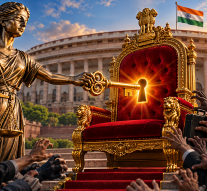
A NATION may build towering cities, send spacecraft towards distant planets, expand its digital infrastructure and celebrate impressive economic growth. Yet one disturbing question remains: what happens when the power to build is not matched by the integrity to serve?
The question touches our daily lives. It arises when public contracts favour unworthy bidders, officials treat public office as personal property, police abuse their authority, teachers exploit vulnerable students, or political representatives place private interests above public welfare. It also surfaces in corporate boardrooms, where profit eclipses responsibility, and in academic institutions, where credentials sometimes matter more than intellectual honesty.
These are not merely isolated instances of misconduct. They expose a deeper institutional deficiency: we have elaborate mechanisms to measure economic performance, professional competence and administrative efficiency, but no equally credible, comprehensive framework for assessing the integrity with which power is exercised. Could India help develop one?
Beyond Corruption: The Missing Pillar of Development — _In Chapter 10 of Theory of India (Walnut, 2025), titled “Character Integrity Index”, political scientist Pinakpani Bharadwaj argues that education, health and character are interconnected foundations of national flourishing. Economic progress, however desirable, cannot replace ethical conduct, social justice, and public trust.
Building on this proposition, a Character & Integrity Index (CII) deserves serious national debate.
ECONOMIC growth and infrastructure remain indispensable. But their benefits depend on the institutions that allocate resources, make decisions and treat citizens. A road contract can create public value or private enrichment. A welfare programme can protect vulnerable families or become an instrument of patronage. A regulator can defend the public interest or serve those it is supposed to regulate. The difference often lies in the integrity of those exercising authority and the systems governing their conduct.
Integrity, therefore, means more than refusing a bribe. It includes truthful declarations, responsible handling of public funds, impartial decision-making, disclosure of conflicts of interest, accountability for decisions, respect for the law and protection of human dignity. An official who never accepts a bribe but routinely humiliates subordinates, discriminates against citizens, or suppresses inconvenient information may still abuse entrusted power.
The central principle is simple: ethical declarations matter, but demonstrated conduct matters more.
What Should an Integrity Index Measure?
The proposed CII could assess ten dimensions: honesty and truthfulness; financial integrity; responsibility and reliability; impartiality and fairness; accountability; transparency; respect for law and rules; conflict-of-interest integrity; respect for human dignity; and public or institutional stewardship.
These attributes would translate an abstract ethical aspiration into observable responsibilities. Relevant evidence might include the accuracy of official declarations, verified financial irregularities, compliance with procurement rules, disclosure of personal interests, treatment of citizens, responses to legitimate scrutiny and the protection of public resources.
The purpose must not be to certify who is a morally superior human being. It should be to establish whether a person entrusted with public authority meets demonstrable standards of integrity appropriate to that responsibility.
This distinction is crucial. Competence and integrity are different qualities. An honest administrator may be professionally ineffective; a highly competent one may be dishonest. Both dimensions matter, but they should be assessed separately.
Nor can one standard apply identically to every profession. Elected representatives, civil servants, police personnel, teachers and public-sector executives exercise different forms of authority and should be assessed against responsibilities relevant to their positions.
The Danger of Measuring Conscience Any proposal to measure integrity must confront a difficult question: can character genuinely be reduced to a numerical score?
Who determines the criteria and their relative weights? How does one distinguish an honest mistake from deliberate deception, an unpopular decision from an unfair one, or an allegation from established misconduct?
A constitutional democracy must assess conduct, not conformity. Religion, caste, political affiliation, ideology, family background, or personal beliefs must never serve as proxies for ethical fitness. Nor should unconventional thinking, dissent or criticism of those in power count against an individual.
A complaint is not proof. An investigation is not a conviction, and a pending criminal case does not establish guilt. Conversely, the absence of a criminal conviction does not automatically demonstrate integrity.
Every adverse finding must therefore follow due process: notice of the allegation, access to relevant evidence, an opportunity to respond, independent review and a right of appeal. Inaccurate records must be corrected, and rehabilitation should remain possible where appropriate.
Without these safeguards, an index intended to restrain the abuse of power could itself become an instrument of surveillance, exclusion or political retaliation.
From Individual Character to Institutional Integrity
An individual’s conduct cannot always be understood independently of the institution in which that person works. Organisations may reward concealment, discourage whistleblowing, tolerate conflicts of interest and protect influential wrongdoers. Even conscientious employees can struggle in systems that punish those who expose misconduct.
The CII must therefore be accompanied by measures of organisational and governance integrity. These could include procurement transparency, audit compliance, grievance redressal, whistleblower protection, conflict-of-interest controls, and impartial enforcement of rules.
An official should not escape responsibility by blaming the system. Equally, a government cannot demand exemplary conduct from its employees while tolerating political interference, opaque procurement or retaliation against those who report wrongdoing.
Integrity must be expected of individuals and embedded in institutions. One possible instrument is a secure Integrity Passport for designated high-trust public positions, recording verified declarations, relevant conflicts of interest and established disciplinary findings. Such a system, however, must not become an unrestricted dossier on private lives. Access, retention, disclosure and correction of records would require clear legal safeguards.
An independent statutory body could establish standards, evaluate assessment methods, audit compliance and publish aggregate findings. Its appointments, funding and functioning would need protection against partisan interference. An institution established in the name of integrity must itself be accountable.
Technology Can Assist, But Must Not Judge
Artificial intelligence could help identify inconsistencies in declarations, procurement records and legally accessible financial disclosures. It might flag unusual patterns for further examination and reduce the burden of routine verification.
But an anomaly is not proof of wrongdoing. Records may be incomplete, identities may be confused, and apparently suspicious transactions may have legitimate explanations. Automated systems can also reproduce existing biases.
Technology should flag concerns; accountable human authorities must establish the facts through due process. No individual should lose employment, promotion or eligibility for public office solely because of an opaque algorithm.
The objective is not to automate moral judgement. It is to make verifying relevant evidence more reliable, transparent, and consistent.
Begin With a National Pilot
India need not immediately introduce an index covering every public servant, elected representative, teacher and private-sector employee. Such an exercise would be administratively formidable and vulnerable to misuse.
A more credible approach would begin with a carefully designed pilot in selected public institutions and clearly defined high-trust functions. Researchers, legal experts, public administrators, ethicists, citizen representatives and data-protection specialists should jointly develop and test the framework.
The pilot must establish whether the indicators are measurable, evidence reliable, assessments consistent and safeguards effective. It should examine administrative costs, data security, appeal mechanisms and the possibility of political interference.
Any proposed scoring thresholds must remain provisional until independently validated. A numerical average must never conceal a grave, established integrity failure; nor should an untested score determine a person’s future.
Existing conduct rules, anti-corruption laws, audit mechanisms, disciplinary procedures and election-related disclosure requirements offer a starting point. The CII should complement and strengthen these arrangements, not bypass legal protections or duplicate existing institutions unnecessarily.
Only after independent evaluation and public consultation should expansion be considered.
The Ethical Test of a Rising India
INDIA’S aspirations cannot be fulfilled through economic expansion alone. Its civilisational traditions will gain contemporary relevance not merely through celebration, but through their expression in public institutions — in how money is spent, how citizens are treated, how authority is restrained, and how wrongdoing is addressed.
The ultimate test of an Integrity Index not be how many people receive certificates or how sophisticated its scoring system becomes. It would be whether procurement becomes fairer, conflicts of interest are disclosed, public resources are better protected, complaints receive impartial consideration, and citizens have greater reason to trust institutions.
A score without reliable evidence is arbitrary. A certificate without consequences is ceremonial. A database without accountability is simply another instrument of power.
The proposed Character & Integrity Index is therefore best understood not as a ready-made solution, but as an institutional idea requiring rigorous research, democratic debate and legal scrutiny.
The principle worth carrying into that debate is this: no person should be entrusted with extraordinary public power without meeting a minimum, independently verifiable standard of integrity; and no institution should demand integrity from its people while escaping accountability itself.
India’s next great achievement may not be another monument to material progress. It may be the creation of institutions in which integrity is no longer an optional personal virtue, but a demonstrable public obligation.
That would be progress measured not merely by what a nation produces, but by how honourably it governs—and how humanely it treats its people.
Reference: Pinakpani Bharadwaj, “Character Integrity Index”, in Theory of India, edited by Ranadhir Mukhopadhyay, S. D. Iyer and D. Verma, Walnut Publication, 2025, pp. 124–132.
(The author is a former director and chief scientist, a social onlooker, and is currently affiliated with Tapovan, a Goa-based Global South think tank.)
 LETTER TO THE EDITOR FOR THE ISSUE DATED OCTOBER 24, 2026
 THERANOS MULTI-BILLION US PATHOLOGY COMPANY EXPOSED!
 INDIA’S PATHOLOGY LABORATORY SCANDAL! By Our Special Correspondent
 MUKESH, ADANI CONTROL MODI?By Our Special Correspondent
 “FRANCE KE SCHOOL THIK KARO”By Paris Correspondent
 A PARADIGM SHIFT: POWER MOVES FROM POLITICS TO TECHNOLOGY AND TACTICS! By Arvind Pinto
 HI MUMBAI, MERI JAAN BUT…
 VILLAINOUS MUSK, ALTMAN, ZUCKERBERG, HOLMES!
 OPTOGENETICS AND THE RAY OF HOPE: LIGHT MEETS THE BRAIN! By Dr Amit Dias
 WEEKEND UPDATES
 LETTER TO THE EDITOR FOR THE ISSUE DATED OCTOBER 17, 2026
 AZAD MAIDAN NO LONGER FREE!
 AZAD MAIDAN CRACKDOWN! Goa’s crackdown on protesters raises grave questions about democracy! By Our Special Correspondent
 INDIAN WOMEN ARE ON THE STREETS AGAIN. EVERYTHING HAS CHANGED BUT NOTHING HAS CHANGED!By Shilpa Phadke
 RBI TIGHTENS SCREWs ON ECONOMY!By Arvind Pinto
Goa is abuzz with excitement as vintage bike and car owners, users, collectors and fans are decking […]