Goa is abuzz with excitement as vintage bike and car owners, users, collectors and fans are decking […]
Old is Gold
October 4, 2016

FOR centuries, power was defined by kings, emperors, and the colonial rulers. Politics was the theatre where wars were declared, treaties signed, and destinies shaped. Then, the 20th century saw this power shift to nation-states and democratic institutions, where parliaments, constitutions, and elections became the instruments of authority. However, even in this political age of independent states , influence was concentrated in leaders who could sway masses— during the World War II, Hitler, Stalin, Churchill or Truman; later to Nehru , Tito or Sukarno in post-colonial world , then again to Kennedy and Khruschev during the Cold War. Politics was the driving force through which countries dominated the world stage
RISE OF ECONOMICS AND CAPITAL
BY the late 20th century, economics began to rival politics as the true driver of global shifts. The decline of the West as the prime economic driver, the freedom from colonialization in the ‘50s and ‘60s, the oil shocks of the 1970s, the liberalization of India in the ‘90s , and China’s entry into the world economy declared that now, markets would be the prime movers that could destabilize governments or empower them. This was the age, when multi-national corporations moved both capital and capabilities across the globe and became as influential as those who worked in government.
The 21st century brought about a dramatic pivot of change. Technology and innovation have become the new sovereign power, rivalling and sometimes eclipsing politics. For, in today’s world, technology , innovation and dreams of Gen X are upturning the world. Global power centres have shifted from traditional political hubs to billionaire-led corporate empires. The twenty-first century demonstrates that the likes of Elon Musk, Ambani or Adani, now yield enormous influence that flows through boardrooms, technology platforms, and capital markets rather than governments alone. These tectonic shifts are slowly reshaping geopolitics, industry regulation, and even social narratives. It would be interesting to study some of these paradigm shifts.
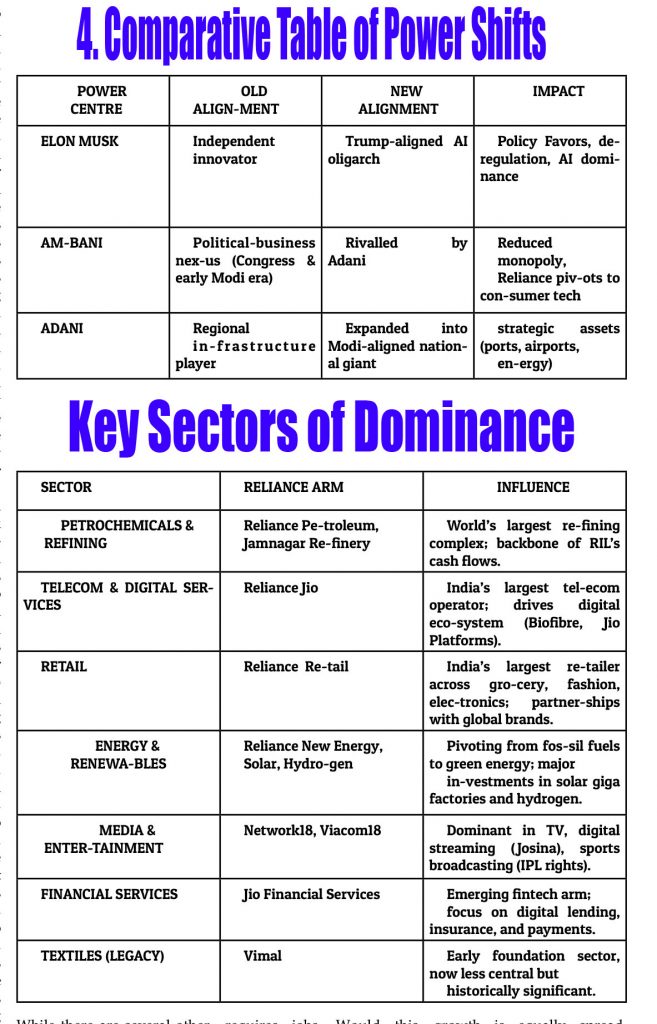
Ambani vs. Adani: India’s Crony Capitalism Shift
Looking at India, a similar shift is being played out in today’s tech driven environment. In the late ’60’s Dhirubhai Ambani, who came back from Aden, began Reliance Commercial Corporation a small textile trading company and then moved into manufacturing synthetic textiles under the Vimal brand. It was in 1977, that Reliance went public with an oversubscribed initial public offering (IPO) for its shares. It was this initial IPO that revolutionised the stock market, when the Indian public began investing in the stock market in a big way. Through the 80s and ‘90s the Ambani group expanded into petrochemicals, plastics and energy.
Dhirubhai’s model was unique: he democratized investment by inviting small investors into Reliance’s IPO, creating a mass shareholder base. He pioneered the idea of backward integration — moving from textiles into petrochemicals and refining to control the entire value chain. His rise marked the shift from traditional family-owned businesses to aggressive, market-driven corporates in India. Dhirubhai dominated the telecom, retail, and petrochemicals, closely aligned with successive governments. Today, the Mukesh Ambani group, despite having been eclipsed wields enormous power in the country. Mukesh Ambani, through Reliance Industries Limited (RIL), has dominant interests across a wide spectrum of sectors in India. His empire reflects both consumer-facing businesses and core industrial infrastructure, making him one of the most diversified corporate leaders globally. The forthcoming Jio Financial IPO is awaited by not only big investors but also the common man. This is a sure indicator of how ordinary Indians believe in the power of technology.
ON the other hand, Gautam Adani’s rise is a textbook case of how liberalization-era entrepreneurs leveraged infrastructure opportunities and government alignment to build empires. His impact on Indian industry is profound because he shifted the axis of growth from consumer markets (Reliance’s model) to hard infrastructure and state-linked assets. Starting small in 1988, Adani Exports began in trading plastics, metals and ago products. In the ‘90s benefitting from the country’s liberalization, the group expanding into coal trading and power. In 1995, Adani secured the Mundra Port in Gujarat, that was the cornerstone of his conglomerate. In this century, the group has diversified into newer fields such as logistics, energy, mining. Today it has beaten the Ambani to become the leading Indian business house with interests spanning ports, airports, cement, media, energy and real estate. All this would not have been possible without a little help from friends – the party in power. For, Adani’s empire is deeply tied to government priorities — ports, airports, energy security. National Growth Driver: His assets are critical to India’s logistics, energy, and construction sectors. In today’s India, both Ambani and Adani, with their close ties to the political elite of the day, are the movers of the economy of the state. While there are several other players, these conglomerates have their interests in a wide range of economic activities ensuring that their interests are safeguarded in government decisions and policy making.
The economic theory that emphasizes technology as the main driver of economic growth is called Endogenous Growth Theory (sometimes referred to as the New Growth Theory. While India does require growth, our burgeoning population requires jobs. Would this come from unilinear growth, where only the privileged and educated reap the fruits of prosperity. The rise of economic oligarchs has attendant risks and implications. Power cannot be the prerogative of a few that control the levers of all power. India does not necessarily have to pattern its development strategy on the US model. Our policy makers need to look at our people the level of our economic conditions to ensure that growth is equally spread. The rural-urban divide, the rich-poor distinction, the employed-unemployed gap continues to grow. Thus while technology and innovation will dominate this decade, India requires its own developmental model to ensure equality of its people!
(Arvind Pinto is the chairperson of Citizencredit Cooperative Bank Ltd, he also practises at National Company Law Tribunal and is retired chief commissioner.)
 LETTER TO THE EDITOR FOR THE ISSUE DATED OCTOBER 24, 2026
 THERANOS MULTI-BILLION US PATHOLOGY COMPANY EXPOSED!
 INDIA’S PATHOLOGY LABORATORY SCANDAL! By Our Special Correspondent
 MUKESH, ADANI CONTROL MODI?By Our Special Correspondent
 “FRANCE KE SCHOOL THIK KARO”By Paris Correspondent
 INTEGRITY MUST BE CONDiTION FOR POWER!By Ranadhir Mukhopadhyay
 HI MUMBAI, MERI JAAN BUT…
 VILLAINOUS MUSK, ALTMAN, ZUCKERBERG, HOLMES!
 OPTOGENETICS AND THE RAY OF HOPE: LIGHT MEETS THE BRAIN! By Dr Amit Dias
 WEEKEND UPDATES
 LETTER TO THE EDITOR FOR THE ISSUE DATED OCTOBER 17, 2026
 AZAD MAIDAN NO LONGER FREE!
 AZAD MAIDAN CRACKDOWN! Goa’s crackdown on protesters raises grave questions about democracy! By Our Special Correspondent
 INDIAN WOMEN ARE ON THE STREETS AGAIN. EVERYTHING HAS CHANGED BUT NOTHING HAS CHANGED!By Shilpa Phadke
 RBI TIGHTENS SCREWs ON ECONOMY!By Arvind Pinto
Goa is abuzz with excitement as vintage bike and car owners, users, collectors and fans are decking […]