Goa is abuzz with excitement as vintage bike and car owners, users, collectors and fans are decking […]
Old is Gold
October 4, 2016
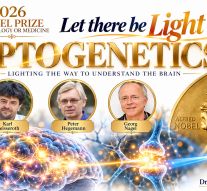
The discovery of a biological light switch has opened an extraordinary window into the mysteries of the brain. By allowing scientists to control selected nerve cells using light, optogenetics has transformed neuroscience and created new opportunities to investigate memory, behaviour and neurological disorders. Although it is not a cure for Alzheimer’s disease, this breakthrough could help illuminate the pathways towards better treatments for several conditions affecting the brain and beyond.
Three scientists, one extraordinary discovery:
The 2026 Nobel Prize in Physiology or Medicine has been awarded jointly to Karl Deisseroth, Peter Hegemann and Georg Nagel for pioneering discoveries that made optogenetics possible. Their work represents a remarkable journey from studying a microscopic organism to developing a powerful technique for investigating the living brain.
The story began with Chlamydomonas, a microscopic green alga that uses light to guide its movement towards favourable conditions. German scientists Peter Hegemann and Georg Nagel investigated how this organism detects light and helped characterise channelrhodopsins, light-sensitive proteins embedded in cell membranes.
These proteins act like microscopic gates. When exposed to light of a suitable wavelength, they allow electrically charged particles called ions to cross the cell membrane, changing the cell’s electrical activity.
American neuroscientist Karl Deisseroth and other researchers subsequently helped develop methods to introduce these light-sensitive proteins into selected neurons, enabling their activity to be controlled with precisely timed light pulses. This became the foundation of optogenetics, combining genetic techniques with optical technology.
What exactly is optogenetics?
The human brain contains billions of neurons connected through intricate networks. Their coordinated activity enables us to learn, remember, move, experience emotions and make decisions.
Traditional research methods can reveal which brain regions are active during a particular task. However, observing activity does not necessarily establish whether those neurons actually cause the behaviour.
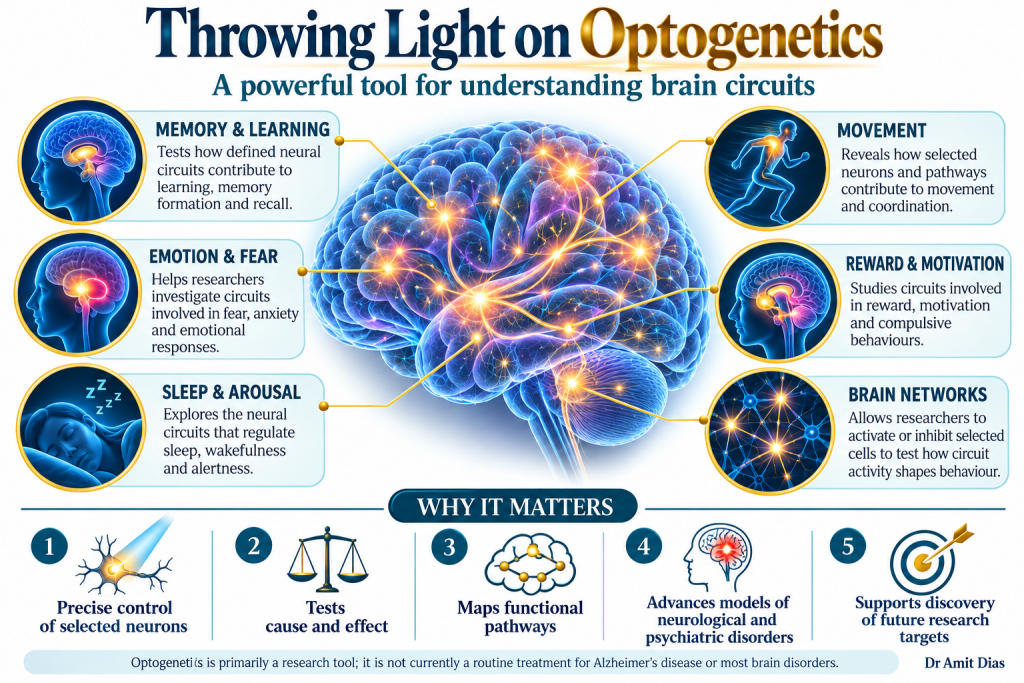
Optogenetics helps answer this question. Scientists introduce genetic instructions that enable selected cells to produce light-sensitive proteins. Carefully controlled light can then activate or inhibit these cells, allowing researchers to observe the consequences.
Imagine investigating how a memory is formed. If a particular group of neurons becomes active when an animal learns to recognise a location, researchers can manipulate those neurons and examine whether learning or recall changes. This helps establish cause-and-effect relationships between neural circuits and behaviour.
Optogenetics is not mind-reading, nor does it allow scientists to switch human memories on and off like a television. It is a sophisticated experimental technique that provides an unprecedented level of control over selected cells, particularly in laboratory models.
Why does this matter for Alzheimer’s disease?
Alzheimer’s disease is the most common cause of dementia. It progressively affects memory, thinking, language and the ability to perform everyday activities. Its characteristic biological features include abnormal amyloid-beta protein accumulation and tau-related neurofibrillary tangles. However, the disease is not simply a matter of protein deposits: synapses, neuronal communication and the activity of entire brain networks are also disrupted.
The other day, while singing in the choir I thought of this analogy. Just as in the choir, even if individual singers remain capable, the performance suffers when they lose coordination or miss their cues. Similarly, brain function can deteriorate when neurons no longer communicate effectively.
Research published in leading neuroscience journals has shown that amyloid-beta can disturb synaptic function and produce abnormal patterns of neuronal activity. Optogenetics allows scientists to investigate how these changes affect memory and whether specific circuits can be influenced to improve their functioning.
There are three particularly important areas of investigation.
First, researchers can examine which circuits contribute to learning, memory storage and recall. This may help explain why people with Alzheimer’s struggle to remember recent conversations, recognise familiar places or navigate environments they once knew well.
Second, experiments in animal models can investigate whether manipulating selected circuits improves particular memory-related outcomes. Such findings may identify potential treatment targets, but they do not establish that optogenetics can reverse dementia in humans.
Third, scientists are exploring the relationship between sleep, brain rhythms and memory. Deep sleep contributes to memory consolidation, and disturbances in sleep and neuronal activity are associated with Alzheimer’s disease. Whether deliberately restoring particular brain rhythms can produce meaningful, lasting benefits for patients remains an important research question.
The promise lies in understanding the mechanisms of disease more precisely, rather than claiming that a treatment is already available.
Beyond Alzheimer’s: a wider medical revolution
Optogenetics has applications extending well beyond dementia.
Parkinson’s disease: This disorder involves the degeneration of dopamine-producing neurons and dysfunction in the brain circuits controlling movement. Optogenetic experiments have helped researchers investigate the roles of different neural pathways in movement abnormalities and understand the mechanisms underlying treatments such as deep-brain stimulation. These insights may inform future therapeutic approaches.
Depression, anxiety and addiction: Researchers have used optogenetics in animal models to investigate the circuits involved in mood, fear, reward and motivation. Such studies help identify how specific pathways influence behaviour and may reveal new targets for psychiatric treatments. They do not mean that complex human emotions can be controlled by simply shining light on the brain.
Epilepsy and other neurological disorders: Because seizures involve abnormal, synchronised electrical activity, scientists are investigating whether selectively activating or inhibiting particular neuronal populations can help explain and potentially control seizure-generating networks. Optogenetics also contributes to research on schizophrenia and autism, particularly the balance and coordination of activity within brain circuits.
Restoring vision: One of the most striking translational applications is the use of optogenetic therapy in certain forms of severe retinal degeneration, including retinitis pigmentosa. In a landmark clinical study published in Nature Medicine in 2021, a patient with advanced retinal degeneration showed partial recovery of visual function following optogenetic treatment combined with specialised light-stimulating goggles. Subsequent clinical research has continued to investigate safety and effectiveness. These approaches remain specialised and experimental; they do not restore normal vision in every patient.
Together, these developments demonstrate that optogenetics is more than a tool for studying memory. It is helping researchers investigate fundamental biological processes and explore new possibilities for treating disorders that were previously difficult to understand.
From laboratory discovery to clinical treatment
Despite its promise, optogenetics faces substantial challenges. Delivering genetic instructions safely, targeting the correct cells and ensuring that sufficient light reaches deep brain structures are significant technical hurdles. Long-term safety and the durability of any therapeutic effects must also be established.
Its principles may nevertheless inform less invasive treatments. A better understanding of dysfunctional brain rhythms could guide research into electrical or magnetic stimulation and carefully timed sensory stimulation. Such interventions would need independent evidence of clinical benefit; success in an animal model cannot be assumed to translate into effective treatment for humans.
For families living with dementia, scientific discoveries bring hope, but that hope must be grounded in evidence. The 2026 Nobel Prize does not announce a cure for Alzheimer’s disease. It recognises a discovery that has given scientists a remarkable way to investigate the biological mechanisms underlying brain function and dysfunction.
Peter Hegemann and Georg Nagel helped reveal how light-sensitive proteins work, while Karl Deisseroth and other researchers helped transform that knowledge into a powerful method for manipulating neural circuits. Their work has expanded our understanding of memory, behaviour and disease, while opening new avenues for research across medicine.
The journey from microscopic algae to the possibility of future treatments reminds us that scientific breakthroughs often begin with curiosity about the natural world. The greatest promise of optogenetics is not that light can cure Alzheimer’s today, but that it may help illuminate the path towards more precise and effective treatments tomorrow.

About the author: Dr Amit Dias is an Assistant Professor in the Department of Preventive and Social Medicine at Goa Medical College. He is associated with dementia research, awareness and care initiatives in Goa for over two decades.
 LETTER TO THE EDITOR FOR THE ISSUE DATED OCTOBER 24, 2026
 THERANOS MULTI-BILLION US PATHOLOGY COMPANY EXPOSED!
 INDIA’S PATHOLOGY LABORATORY SCANDAL! By Our Special Correspondent
 MUKESH, ADANI CONTROL MODI?By Our Special Correspondent
 “FRANCE KE SCHOOL THIK KARO”By Paris Correspondent
 INTEGRITY MUST BE CONDiTION FOR POWER!By Ranadhir Mukhopadhyay
 A PARADIGM SHIFT: POWER MOVES FROM POLITICS TO TECHNOLOGY AND TACTICS! By Arvind Pinto
 HI MUMBAI, MERI JAAN BUT…
 VILLAINOUS MUSK, ALTMAN, ZUCKERBERG, HOLMES!
 WEEKEND UPDATES
 LETTER TO THE EDITOR FOR THE ISSUE DATED OCTOBER 17, 2026
 AZAD MAIDAN NO LONGER FREE!
 AZAD MAIDAN CRACKDOWN! Goa’s crackdown on protesters raises grave questions about democracy! By Our Special Correspondent
 INDIAN WOMEN ARE ON THE STREETS AGAIN. EVERYTHING HAS CHANGED BUT NOTHING HAS CHANGED!By Shilpa Phadke
 RBI TIGHTENS SCREWs ON ECONOMY!By Arvind Pinto
Goa is abuzz with excitement as vintage bike and car owners, users, collectors and fans are decking […]