Goa is abuzz with excitement as vintage bike and car owners, users, collectors and fans are decking […]
Old is Gold
October 4, 2016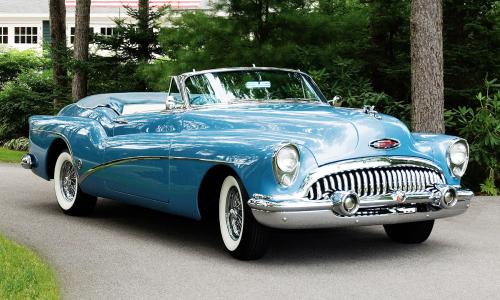
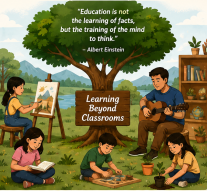
Author of `Learning from Life: Parenting, Unschooling and Homeschooling’ Vineeta Sood is all for different ways of meeting the challenges of educating our children in today’s times. This is an idea whose time has long since arrived as parents and educators are now taking a closer and keen look at it and perhaps finding it more viable than the old ways of packing off children to school daily. Here’s a fascinating, challenging viewpoint of what the future holds out for children….
WE live in a fast-paced, ever-changing world that brings unique complexities into our personal, professional, and relational lives. The mainstream education system, originally designed to prepare a workforce for the industrial revolution, has become increasingly obsolete. Over time, it has evolved into a rigid, top-down model, heavily focused on academic performance and examinations. Understandably, many individuals and small groups have voiced discontent, advocating instead for the holistic growth and development of children.
What we need today is an education system that nurtures curiosity, sensitivity, empathy and creativity. We need to design and create experiences for our students which promote critical thinking, problem-solving, collaboration, resilience, and relational capacities. With information now available at our fingertips, the real challenge is cultivating discerning ability to distinguish reality from rhetoric. We need a generation that believes in themselves, has enough capacity for self-observation and critical evaluation and knows their voice matters.
A generation that understands the difference between authentic expression and aggression.
The Rise of Alternative Education
ALTERNATIVE education has steadily grown over the past few decades. It is an umbrella term for diverse initiatives created by individuals or small groups dissatisfied with the mainstream system. These approaches move away from the standardized, one-size-fits-all model toward individualized learning, where creativity and holistic development take centre stage. They are sensitive to the diverse needs and contexts of learners.
Alternative learning spaces vary widely depending on the vision of their founders. Some emphasize music, arts, free play, or organic farming. Others weave spiritual elements into their programs or design curricula around developmental stages of growth. Many draw inspirations from philosophers and educationists such as Rabindranath Tagore, Jiddu Krishnamurthy, Sri Aurobindo and the Mother, Maria Montessori, or the Waldorf tradition. Homeschooling and un-schooling represent more individualized approaches, with each family shaping its own philosophy. Despite these differences, a common thread runs through them all which is empowering the child by focusing on holistic development.
Because these initiatives are usually small-scale and independent, alternative education is not an organized sector. This independence brings both strengths and challenges.
A story:
LET us take a peep into a small alternative school in India. One morning, a group of six-year-olds gravitated towards clay corner. One child shaped a bird, another a tree, while a third created a strange hybrid creature with wings and a shell. When the facilitator showed curiosity towards the creation, the child said, “It’s a turtle that can fly. It goes wherever it wants.”
That moment captures the essence of alternative education. Instead of being given instructions and binding children into right or wrong dynamics, children are invited to take initiatives, to choose, to imagine, to experiment, and to express themselves. The teacher’s role is to listen, to encourage, and to help the child see possibilities. As a result, we have a classroom where learning feels like play, and play feels like discovery.
The Bright Side: Pros of Alternative Education
PROS of alternative educational setups are all in favour of the holistic and humanistic development of children, families and teachers.
Personalized learning: In the Alternative Learning Spaces, children progress at their own pace. Curricula are tailored to their interests and abilities, offering enough challenge to spark growth without overwhelming them. This builds qualities like confidence and resilience that exams alone rarely nurture.
Freedom and flexibility: Students often have the freedom to choose what, when, and how they learn. This autonomy fosters curiosity and deep exploration, allowing them to follow their passions rather than a rigid timetable.
Responsibility: When learners are trusted to chart their own path, with adults offering guidance rather than control, they naturally learn to take ownership of their projects and decisions. Responsibility becomes a lived experience, instead of an expectation.
Creativity and critical thinking: Instead of being drilled for exams, students are encouraged to experiment, improvise, and solve real-world problems. This nurtures creativity and sharpens critical thinking. These skills are essential for navigating today’s complex world.
Community and belonging: Authentic, curiosity-driven interactions help children develop a sense of belonging. These spaces often evolve into supportive, creative communities where learning feels joyful rather than stressful.
Exploratory advantage: When adults don’t limit children with rigid agendas, learners often surprise us by expanding the scope of exploration beyond what we could imagined.
Attuned educators: Teachers in these spaces are often deeply aware of their students’ emotional and social landscapes. They create safe environments that nurture holistic growth, tailoring opportunities to each child’s needs.
The Flip Side: Cons of Alternative Education
LIKE any other thing in life, alternative education is not free of its challenges. Most of them stem from financial and human resource limitations.
Funding limitations: Unlike mainstream schools, alternative setups rarely receive institutional funding. They rely heavily on parent contributions, and facilitators often work full-time without adequate pay.
Resource constraints: Limited finances mean fewer materials and restricted opportunities for diverse exposure. This can affect the richness of learning experiences.
Parental commitment: These schools often ask parents to align with their philosophy to ensure consistency between home and school. While valuable, this demands significant time, energy, and resources from the parents which many families may not be able to sustain.
Teacher challenges: Educators must be versatile, deeply committed, and aligned with the school’s philosophy. But financial insecurity makes it hard to attract and retain such facilitators.
Intentional rigor: Balancing freedom with physical, intellectual, emotional, and relational rigor requires exceptional intentionality. Teachers must design learning opportunities with care, which demands time and preparation.
Limited peer diversity: Small student numbers foster close teacher-student relationships but can restrict exposure to diverse peer groups. In homeschooling situations, parents need to work extra hard to create opportunities for peer interaction.
Where Do We Go from Here?
LIKE any other thing in life, alternative education is not perfect. However, it offers a powerful model that can be refined and replicated. It reminds us that education is about nurturing human beings to grow into their best versions.
If we want to bring radical change to our education system, we must first develop awareness of what children need a nd how they learn. We must ask:
• What kind of education leads to holistic development?
• How do we create spaces where children feel safe, curious, and empowered?
Supporting alternative education financially and structurally could be one way forward. Imagine if these small initiatives had access to better resources, fair compensation for teachers, and wider recognition. They could provide students with opportunities that blend the best of both worlds: the rigor of mainstream education and the creativity of alternative approaches.
At its heart, alternative education is about trusting children to explore, trusting teachers to guide, and trusting communities to nurture growth. It’s about believing that education is much more than exams and grades. It can be a journey of becoming fully human.
(Vineeta Sood is an author, therapist, and advocate for homeschooling and alternative education. She lives in Panjim, Goa and has brought up her own two children through home education with amazing and remarkable success; hence, is an advocate for alternate ways of educating children.)
 LETTER TO THE EDITOR FOR ISSUE DATED OCTOBER 03, 2026
 GEN-Z BLOCKED FROM VOTING BY GYANESHWAR MODI!
 THE FORAL OF 1526 Five Hundred Years Later, What Does Goa’s Oldest Village Charter Really Mean?
 20 YEARS IN ‘HERALD’, 43 IN GOA!
 THE DEGRADATION OF JNU – MY ALMA MATER! By Arvind Pinto
 THE WOMEN WHO LOOK BACK! By Prema Viswanathan
 GOA IS CELEBRITY STATE!
 HI MUMBAI MERI JAAN BUT…
 WEEKEND UPDATES
 LETTER TO THE EDITOR FOR ISSUE DATED SEPTEMBER 26, 2026
 DIVIDED EVEN IN DEATH!By Rajan Narayan
 IF YOU CLAIM THE CREDIT, TAKE THE RESPONSIBILITY!By Joquim Goes
 8 EMAILS IN 7 DAYS, BUT VALID GOA VOTERS STILL LEFT OUT: EC’S FLAWED SYSTEM!By Ritika Chopra
 MAKE IN INDIA: UNITED PAYMENTS INTERFACE India’s digital local leap to global benchmark…By Arvind Pinto
 BRING BACK THE FLATBREADS OF INDIA!
Goa is abuzz with excitement as vintage bike and car owners, users, collectors and fans are decking […]