Goa is abuzz with excitement as vintage bike and car owners, users, collectors and fans are decking […]
Old is Gold
October 4, 2016
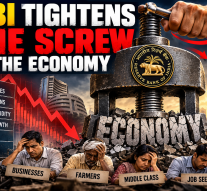
On the 7th October 2026, the Monetary Policy Committee (MPC) of the RBI decided to raise the policy repo state by 25 basis points from the earlier rate to 5.25 percent to 5.50 percent. The MPC noted that the geopolitical developments especially the West Asian conflict has made an impact on our economy. This coupled with rising inflation reaching up to 4.4 percent this year, the need for recalibrating the policy rate was imperative. Accordingly, the Committee voted unanimously to suggest an increase.
The hike in the repo rate changes the cost of money, creating ripples across the economy. With the hike in the Bank rate, the credit supply to the economy gets curtailed, thereby restricting growth in investment and expansion. The RBI that controls the monetary supply in the country has initiated a “dear money policy as it is called. The object of this dear money policy is to curb money supply that circulates in the economy . With the RBI raising the repo rate, the rate at which banks borrow money from the former, increases proportionately. Thus the cost of funds lent by banks also rise. Banks in term charge higher rates to their customers. Thus term loans, overdrafts, home or personal loans become more expensive. Borrowers think twice before approaching banks for money. Businesses delay expansion or reduce investment due to higher financing costs. At the lower end, small and medium enterprises (SMEs) that are heavily reliant on bank credit feel the squeeze the most. On the macro level consumption and investment slow down. Sectors that are dependent on credit see slower growth. The lower demand reduces pressure on prices. Savings in the economy rise with banks increasing deposit rates, further reducing consumption. While inflation may persist due to imports such as oil prices but demand driven inflation in the domestic economy cools down. Thus in the short term, growth slows but inflation that hits everyday life is kept in check.
Impact on different Segments
What is the impact of the RBI raising the rate from 5.25 to 5.5%. For the consumer, all home, automobile or personal loans the floating rate EMIs will rise. Further newer loans will become costlier. Now those looking at investment in real estate will find that all the major public sector banks have revised their lending rates for new home loans. Effective 8th October 2026, Punjab National Bank, Indian Overseas Bank, Bank of India Bank of Baroda to name a few have all raised their lending rates by 25 basis points in line with the RBI’s . Even the SBI has raised its marginal cost of funds lending rate making the equated monthly instalments costlier both for new and existing borrowers. New loans across the board, such as housing, auto or personal loans would all get costlier. While fixed loans may remain unaffected in the short term, many fixed products have reset clauses after a period and these also could be revised subsequently. Further banks would find it difficult to increase their asset book, since many of their customers would cut investment in new assets, or expansion of their existing businesses. On the macro level this will act as a damper to economic growth. the RBI’s rate hike inevitably affects economic growth, and the central bank is acutely aware of that trade off. Its challenge is to balance inflation control with growth preservation, a delicate act that defines monetary policy credibility. For the primary goal of the RBI is to ensure inflation is kept around 4 percent . For the RBI growth is a secondary objective. Thus the RBI strategy is to a short term slowdown for a long term sustainability.
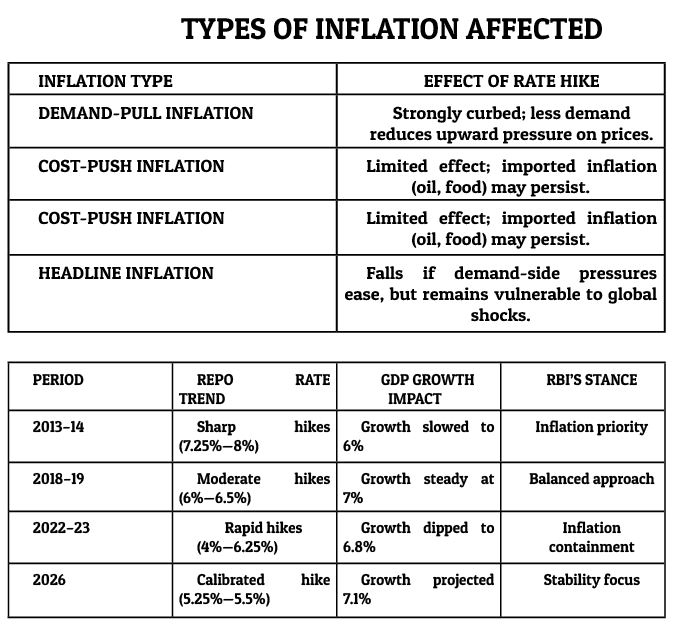
The rate cut also have broader economic implications. With higher EMI’s in a household, the disposable income is reduced, leading to a tightening of budget and spending in the family. For businesses working capital now becomes costlier, leading to a slower expansion, and this will hit small and medium businesses that are unable to obtain other means of capital funding. Further larger infrastructure projects that rely of banking financing are also hit since the rate of interest of their loans increase. With the rate of interest increasing, banks demand for higher mortgages and securities will further add increased financial burdens on corporates. For those who invest in term deposits in banks especially the elderly, there is a silver lining since deposit rates will rise, giving them a better return. The hike is also an attempt to control inflation and over time. With less borrowing and spending, demand driven inflation moderates. The intention of the RBI is to bring down inflation especially in food and daily necessities that the common man uses. Below are the various types of inflation that the rate hike has impacted.
With the rise of the repo rate, the yields in the Indian bond market will also increase. This can attract foreign capital into the Indian bond market, thereby strengthening the Indian rupee. Further if global investors view Indian markets giving them better returns, they would invest in our markets, ensuring the strengthening of the local currency. In short, the RBI’s repo hike is a defensive tool: it can strengthen or stabilize the rupee against the dollar if global conditions are favorable, but if the US dollar is surging, India’s hike may only soften the blow rather than reverse it.
Central banks worldwide have done exactly what the RBI has done: raised policy rates to combat inflation while trying to preserve growth. The RBI’s October 2026 move fits into a global pattern of monetary tightening that began after the pandemic era stimulus and was reinforced by supply shocks, oil volatility, and geopolitical tensions. Over the decades the RBI has used these repo rates as a effective strategy to ensure a balance between inflation and growth.
As both banks and businesses get down to work with the new repo rate, the economy will over the next few months will see a slower pace of growth. Hopefully this increase in the repo rate will help control inflation during the festival period, when India goes shopping!
(Arvind Pinto is the chairperson of Citizencredit Cooperative Bank Ltd, he also practises at National Company Law Tribunal and is retired chief commissioner.)
 LETTER TO THE EDITOR FOR THE ISSUE DATED OCTOBER 17, 2026
 AZAD MAIDAN NO LONGER FREE!
 AZAD MAIDAN CRACKDOWN! Goa’s crackdown on protesters raises grave questions about democracy! By Our Special Correspondent
 INDIAN WOMEN ARE ON THE STREETS AGAIN. EVERYTHING HAS CHANGED BUT NOTHING HAS CHANGED!By Shilpa Phadke
 SSR OVERRULED SIR IN GOA!
 HI MUMBAI MERI JAAN BUT…
 RAJENDRA ARLEKAR WILL REPLACE PRAMOD SAWANT?
 MENTAL HEALTH ACROSS THE LIFESPAN! By Dr Amit Dias
 WEEKEND UPDATES
 LETTER TO THE EDITOR FOR THE ISSUE DATED OCTOBER 10, 2026
 WHEN THE MACHINE OVERRIDES THE LAW!
 HAS GOA BECOME MORE PERMISSIVE? By Special Correspondent
 BILLIONAIRES MULTIPLYING AT THE COST OF THE MIDDLE CLASS!
 THE SHADOW OF VOTE THEFT: WHY CEC GYANESH KUMAR MUST RESIGN!By Dr Olav Albuquerque & Deborah Cordeiro
 ULTRA MODERN ‘MID-DAY’ OFFICE
Goa is abuzz with excitement as vintage bike and car owners, users, collectors and fans are decking […]