Goa is abuzz with excitement as vintage bike and car owners, users, collectors and fans are decking […]
Old is Gold
October 4, 2016
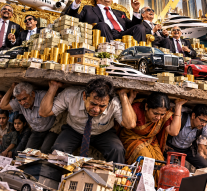
Introduction: The Two India’s
India today is a paradox. On one hand, it boasts of being the fastest-growing major economy, producing billionaires at a pace that rivals Silicon Valley. On the other, its middle class—the supposed backbone of democracy and consumption—is increasingly squeezed, muddled, and insecure. Goa, often seen as a microcosm of India’s contradictions, reflects this duality vividly: luxury villas mushrooming along coastal belts, where outsiders, termed ‘Bilo munis’ from the North, buy up properties by the ton, while traditional Goan families in the villages across the state, struggle to maintain not only their little hovels and houses but livelihoods amidst rising costs and shrinking opportunities.
The Billionaire Boom
According to Visual Capitalist, China, with 1,110 billionaires holds the first rank in the number of billionaires in the world. The US follows next with 1000 billionaires. Interestingly India with 308 is the third highest ranking in the billionaire count. India’s billionaire landscape in 2026 is dominated by Gautam Adani ($112.7B) and Mukesh Ambani ($86.3B) Among women Savitri Jindal is India’s richest woman, with her wealth tied to metals and mining. The Lakshmi Mittal, of Arcelor fame has made his fortune in steel manufacturing and mining. Sunil Mittal Chairman of Bharti Airtel is in the telecommunication business. Cyrus Poonawalla, Shiv Nadar, Dilip Shanghvi, Kumar Mangalam Birla, and the Hinduja family. These names represent the most prominent billionaires shaping India’s economy today. The newer Indian billionaires are several young entrepreneurs who have had the vision to begin as start-ups and now are big league. Take the instance of Kaivalya Vohra and Aadit Palicha just 23, and 24 years respectively who had co-founded Zepto the quick commerce company. Or again there is Deepinder Goyal the founder of the food delivery chain called Zomato . Sadly in India, the top 1% of the population controls 40% of the national wealth. This is the crux of Indian equality. This inequality can be seen even in a small state like Goa- Billionaires from Mumbai, Delhi or Bangalore fly into Goa, grabbing prime coastal land, building palatial villas, pushing up land prices beyond the reach of the locals. Walk into Panjim in the evening and you will find these billionaires spending some of their money at the many casinos that line the Mandovi river – while the locals sit at the tavernas or move to the Gulf for a job!
The Muddling Middle Class
The middle class, once celebrated as India’s engine of growth, is now muddling through with a population of 1.6 billion, the middle classes between 150-220 million people is around 10 to 15% of the population. The lower middle class is around 25 to 35% of the population with 350 to 500 million. The middle class is not a monolithic block, since there are several categories that fit into this class. The annual income of the middle class is between 5 to15 lakhs per year. Most of the middle class carry a debt burden. The average middle class debt is 4.8 lakhs. This debit is basically in the form of personal loans, gold loans especially during marriage and credit card debts. On the bright side, the middle class are investment conscious. The rise of investors is mutual funds as also in the stock market is due to investment from this category from 2 and 3 tier cities across the country. Sadly one of the main concerns of the middle class is stagnant income. For the majority of the middle class earn salaries that unfortunately has not kept pace with inflation. On the other hand, this class has to cope with rising costs on various fronts. Education has become a major item in most middle-class budgets – this extends to tuitions, coaching classes or private coaching for competitive examinations. Then again healthcare has skyrocketed. And should one decide to invest in real estate – a house- the risking costs of housing has risen astronomically. Several of this class are fortunate to secure well paid jobs in some of the niche sectors such as IT, government or banks. But in the private sector the risk of being retrenched is a sword that hangs over the heads of these competing sectors. Further the risk of a downside in contracting and gig workers is something that is at the back on one’s mind, in an uncertain economic scenario.
In Goa, the middle class faces unique pressures. Several of the traditional occupations such as farming or mining have collapsed, leaving the families of those tilling the soil or the miners in dire straits. Tourism that was once the main stay of the locals is slowly becoming unpredictable with foreign tourists seeking other destinations. While Indian tourists have begun filled the void, much of the infrastructure built on the coastal belt is not fully exploited since tourism in Goa is seasonal. Middle-class Goan households often rely on remittances from relatives abroad, underscoring their fragile domestic economic base.
Goa’s Inequality Landscape
Goa presents a microcosm of the Indian inequality. The advent of mining during the Portuguese era, created a coterie of rich Goan billionaires that exploited the mineral resources, paying pittance by way of royalty, while miners barely made ends meet. The stoppage of mining by the Supreme Court, was a deathblow to several families who depended upon mining. The ban also affected small contractors, vehicle and truck operators as also ancillary business that were associated with mining.
1. Tourism DivideOn the tourism front, the divide is equally apparent. On the other hand there are those five star resorts where billionaires wine and dine in a world of luxury and elan. Look at the five star casinos where the jet set lose lakhs each day. Then there are the guest houses and shacks that struggle against increasing licensing fees, competition and seasonal downturns.
2. Real Estate BoomGoa is indeed a paradise for the rich and powerful. See those luxury villas that have risen in Assagoa, Anjuna Dona Paula or in Colva. On the other hand, go into the villages and you will find Goan families who are hard pressed to keep their ancestral houses repaired with rising costs of construction material. Many are forced to sell their ancestral houses or lands and move into smaller houses in the cities
Education and Migration
The majority of Goans are educated, since most Goan families believe in education as a means of upward mobility. However with scare employment, many Goan graduates end up in call centres or have to migrate to the Gulf in search of employment. Unfortunately with little industrial infrastructure, the employment market in Goa is limited to tourism or gig workers such as tourist taxi operators.
National Context: India’s Inequality Mirrors Goa
As is seen across the country, India is indeed a paradox. The first is the urban /rural divide. Our urban centres are modern, with infrastructure, transport networks, health care, while the rural expanse lives in the last century with just the basic facilities. India’s metros sure ahead in the latest technology, while our villages live in a time capsule. You will find it here in Goa – Panjim Margoa or Mapusa had the luxury of good roads, infrastructure, while just outside Panjim or Margoa, villages are in the time wrap.
Or look at our consumption patterns. The top echelons of our society travel in planes can afford all that money can buy, while our poor eke out a dreary existence. Even our polices are titled towards the rich and the powerful. Corporates have tax breaks – amnesty schemes, while the small traders have GST rule book thrown at them in cases of default.
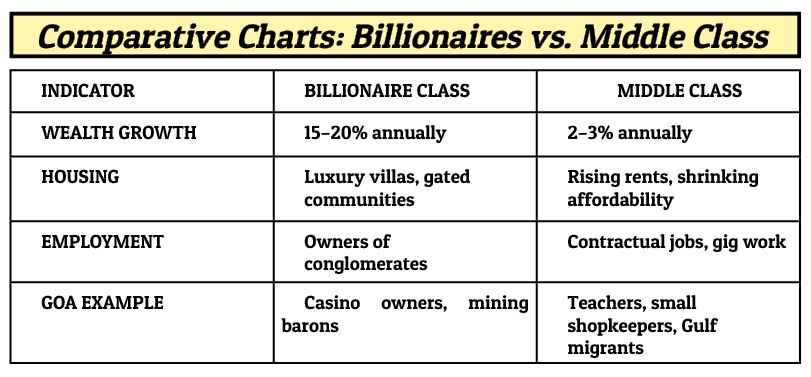
Is the middle Class thriving
Yes, India’s middle class is expanding rapidly. However if one looks at the reality many who were lifted into the middle-class post-liberalization are slipping back due to inflation, job insecurity, and rising debt.
What lies Ahead
Read the papers and you will find an increasing social unrest. Recently the Cockroach Janata Party was successful in removing the Union Education Minister for the leakages in the competitive examination Today the heat is on the Chief Election Commissioner for disentrancement of millions of eligible voters. With inflation running high, there will be protests to highlight government’s inability to control prices. In Goa, the local identity is slowly disappearing with politicians selling land to rich outsiders who are able to buy land at exorbitant prices. Goa’s overdependent on tourism and foreign remittances has made the state vulnerable to global shocks. .
Towards Solutions
Presently our fiscal policies are oriented towards those who can effectively manage the system, The country requires a system where tax does not place burden the poor as against the elite classes who should be contributing more to the exchequer. Our growing middle classes need to be given access to affordable housing , healthcare and education . For the middle class hold the key to India’s growth and prosperity.
Conclusion: Two Futures
India stands at a crossroads. If billionaires continue to bloat while the middle-class muddles, the social contract will fray. Goa, with its unique blend of heritage and modernity, offers a warning: unchecked inequality erodes not just economics but culture, identity, and community. The challenge is clear—India must rebalance growth, our governmental policies must ensure that income and growth are not only the prerogative of the rich, but must be equally divided. For when the lowest strata of society have the means to be economically self-sufficient can the country truly proper.
(Arvind Pinto is the chairperson of Citizencredit Cooperative Bank Ltd, he also practises at National Company Law Tribunal and is retired chief commissioner.)
 LETTER TO THE EDITOR FOR THE ISSUE DATED OCTOBER 10, 2026
 WHEN THE MACHINE OVERRIDES THE LAW!
 HAS GOA BECOME MORE PERMISSIVE? By Special Correspondent
 THE SHADOW OF VOTE THEFT: WHY CEC GYANESH KUMAR MUST RESIGN!By Dr Olav Albuquerque & Deborah Cordeiro
 ULTRA MODERN ‘MID-DAY’ OFFICE
 HI MUMBAI MERI JAAN BUT…
 TCS INVOLVED IN SIR MATCH FIXING!
 CEREBRAL PALSY: UNDERSTANDING ABILITY, ENABLING INCLUSION! By Dr Amit Dias
 WEEKED UPDATES
 LETTER TO THE EDITOR FOR ISSUE DATED OCTOBER 03, 2026
 GEN-Z BLOCKED FROM VOTING BY GYANESHWAR MODI!
 THE FORAL OF 1526 Five Hundred Years Later, What Does Goa’s Oldest Village Charter Really Mean?
 20 YEARS IN ‘HERALD’, 43 IN GOA!
 THE DEGRADATION OF JNU – MY ALMA MATER! By Arvind Pinto
 THE WOMEN WHO LOOK BACK! By Prema Viswanathan
Goa is abuzz with excitement as vintage bike and car owners, users, collectors and fans are decking […]