Goa is abuzz with excitement as vintage bike and car owners, users, collectors and fans are decking […]
Old is Gold
October 4, 2016
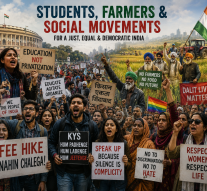
THE recent CJP’s student movement that has folded with the resignation of education minister, Dharmendra Pradhan, has ended for the time being. While charges are still being traded, of police brutality, of whether the cases filed are being dropped and what is the future of the CJP, the drama at Jantar Mantar has ended. For movements by themselves do not bring about social change. Policies, institutions and processes require to be put into place that make this change happen. Let’s look at some of the major social movements in the recent decades, to discover whether these brought about the desired changes to the betterment of the citizens of the country.
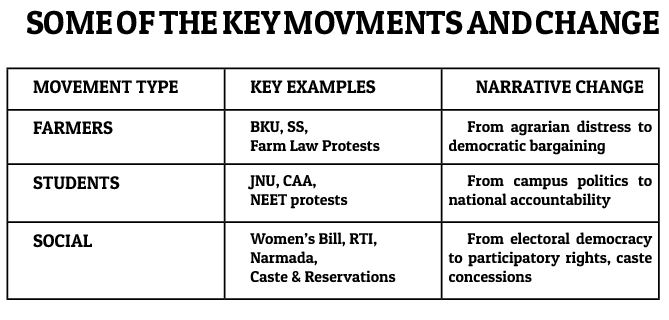
India’s social, farmers, and student and women’s movements over the last few decades have profoundly reshaped the national narrative — transforming agrarian distress into democratic bargaining, student protests into accountability campaigns, and social mobilizations into broader struggles for rights of women . Goa, too, has felt these ripples, with its own farmers, youth, women aspirations and civil society groups participating in and adapting these movements.
Farmers’ Movements: From Landlords to State Policy
WHEN India gained independence, land was largely in the hands of large zamindar whose lands were tilled by landless farmers. Even in pre-Independence, Gandhi in his travels across the country, found that there was inequitable distribution of land, leading to a coterie of the landed gentry having huge holdings while share croppers worked on these lands. Immediately after Independence, Vinobha Bhave, one of Gandhi’s disciples started the Bhoodhan movement where some of these landowners voluntary gave up possession of their vast estates, in favour of the landless. The first of its kind, Bhoodhan, slowly dissolved with the death of its prime mover. While the movement is forgotten, certain farmers did benefit by obtaining land which they were working on .
During the 1970s–80s, the Bhartiya Kisan Union (BKU) in Uttar Pradesh and Shetkari Sanghatana movement in Maharashtra, were different. These movements moved away from the earlier issues of the zamindar and the landless, a shift from peasant versus landlord struggles to a totally new dimension. In the 70s with the green revolution, certain states, like Punjab saw an increased production, greater concessions from the government, while other states did not have such progressive policies. Thus, farmers beginning in Uttar Pradesh and later in Maharashtra, began demanding policies and concessions from the state. The leaders of these two movements often brought farmers with their tractors into the state capitals to compel the legislators to listen to them; the leaders of these movements, sought to project agriculture as the primary economic activity in rural India, demanding fair policies for this sector. Their demands were to ensure fair and remunerative prices for crops, loan waivers, and market reforms, reshaping agricultural policy.
The farmers’ movement that emerged in the 1970s and gained momentum in the 1980s represented a distinct phase in the history of agrarian unrest in India. Unlike earlier mobilizations of landless labourers and marginal peasants against landlords and zamindar, this new wave was driven by propertied, market-oriented cultivators whose primary grievances were against the state’s pricing regime and subsidy structures. The central contradiction had shifted: it was no longer farmer versus landlord, but farmer versus state.
• The succeeding decades the 1990–2000 while farmers’ mobilization waned , there were sporadic unrest on account of drought agitations in Tamil Nadu (2017) and the Maharashtra Long March (2018). These movements highlighted the concerns ecological and climate stress that is impacting crop production. This movement also brought to fore the financial and debt issues that plague the agricultural community
2002-21: The nationwide farm law protests in Punjab became one of the largest mass mobilizations in independent India, forcing the repeal of controversial laws and reasserting farmers as central actors in democracy.
Today, the government can no longer take farmers for granted. The agricultural lobby demands that they be consulted in legislation where their interests are concerned. Farmers are no longer seen as passive cultivators but as democratic negotiators of rights, using social media, symbolic dramatization, and urban protests to amplify their voices. The recent tariff talks between India and the US is being scrutinized by the agricultural sector to ensure that their rights are adequately protected in the event of the entry of US agricultural products into the country.
Student Movements: From Campus to National Stage
STUDENT movements have always been centre stage in the country, where all major political parties have their youth wings, that are feeder grounds for future politicians.
1970s–80s: Student unions were hotbeds of political mobilization, often aligned with Left or regional parties. One will remember this was the time, when the Left parties controlled both trade unions as also University Student Unions. The leaders of both CPI and the CPM today were student leaders of their youth wings. Those were indeed heady days, when student agitations brought to fore issues of the common man. Sadly in today’s polarised political scene, the left parties have run out of relevance and their student bodies are a pale self of what existed what was then termed the ‘Red Decade’ The brutal power of the state has made Communism irrelevant in India.
• 2010s–2020s: Movements like the JNU protests (2016), anti-CAA protests (2019–20), and recent NEET exam irregularity protests (2026) highlight students’ role in demanding transparency, accountability, and democratic rights. In the recent rise of the CJP, student power has once again come to the fore. Government with the resignation of the education minister has ensured that the CJP lie as a forgotten memory. While the leaders of this movement, believe that they can once again bring back students to Jantar Mantar, this would not happen. With government taking steps to remedy the examination system, the country believes that reforms are in a right direction. The student movements have created a narrative shift from the days when students took to the streets to highlight the issues of the common man, to the CJP movement of today, that centres around the immediate concerns; namely reform in the examination system, the employment and job market, the professional entrance tests. Student protests of today, are about the increasing unemployment rates, their professional future. Students now have reframed politics around rights, representation, and integrity in governance, often challenging the corrupt practices, where one can buy both the examiner and the examination system.
The country has been a land of different social movements that reflect the malaise of the common man. Like most movements they come to centre stage, then gradually peter out of steam. There have been civil society mobilizations: Anti-corruption protests (Anna Hazare, 2011), environmental struggles (Narmada Bachao Andolan), and rights-based campaigns (Right to Information, Right to Food) expanded the scope of democracy beyond electoral politics. Social movements reframed democracy as participatory and rights-based, not merely representative. With increasing unemployment and the need to have reservations in government jobs for certain castes, various caste leaders have brought their followers to push governments into conceding into their demands.
In 2024, Manoj Jarange-Patil, a prominent Maratha reservation activist marched from his village Antarwali Sarati in Jalna to Mumbai with thousands of his followers to demand reservation for the Maratha community.
Impact on India’s Narrative
WHAT have these movements achieved? On a macro level, most of these movements have a single orientation. They often have a single leader, who has neither the organizational skill nor even the ability to effectively control the enthusiasm of those he leads. A majority of these movements slowly grind to a halt. On the other hand, these movements have forced governments to negotiate, showing that policy is not top-down but contested. In reality, the fact that the CJP was able to obtain the resignation of the educational minister is indeed noteworthy, since the gathering at Jantar Mantar was spontaneous with little infrastructural backing or planning. Today’s movements have seen new methods that enhance participation. There is extensive use of social media, symbolic protest, and urban mobilization broadened participation. Thanks to You Tube and similar channels these protests have been able to break the biased reporting of the institutional press. Like movements before these gatherings often fragment, attract leaders from the political class who attempt to align with the sentiment in order to gain political mileage. Further there are always allegations of infiltration by outsiders and unsocial elements that sometimes undermine the credibility of the movement
Talking of Goa, Goan farmers though scattered and have at times, (especially in sugarcane and cashew sectors) raised their voices, while students, and civil society have echoed these struggles, linking local grievances — like exam integrity and agrarian pricing — to national debates.
In sum total, India’s farmers, students, and social movements have shifted the narrative from passive acceptance to active contestation — making democracy more participatory, more accountable, and more complex. Goa, as a microcosm, reflects these national currents while adding its own local voice to the chorus of change.
One of the more awakening movements in India, is the rise of women power in their quest of equality in the country. In theory, the Constitution provides that there is no discrimination between the sexes and that every Indian is equal. Sadly, inequality is built in the Indian social and cultural ethos, where women were subordinate to men. However, over the decades, this quest for equality both in social, economic and cultural spheres has grown.
The 1970s marked a decisive break. A convergence of economic hardship, political unrest, and global feminist currents shook Indian women’s activism out of its welfare-oriented frame and pushed it toward a rights-based, confrontational approach. Many of the women’s issues and the consequent local movements that have followed have resulted in several areas of legislation that has over the decades given women the push to equality. The capital rape incidents have brought on stricter laws while the Supreme Court directives on sexual harassment has ensured the formation of POSH committees at most work places. There is a greater awareness of sexual discrimination in employment, our industrial sector as also in the government.
THE various social movements in the country have grown from limited concerns, to a greater pan India movement, as we have seen in the CJP demonstrations at Delhi, recently. Each of these movements have had a measure of success, while slowly dissipating over time. These have been started by individuals who have been able to create the drive to bring people to come on to the roads for a cause. These movements indicate that the right to protest is a right that the Constitution has given to us Indians to put forward our demands to the governments of the day. Hopefully, we, the people, can make governments listen to our demands.
(Arvind Pinto is the Chairman, Citizencredit Cooperative Bank Limited)
 LETTERS TO THE EDITOR FOR ISSUE DATED SEPTEMBER 12, 2026
 GOAN TEACHERS ARE CONTRACT LABOR!
 THE COLOUR IS PRESTIGIOUS! THE PROCESS MUST BE EQUALLY SO!
 DOGS ATTACK GOANS, OWNERS GET ACQUITTED!By Dr Olav Albuquerque & Deborah Cordeiro
 CYBER FRAUD: A THREAT TO FINANCIAL SECURITY & MENTAL WELL-BEING! By Adv Vinayak (Mama) D Porob
 RUPEE IN FREE FALL: WHY THE SLIDE MATTERS MORE THAN THE NUMBER! By Arvind Pinto
 SHRAVAN BYE-BYE, CHOVOTH WELCOME!
 HUSBANDS SHOULD KNOW HOW TO COOK, BE WILLING TO WASH VESSELS!
 HOLD ON TO LIFE: CHANGING THE NARRATIVE ON SUICIDE! By Dr Amit Dias
 WEEKEND UPDATESLETTER TO THE EDITOR FOR THE ISSUE DATED SEPTEMBER 05, 2026
 WHEN A MOUNTAIN BECAME A RIVER!By Ranadhir Mukhopadhyay
 REAL GROUP TURNS 80!
 WHEN ‘I’LL MARRY YOU’ IS A LIE! Why Goa’s courts are failing women…By Dr Olav Albuquerque & Deborah Cordeiro
 WHEN THE LEGAL FRATERNITY TOOK TO THE FIELD IN GOA! By Adv Vinayak (Mama) D Porob
Goa is abuzz with excitement as vintage bike and car owners, users, collectors and fans are decking […]