Goa is abuzz with excitement as vintage bike and car owners, users, collectors and fans are decking […]
Old is Gold
October 4, 2016
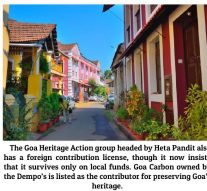
FEW laws enacted in Independent India have generated as much debate in civil society circles as the Foreign Contribution Regulation Act (FCRA). Originally conceived in 1976, during one of the most politically charged periods in Indian history, the Act was designed to regulate the inflow of foreign donations into the country. Its stated purpose was noble: to safeguard national sovereignty and ensure transparency in the use of foreign funds. Yet, over the decades, the FCRA has become a lightning rod for criticism, particularly among non-governmental organizations (NGOs) pr, religious institutions, and grassroots movements that depend on international support. As I write this, the government has sent the proposed amendments to a Joint Parliamentary Committee to be examined.
Goa, with its unique blend of colonial heritage, vibrant tourism economy, and active civil society, offers a particularly revealing case study. Here, the FCRA intersects with environmental activism, church restoration projects, and village level welfare initiatives, creating a microcosm of the national debate. This article explores the evolution of the FCRA, its legal contours, and its impact on Goa’s social fabric.
The Origins and Purpose of FCRA
THE FCRA was first enacted in 1976, during the Emergency declared by then Prime Minister Indira Gandhi. The political climate was marked by suspicion of foreign interference, and the government sought to regulate the flow of funds that could potentially influence domestic politics. Interestingly whenever there is a political issue in India, the party in power, alludes to foreign interference, notably Pakistan, or US or some former colonial power. The Act required individuals and organizations receiving foreign contributions to register with the Ministry of Home Affairs. Its scope was broad: political parties, journalists, academics, and NGOs all came under its purview. Over time, the law was amended — most notably in 2010 and again in 2020 — to tighten compliance and reduce administrative flexibility.; Prior permission to receive funds is mandatory, all monies are to be received only through a single channel, the SBI New Delhi branch. There is a blanket ban on foreign funding for activities that impinge the sovereignty of the country, communal harmony or the electoral process. The recent amendment seeks to take over the assets where the registration of institutions is denied by government. The rationale was clear: foreign money should not be allowed to destabilize India’s democratic institutions. Yet, critics argue that the law has often been used less as a shield against foreign influence and more as a sword to control dissenting voices.
Goa’s Context: Why FCRA Matters Here
GOA’S social and cultural landscape makes it uniquely sensitive to FCRA regulation.
• Tourism driven economy: With millions of international visitors coming to this paradise on earth each year, Goa has long been a recipient of foreign goodwill. NGOs working on heritage conservation, environmental protection, and community up-liftment often rely on foreign donors who feel a personal connection to the state. Many a tourist, who come to Goa, often decides to send funds to help a particular cause, or institution.
• Religious diversity: Catholic institutions, many with historic ties to Portugal and Europe, receive significant foreign contributions for church restoration, education, and social welfare. These funds are used by Church authorities to feed the poor, clothe the naked, run social and educational institutions for the locality.
• Grassroots activism: From river cleaning drives to women’s empowerment programs, foreign funding has often filled gaps left by limited state support.
In short, Goa’s global connections make foreign contributions not just desirable but often essential. The FCRA, therefore, has a disproportionate impact in Goa compared to other Indian states.
Key requirements include:
• Maintaining a designated bank account the designated bank is the SBI, New Delhi branch, exclusively for foreign contributions.
• Filing annual returns detailing the source and utilization of funds.
• Ensuring that funds are used strictly for the stated objectives of the organization.
Violations can lead to suspension or cancellation of registration. For small NGOs in Goa, often run by volunteers with limited administrative capacity, these requirements can be daunting. A missed deadline or a clerical error can result in the loss of foreign funding, effectively shutting down operations.
Case Studies from Goa
a) Environmental NGOs
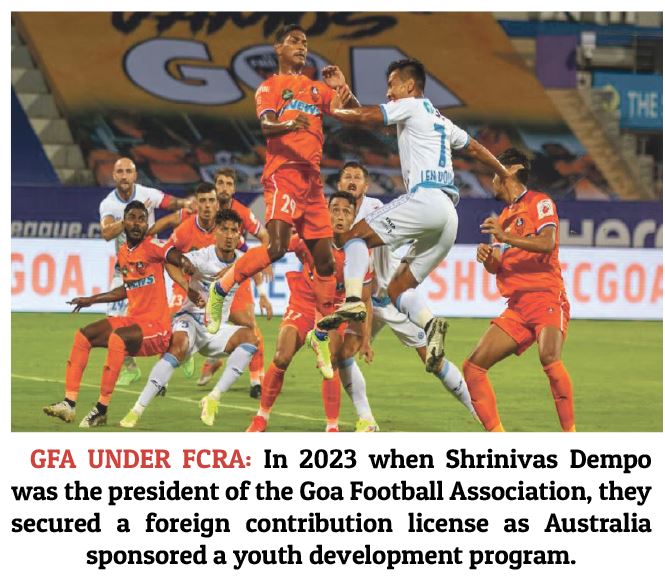
The Goa Foundation, one of the state’s most prominent environmental NGOs, has long campaigned against illegal mining and coastal degradation. Its activism has attracted international support, particularly from environmental groups in Europe. Yet, this very support has made it a target of scrutiny under FCRA. Critics allege that foreign funds are being used to influence local policy debates, while supporters argue that without such funding, Goa’s fragile ecology would be left unprotected.
Smaller groups working on turtle conservation in Morjim and Galgibaga beaches have also relied on European eco tourism grants. These projects, aimed at protecting nesting sites, often struggle with compliance challenges. A delay in FCRA approval can mean missing an entire nesting season, undermining years of conservation work.
b) Religious Institutions
Goa’s Catholic parishes and diocesan bodies have historically received donations from Portuguese and European benefactors. These funds are often used for church restoration, education, and social welfare. However, post FCRA, many institutions had to restructure their accounts and reporting systems.
For example, restoration projects of heritage churches in Old Goa — recognized by UNESCO as World Heritage Sites — have faced delays due to FCRA approvals. The Basilica of Bom Jesus, which houses the relics of St. Francis Xavier, has seen restoration projects stall, not because of lack of donor interest but because of regulatory hurdles.
c) Social Welfare NGOs
Organizations like Caritas Goa and village level women’s self help groups often depend on foreign aid for health camps, education, and livelihood programs. Scholarships for underprivileged Goan students, funded by European donors, have sometimes been abruptly halted due to FCRA restrictions.
In villages like Siolim and Cuncolim, women’s cooperatives have struggled to sustain micro finance initiatives after foreign contributions were blocked. The result is not just financial strain but a loss of trust among beneficiaries who suddenly find themselves without support.
The 2020 Amendment: A Turning Point
The 2020 amendment to the FCRA introduced several significant changes:
• Administrative expenses cap: Reduced from 50% to 20%, squeezing NGOs that rely on foreign funds for salaries, rent, and infrastructure.
• Centralization of funds: Mandatory routing of all foreign contributions through a designated SBI branch in New Delhi created logistical hurdles for Goan NGOs.
• Prohibition on sub granting: Larger NGOs could no longer pass funds to smaller grassroots organizations, curtailing collaborative projects.
For Goa, these changes were particularly disruptive. Many small NGOs depended on partnerships with larger organizations to access foreign funds. With sub granting banned, these collaborations collapsed, leaving village level initiatives stranded.
Criticisms and Defences
The FCRA has its defenders and detractors.
• Critics argue: The law is wielded as a political tool to stifle dissent. NGOs challenging mining, tourism policies, or infrastructure projects in Goa often find themselves under scrutiny. The sudden cancellation of FCRA registrations is seen as a way to silence inconvenient voices.
• Defenders claim: Transparency is essential. Foreign funds must not be misused to destabilize local governance. The law ensures that donations are used for genuine social work and not for political lobbying.
This tension reflects a broader debate: how to balance national sovereignty with the need for international solidarity.
Goa’s Civil Society Response
Faced with FCRA restrictions, Goan NGOs have adapted in creative ways:
• Local fundraising: Many have tapped into the Goan diaspora in the UK, Portugal, and the Gulf, seeking direct contributions that bypass FCRA.
• Crowd funding: Heritage groups have experimented with online platforms, linking donations to tourism experiences.
• Domestic registration: Some organizations have chosen to register as trusts or societies without foreign funding, limiting their scope but ensuring compliance.
These adaptations reflect resilience, but they also highlight the limitations imposed by FCRA. Without foreign support, many initiatives remain underfunded and unable to scale.
Comparative Lens: Goa vs. Other States
In states like Delhi or Tamil Nadu, large NGOs dominate the FCRA landscape. Their professional administrative structures make compliance easier. Goa, by contrast, is characterized by small, localized initiatives — parish projects, village cooperatives, environmental collectives.
The impact of FCRA restrictions is therefore felt more acutely. A single cancellation can wipe out an entire village program. The law, designed for national regulation, often feels disproportionate when applied to Goa’s grassroots realities.
Legal Battles and Judicial Oversight
The Bombay High Court (Goa Bench) has occasionally heard petitions from NGOs challenging FCRA cancellations. The Bombay High Court’s Goa Bench recently stayed the cancellation of FCRA certificates of two church-run NGOs, ruling that mere non-receipt of foreign funds for three consecutive years does not automatically mean the organizations are “defunct.” The Court emphasized that activities carried out with domestic resources still count toward fulfilling their objectives, and directed the Centre to respond by September 10, 2026. Nationally, the Supreme Court has upheld the constitutionality of the Act, emphasizing sovereignty over unrestricted foreign inflows.
For Goan NGOs, however, litigation is costly and often beyond their capacity. Most choose quiet compliance or closure rather than prolonged legal battles. This creates a chilling effect, discouraging activism and innovation.
Future Pathways
Looking ahead, several pathways could ease the tension between regulation and social progress:
• Digital transparency: Blockchain based donation tracking could simplify compliance and reassure regulators.
• Local philanthropy: Encouraging Goan business houses and diaspora to fund social initiatives could reduce dependence on foreign contributions.
• Policy reform: A more nuanced FCRA framework that distinguishes between political lobbying and genuine social work could strike a better balance.
Ultimately, the challenge is to ensure that regulation does not suffocate grassroots initiatives. Goa’s civil society has shown resilience, but it needs a regulatory environment that supports rather than hinders its efforts.
Conclusion
THE FCRA embodies India’s tension between openness and control. In Goa, this tension is magnified by the state’s global connections, colonial heritage, and vibrant civil society. While regulation is necessary to safeguard sovereignty, the challenge lies in ensuring that compliance is not complicit for stifling the social religious and charitable institutions that have blossomed in India, thanks to the generous inflow of foreign funds!
(Arvind Pinto is a Chairman, Citizencredit Cooperative Bank Limited)
 LETTER TO THE EDITOR FOR ISSUE DATED OCTOBER 03, 2026
 GEN-Z BLOCKED FROM VOTING BY GYANESHWAR MODI!
 THE FORAL OF 1526 Five Hundred Years Later, What Does Goa’s Oldest Village Charter Really Mean?
 20 YEARS IN ‘HERALD’, 43 IN GOA!
 THE DEGRADATION OF JNU – MY ALMA MATER! By Arvind Pinto
 THE WOMEN WHO LOOK BACK! By Prema Viswanathan
 GOA IS CELEBRITY STATE!
 HI MUMBAI MERI JAAN BUT…
 WEEKEND UPDATES
 LETTER TO THE EDITOR FOR ISSUE DATED SEPTEMBER 26, 2026
 DIVIDED EVEN IN DEATH!By Rajan Narayan
 IF YOU CLAIM THE CREDIT, TAKE THE RESPONSIBILITY!By Joquim Goes
 8 EMAILS IN 7 DAYS, BUT VALID GOA VOTERS STILL LEFT OUT: EC’S FLAWED SYSTEM!By Ritika Chopra
 MAKE IN INDIA: UNITED PAYMENTS INTERFACE India’s digital local leap to global benchmark…By Arvind Pinto
 BRING BACK THE FLATBREADS OF INDIA!
Goa is abuzz with excitement as vintage bike and car owners, users, collectors and fans are decking […]