Goa is abuzz with excitement as vintage bike and car owners, users, collectors and fans are decking […]
Old is Gold
October 4, 2016
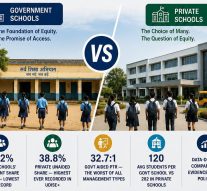
India’s school education system serves 24.69 crore children across 14.71 lakh recognised schools. These schools are not a monolith. They belong to four distinct management types — Government, Government Aided, Private Unaided Recognised, and Others — each with a different mandate, funding model, student body, and accountability structure. For decades, the debate has framed this as a simple contest: government schools are failing, private schools are succeeding. The UDISE+ data tells a more complex and more important story. This analysis presents the first head-to-head comparison of all management types across every major UDISE+ indicator: schools, enrolment, teachers, PTR, infrastructure, and digital access — drawing on verified data from UDISE+ 2024-25 and the trend from 2018-19. It also addresses the structural question the enrolment debate obscures: are private schools actually better, or are they simply different, serving different children, in different places?
“Government schools hold 68.9% of India’s schools and teach 49.2% of children. Private unaided schools hold 23.1% of schools and teach 38.8% of children. But these numbers — in isolation — explain nothing about quality, equity, or structural role.”
CRITICAL FINDING: THE AVERAGE SCHOOL SIZE GAP
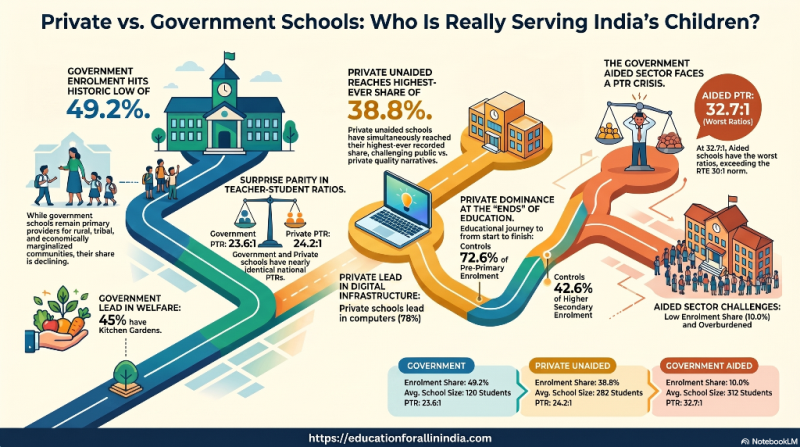
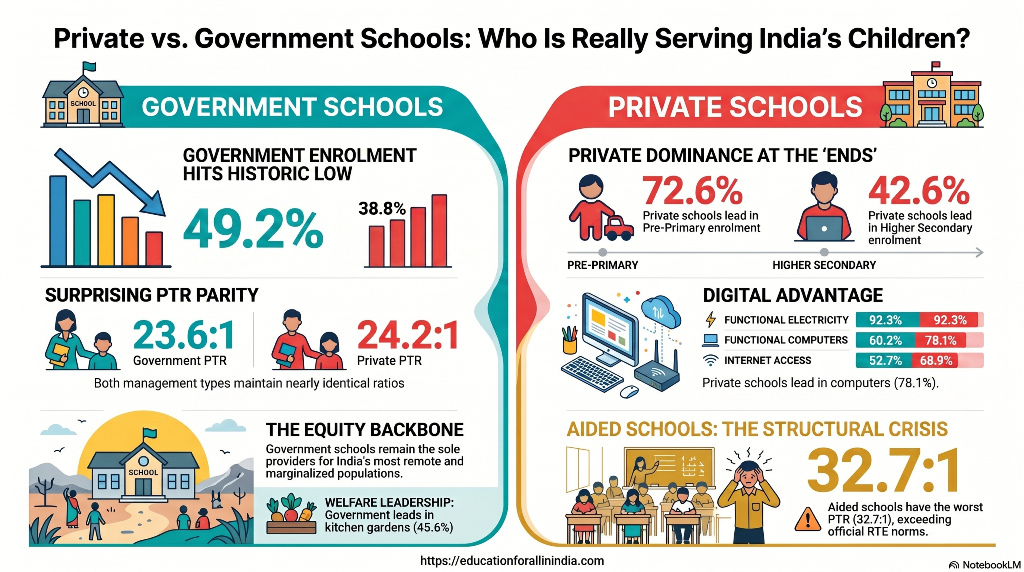
The average government school has 120 students. The average private school has 282 students, 2.4 times larger. Government schools serve a dispersed, rural population in smaller communities; private schools are concentrated in urban centres with denser demand. Comparing their outcomes without this structural context produces misleading conclusions.
THE COVID ENROLMENT PATTERN — AN OBSERVED TREND, NOT A PROVEN CAUSE
Government schools’ enrolment share rose from 50.4% (2018-19) to 54.1% (2022-23), then fell to 49.2% by 2024-25. This pattern is consistent with COVID-period economic pressures and affordability constraints followed by partial normalisation. UDISE+ records enrolment but does not establish the reasons for these changes. The affordability interpretation is plausible and widely cited, but it remains an interpretation—not a demonstrated finding. The subsequent fall to 49.2% by 2024-25 confirms this was a temporary affordability effect. Policy responses that treat the COVID spike as evidence of government school revitalisation will produce misdiagnosed interventions.
THE TEACHER SHARE PARADOX
Government schools employ 50.9% of all teachers for 49.2% of students — a near-perfect proportional allocation nationally. Private schools employ 39.1% of teachers for 38.8% of students — an equal proportion. On teacher-student ratios, neither system has a structural national advantage. The real PTR crisis exists within government schools at the state and block level, where teacher deployment is deeply uneven. Who Is Really Serving India’s Children? — The Equity Question
The central question cannot be answered by comparing national aggregate PTRs or infrastructure percentages. It requires asking: which children are being served, and where?
Geographic distribution: Government schools operate in every geography — remote tribal villages, coastal hamlets, mountain communities, and flood-prone districts. Private unaided schools are more concentrated in urban and semi-urban areas than government schools. The vast majority of single-teacher schools — which exist to provide geographic access in remote areas — are government schools. The private sector was never designed to serve geographic equity.
Social profile: Government schools serve the bulk of India’s most educationally marginalised children. In Bihar, UP, Rajasthan, and Assam, government schools account for 70-80%+ of primary enrolment. Available evidence from NFHS-5 (2019-21) and NSSO household surveys suggests that SC and ST children are more concentrated in government schools — reflecting fee-based exclusion from private schools and geographic concentration of SC/ST populations in areas primarily served by government schools. UDISE+ 2024-25 does not separately publish management-type enrolment by social category at the national level. Private schools, by definition, fee-charging, structurally limit access for lower-income quintiles.
Level-wise concentration: Private schools dominate at precisely the two ends of the school system where social stratification is most consequential. At pre-primary (72.6% private), they shape the school-readiness gap that compounds disadvantage through primary school. At the higher secondary level (42.6% private), they control access to credentials that determine university admission and economic opportunity. Government schools serve the middle of the educational journey; private schools disproportionately control the beginning and the end.
RTE SECTION 12(1)(C) — THE SYSTEM’S PRIMARY EQUITY MECHANISM
The RTE Act mandates that private unaided schools reserve 25% of Class I seats for children from the economically weaker section (EWS). UDISE+ 2024-25 does not publish EWS enrolment separately by management type, but independent assessments consistently show implementation remains patchy — with many private schools providing the mandated seats only under legal pressure. This mechanism, properly enforced and extended, is the primary policy lever for connecting the private sector’s quality advantages to equity goals. Policy Implications — What the Data Demands
The evidence from six years of UDISE+ data points to six non-negotiable policy priorities:
Close the digital divide in government schools — as a national infrastructure priority.
The 17.9 pp computer gap and the 16.2 pp internet gap between private and government schools are the clearest measurable infrastructure inequalities in the system. A time-bound mission — with central funding, state implementation, and annual public reporting — to bring government school computer and internet coverage to 90% within three years is both achievable and essential for NEP 2020’s digital learning vision.
ABOUT THE AUTHOR
Prof. Arun C. Mehta is a former Professor and Head, Department of Educational Management Information System (EMIS), National Institute of Educational Planning and Administration (NIEPA), New Delhi. He is the founder and editor of educationforallinindia.com — India’s leading independent repository of school education data and analysis since 1999.
Courtesy: educationforallinindia.com
 LETTER TO THE EDITOR FOR THE ISSUE DATED OCTOBER 10, 2026
 WHEN THE MACHINE OVERRIDES THE LAW!
 HAS GOA BECOME MORE PERMISSIVE? By Special Correspondent
 BILLIONAIRES MULTIPLYING AT THE COST OF THE MIDDLE CLASS!
 THE SHADOW OF VOTE THEFT: WHY CEC GYANESH KUMAR MUST RESIGN!By Dr Olav Albuquerque & Deborah Cordeiro
 ULTRA MODERN ‘MID-DAY’ OFFICE
 HI MUMBAI MERI JAAN BUT…
 TCS INVOLVED IN SIR MATCH FIXING!
 CEREBRAL PALSY: UNDERSTANDING ABILITY, ENABLING INCLUSION! By Dr Amit Dias
 WEEKED UPDATES
 LETTER TO THE EDITOR FOR ISSUE DATED OCTOBER 03, 2026
 GEN-Z BLOCKED FROM VOTING BY GYANESHWAR MODI!
 THE FORAL OF 1526 Five Hundred Years Later, What Does Goa’s Oldest Village Charter Really Mean?
 20 YEARS IN ‘HERALD’, 43 IN GOA!
 THE DEGRADATION OF JNU – MY ALMA MATER! By Arvind Pinto
Goa is abuzz with excitement as vintage bike and car owners, users, collectors and fans are decking […]