Goa is abuzz with excitement as vintage bike and car owners, users, collectors and fans are decking […]
Old is Gold
October 4, 2016
By Arvind Pinto
(IRS, Chief Commissioner Income Tax, Retired)
WHEN I sat for the Indian Civil Service Examinations popularly known in Delhi as the Great Indian Gamble in November 1975, conducted by the Union Public Service Commission, the process was daunting but straightforward. In the mid 70’s the sitting for the IAS examination had an aura, the premier government service, the steel frame that once ruled India. The pattern of examination was simple: a written test; three papers: one Indian language, an English language paper and a general studies subject – which sort to test your basic awareness of history, politics, geography and economic. Then there were two higher papers: where you could choose your subjects. The successful candidates were called for an interview that tested personality more than aptitude. The exam was designed to filter out specialists with encyclopaedic knowledge, to create generalists who could control crowds, echoing the colonial legacy of producing administrators who could govern with authority. At that time around one lakh hopefuls competed for around 700 posts, from the prestigious IAS, IFS, IRS and a host of other Class I and Class II services. I still remember the examination process: going from Kaveri Hostel in Jawaharlal Nehru University in South Delhi to the UPSC centre at Shahjahan Road. At the stroke of the clock, the papers were given to us. We sat for three hours answering the papers. My subjects at JNU, being Sociology and Anthropology, I found the UPSC questions similar to the subjects that the professors at JNU taught us. Later did I learn that the professors as JNU were indeed paper setters for the UPSC also. I also remember the excitement in the hostel where I was at JNU, the excitement that followed finding your UPSC number on the newspaper informing the world of your selection for the interview and then finally, the news that the UPSC has selected you for appointment to Government Service. The appointment letter read that the President of India is pleased to appoint you to the specific service. In my case it was the Indian Revenue Service. This appointment letter completes the process of selection by the Union Public Service Commission.
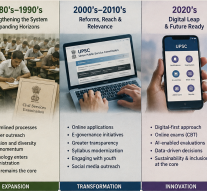
Half a century later, the UPSC has transformed the three-stage process—Prelims, Mains, and Interview—into various combinations based on several Committee that have looked at reforming the system to ensure that the cream of Indian youth qualify to enter these prestigious services.
While Goans do attempt the examinations, not many have been successful. Most of the Goans have been seconded into the IAS, (AGMUT) joint cadre, which comprises of Goa and many of the North-Eastern states. Most of the IAS officers who come to service in Goa are mainly outsiders.
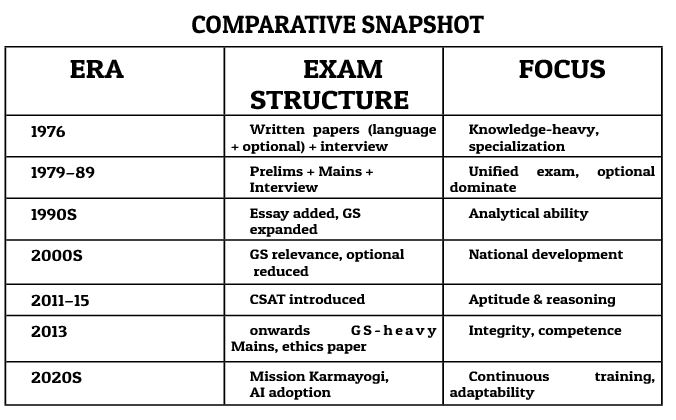
1976: The Old Order
The UPSC exam of my time was a test of endurance. Candidates chose multiple optional subjects, often from law, history, economics, or literature. Certain subjects such as sociology or history were said to be scoring, since most of the candidates would opt for these subjects. Language papers were compulsory, reflecting India’s multilingual ethos. The interview was decisive, with board members probing not just knowledge but demeanour. At the interview, the emphasis was on book knowledge, but how the candidate was able to tackle the questions asked. The UPSC examinations in the ‘70s had an age bar – 26 was the upper age limit.
Kothari Committee (1979)
THE watershed moment came with the Kothari Committee’s recommendations. The exam was restructured into a three-tier test : Prelims + Mains + Interview, creating a unified system for all services. Prelims tested general awareness, while Mains retained optional but added General Studies. The Kothari Committee proposed a two- stage system – where the preliminary examination was meant to screen out the non-serious candidates and only those who passed this were able to sit for the mains. Further the Committee recommended a common examination for all services, where the allocation of services was based on merit in the examination and the preference given by the candidate while filling the form. The Kothari committee argued that administrators require to be generalists since they could be moved from one department to another and therefore recommended the strengthening general studies papers. Further the optional papers were reduced to balance them with general studies. The interview or personality test was retained by with reduced weightage as compared to written papers. During the interview the assessment was made to judge one’s suitability for public service rather than academic brilliance. This committee also suggested the raising of the age limit to give a chance for those who appeared for the examination after obtaining a professional degree such as engineering, law or medicine.
1989: The Focus on Essay and General Studies
The Satish Chandra Committee key reform was to introduce the essay paper. The thought behind this introduction was to test the candidates’ analytical ability, clarity of thought and structured expression. For the committee was of the view that a bureaucrat needs to have an analytical mind when dealing with issues that come before him. Another reform of this committee was to expand general studies, which the Committee felt was important for government servants in executing government policy. The Committee also recommended an increased weightage for the interview since this is where the candidates’ qualities of leadership and suitability for public service would come to the fore.
2000 Alagh Committee
THE YK Alagh Committee emphasized papers on national development, administration, and science in society, aligning the exam with governance realities. Many more subjects were not made available to candidates. For earlier most of the successful candidates were from the humanities, now science and engineering students began to fill the civil services.
2011–15: Civil Service Aptitude Test
The Civil Services Aptitude Test (CSAT) was introduced in 2011 as Prelims Paper II, testing comprehension, reasoning, and numeracy. Initially counted toward merit, it was later made qualifying after protests that it disadvantaged non-English medium candidates. The aptitude tests were forward thinking in design, but this required a level of English language skills that put many aspirants at a disadvantage especially those who had studied in regional languages.
Nigavekar Reforms
IN 2011, yet another committee named the Nigavekar Committee was constituted to review and modernize the UPSC examination system. This committee recommended increasing the weightage for general studies. The rationale for this suggestion is that administrators require to be generalists who have a macro perspective of governance, society and ethics. Following this perspective the Committee recommended that the main papers be restructured to emphasize four General Studies papers . The committee also recommended the introduction of an ethics paper since it believed that civil servants need to have ethical principles in their service to the people. Further the optional papers that earlier were two, was reduced to one paper The message was clear: administrators must be generalists, capable of handling diverse challenges with integrity.
Gen Z Challenge: Digital Abundance, Mental Strain
IF getting into the Civil services in the ‘70s was tough, today with the number of those applying being around 6 lakhs for 800 government posts, the chances of success are daunting. A candidate has to be focussed, spend long hours studying and requires systematic preparation to be able to be successful.
What are the resources available?
WHERE 1976 aspirants struggled with scarcity, Gen Z faces overabundance. YouTube lectures, Telegram notes, PDFs, mock tests, coaching apps — the flood of material creates paralysis of choice. The challenge is not finding resources, but curating them.
Changing Contours
THE UPSC has evolved from a knowledge filter to a competence and integrity filter. For Gen Z, the challenge is not just clearing the exam, but reconciling its demands with their digital, globalized lives. Goa’s youth must balance tradition — the steel frame ethos —with modern realities: digital distractions, mental health, and global opportunities. The solution lies in mentoring, localized coaching, and community support.
As someone who entered service in 1976, and have retired after more than thirty- five years in government service the examinations have evolved from a test of knowledge to an expression of one’s use of this knowledge, from specialization in a particular subject to a general overview , from knowledge to integrity. The exam remains India’s toughest, but its meaning has shifted. For Gen Z, success will depend not just on clearing papers, but on finding one’s role and purpose in the bureaucracy!
 LETTER TO THE EDITOR FOR THE ISSUE DATED OCTOBER 10, 2026
 WHEN THE MACHINE OVERRIDES THE LAW!
 HAS GOA BECOME MORE PERMISSIVE? By Special Correspondent
 BILLIONAIRES MULTIPLYING AT THE COST OF THE MIDDLE CLASS!
 THE SHADOW OF VOTE THEFT: WHY CEC GYANESH KUMAR MUST RESIGN!By Dr Olav Albuquerque & Deborah Cordeiro
 ULTRA MODERN ‘MID-DAY’ OFFICE
 HI MUMBAI MERI JAAN BUT…
 TCS INVOLVED IN SIR MATCH FIXING!
 CEREBRAL PALSY: UNDERSTANDING ABILITY, ENABLING INCLUSION! By Dr Amit Dias
 WEEKED UPDATES
 LETTER TO THE EDITOR FOR ISSUE DATED OCTOBER 03, 2026
 GEN-Z BLOCKED FROM VOTING BY GYANESHWAR MODI!
 THE FORAL OF 1526 Five Hundred Years Later, What Does Goa’s Oldest Village Charter Really Mean?
 20 YEARS IN ‘HERALD’, 43 IN GOA!
 THE DEGRADATION OF JNU – MY ALMA MATER! By Arvind Pinto
Goa is abuzz with excitement as vintage bike and car owners, users, collectors and fans are decking […]