Goa is abuzz with excitement as vintage bike and car owners, users, collectors and fans are decking […]
Old is Gold
October 4, 2016
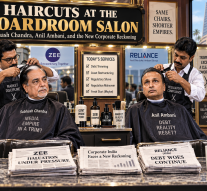
WHEN bankers speak of “haircuts,” they don’t mean those fancy salon trims that make you look fashionable. They mean the painful financial write-offs lenders and bankers swallow when corporate empires collapse under debt. In recent years, India has witnessed some of its most high-profile moguls — Subhash Chandra of Zee, Anil Ambani of Reliance ADA Group, and others —subjected to this ruthless financial barbering.
The Zee Saga
SUBHASH Chandra, once hailed as the father of the Indian satellite television when he launched Zee TV in 1992 , his empire was built through the Essel Group, spanning several different verticals. To the TV crazy Indian, he was a Media Moghul, founder of the Zee Entertainment group that brought the latest pulp to an Indian audience starved for nightly entertainment . Chandra’s company was India’s pioneering satellite TV network, and this group later expanded into film production, digital streaming, and broadcasting.
THEN there was Essel Propack which manufactured laminated plastics tubes and in 1984 when it started manufacturing was one of its kind in India. The group then ventured into development of infrastructure with Essel Infra projects founded in 2007, entering into ventures such as roads, power transmission, renewable energy such as solar, wind and hydro power project, and urban infrastructure, and finally there was Essel Finance where the non-banking finance company was operating in housing finance, mutual funds, and insurance distribution With such an array of business enterprises, what could go wrong. But behind the glitter of success was a growing pile of debt, which required timely return. Subhash Chandra’s empire fell because his Essel Group expanded aggressively into debt-heavy infrastructure and utilities, where banks were lending to his various companies relying on his personal guarantees to secure loans. Essel group’s defaults began surfacing around 2018–2019, primarily through its infrastructure arm, Essel Infraprojects Limited (EIL). EIL borrowed heavily for roads, power transmission, renewable energy, and urban utility projects. Delays in execution, regulatory hurdles, and poor returns meant cash flows dried up The infrastructure projects started with great fanfare, did not yield the income required to service the mounting debt. . In January 2019, there was a crash in the prices of Zee shares. Concerns about Essel Group’s debt exposure triggered a Zee Entertainment stock collapse. Lenders began selling pledged shares, wiping out investor confidence. About this time Essel Infraprojects failed to service loans on time, these loans became stressed assets. Soon creditors, including mutual funds and banks, flagged defaults on bonds and project loans. Subhash Chandra, the key player of the group, had given personal guarantees for group borrowings. When EIL defaulted, creditors pursued him directly, escalating liabilities to Rs22,000+ crore. The matter came before the NCLT. Insolvency proceedings were begun by Indiabulls Housing Finance (now Sammaan Capital) on defaults where Subash Chandra had given personal guarantees. This case was admitted in 2024 under Section 95 of the Insolvency and Bankruptcy (IBC) . Several creditors were party to the petition and the total admitted claims were Rs22,006.57 crore. As against these claims Chandra proposed paying Rs 6.25 -to 6.5 crore, citing that he had limited personal assets. Interestingly 80% of the creditors supported the plan. The Tribunal approved the repayment plan. But the uproar against this rather biased order was stayed by a larger five bench pending further hearings. This colossal downfall has several important lessons to be learned. For Essel, the media was its core strength, where its expertise lay. While Esset thrived in the media business, its foray into infrastructure was a disaster. While most business houses would like to diversify, this process should be gradual, gaining sectoral expertise and garnering strong partners to grow with. In business short- term borrowing to fund long term infrastructure projects as Essel did, creates a mismatch in financial planning. Chandra’s personal guarantees turned corporate defaults into personal insolvency. Most shrewd business men rarely commit their personal wealth and avoid personal guarantees. For when ventures failed to generate returns, defaults cascaded across the group, dragging Chandra personally into insolvency. Lenders forced asset sales, and the once-proud Zee group had to cede control to institutional investors. The “haircut” here was symbolic: banks wrote off portions of loans, while Chandra lost the commanding seat he had held for decades.
Anil Ambani’s Fall
ANIL Ambani’s story is even murkier. From being listed among the world’s richest men, his Reliance ADA Group slid into insolvency. Telecom ambitions collapsed, power projects stalled, and lenders faced massive write-downs. Ambani himself declared his net worth at “zero” in court — a dramatic haircut not just for creditors, but for his personal stature.
Others in the Queue.
SUBASH Chandra and his Essel group is not the only entrepreneur that has gone bust. Essar, Videocon, Jet Airways, DHFL are some of the other companies that each saw lenders forced into compromises, accepting fractions of their dues. The Insolvency and Bankruptcy Code (IBC) that became law in 2016, has become the barber’s chair, where creditors negotiated how much hair to cut, and promoters watched their empires shorn away.
Goan Angle
For Goan readers, these corporate haircuts resonate with local anxieties:
• Cooperative banks in Goa have faced similar pressures when loans to flashy real estate or tourism ventures soured.
• The lesson is clear: unchecked ambition, without risk management, leads to painful trims for depositors and lenders alike.
Narrative Metaphor
THE haircut metaphor works beautifully here. In salons, a haircut can be stylish, voluntary, even rejuvenating. In finance, it is involuntary, humiliating, and often leaves scars. Subhash Chandra and Anil Ambani remind us that even titans are not immune to the barber’s blade of debt restructuring.
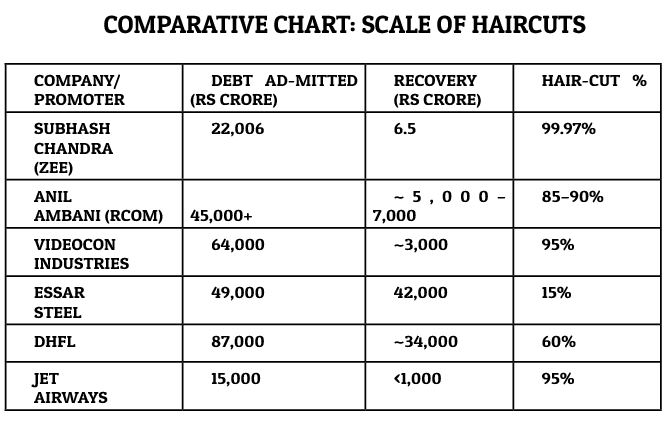
India’s corporate “haircuts” have reached extraordinary proportions: Subhash Chandra of Zee saw creditors accept just Rs6.5 crore against admitted claims of Rs22,006 crore (a 99.97% haircut), while Anil Ambani’s Reliance ADA Group collapsed into insolvency with lenders writing off tens of thousands of crores. These cases highlight how India’s Insolvency and Bankruptcy Code (IBC) has become the barber’s chair where banks, depositors, and investors watch their money shorn away.
Subhash Chandra and Zee: The 99.97% Haircut
• Case: NCLT approved a repayment plan in August 2026.
• Claims admitted: Rs22,006.57 crore.
• Settlement: Only Rs6.5 crore paid, translating to 0.03% recovery.
• Impact: LIC Housing Finance, with claims of Rs1,322 crore, received just Rs38 lakh.
• Controversy: Critics argue the headline figure is misleading since much of the debt was guaranteed by Chandra, not personally borrowed. Still, the optics of a near-total wipeout shocked the financial world.
Anil Ambani: From Billionaire to “Zero Net Worth”
• Reliance Communications (RCom): Once India’s telecom challenger, collapsed under debt exceeding Rs45,000 crore. The financial creditors recovered only fractions of their dues; Chinese banks and Indian lenders faced massive write-downs. Interestingly Anil Ambani told a UK court in 2020 that his net worth was “zero.” In RCom’s insolvency, lenders faced haircuts of 85–90%, with assets sold piecemeal to Reliance Jio and others.
Other Corporate Haircuts
• Videocon Industries: Banks wrote off nearly 95% of Rs64,000 crore debt.
• Essar Steel: Creditors recovered about Rs42,000 crore against Rs49,000 crore owed (haircut ~15%).
• DHFL (Dewan Housing Finance): Lenders took a 60% haircut on Rs87,000 crore debt.
• Jet Airways: Creditors faced 95% losses, with revival plans offering only token recoveries.
Do Haircuts Help or Harm?
• On the one hand haircuts rescue failing companies, they help keep the name of the entrepreneur who then is able to start afresh. The companies are taken over by new lenders who revive them and ensure that workers do not suffer. But in reality ; in most cases, promoters walk away lightly while banks (and depositors indirectly) absorb the losses. Several cooperative banks in Goa and elsewhere have faced similar shocks when loans to flashy ventures soured. The banks are left to absorb the shock with haircuts that dig into their reserves. Without strong accountability, haircuts risk becoming bailouts for the powerful rather than genuine restructuring tools.
The Goan Scene
FOR Goan readers, these corporate sagas resonate with local anxieties. Certain co-operative banks in Goa have faced loan defaults in tourism and real estate, forcing depositors to bear the brunt. The metaphor of the “haircut” is apt —while a salon trim can be stylish, financial haircuts are humiliating, involuntary, and often leave scars that are borne by the lending institutions.
IN conclusion, Subhash Chandra’s 99.97% haircut and Anil Ambani’s collapse are not isolated episodes but part of a broader pattern where India’s financial system trims away billions, often at the expense of ordinary depositors and taxpayers. The barber’s chair of insolvency is crowded, and the scissors are sharp. But in most cases, the losers are our public institutions, banks and the lending agencies!
(Arvind Pinto is the Chairperson of Citizencredit Cooperative Bank Ltd, he also practises at National Company Law Tribunal.)
 LETTER TO THE EDITOR FOR THE ISSUE DATED OCTOBER 17, 2026
 AZAD MAIDAN NO LONGER FREE!
 AZAD MAIDAN CRACKDOWN! Goa’s crackdown on protesters raises grave questions about democracy! By Our Special Correspondent
 INDIAN WOMEN ARE ON THE STREETS AGAIN. EVERYTHING HAS CHANGED BUT NOTHING HAS CHANGED!By Shilpa Phadke
 RBI TIGHTENS SCREWs ON ECONOMY!By Arvind Pinto
 SSR OVERRULED SIR IN GOA!
 HI MUMBAI MERI JAAN BUT…
 RAJENDRA ARLEKAR WILL REPLACE PRAMOD SAWANT?
 MENTAL HEALTH ACROSS THE LIFESPAN! By Dr Amit Dias
 WEEKEND UPDATES
 LETTER TO THE EDITOR FOR THE ISSUE DATED OCTOBER 10, 2026
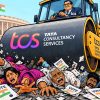 WHEN THE MACHINE OVERRIDES THE LAW!
 HAS GOA BECOME MORE PERMISSIVE? By Special Correspondent
 BILLIONAIRES MULTIPLYING AT THE COST OF THE MIDDLE CLASS!
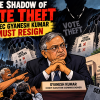 THE SHADOW OF VOTE THEFT: WHY CEC GYANESH KUMAR MUST RESIGN!By Dr Olav Albuquerque & Deborah Cordeiro
Goa is abuzz with excitement as vintage bike and car owners, users, collectors and fans are decking […]